
What Does 10 Bar Mean for a Pneumatic Cylinder?
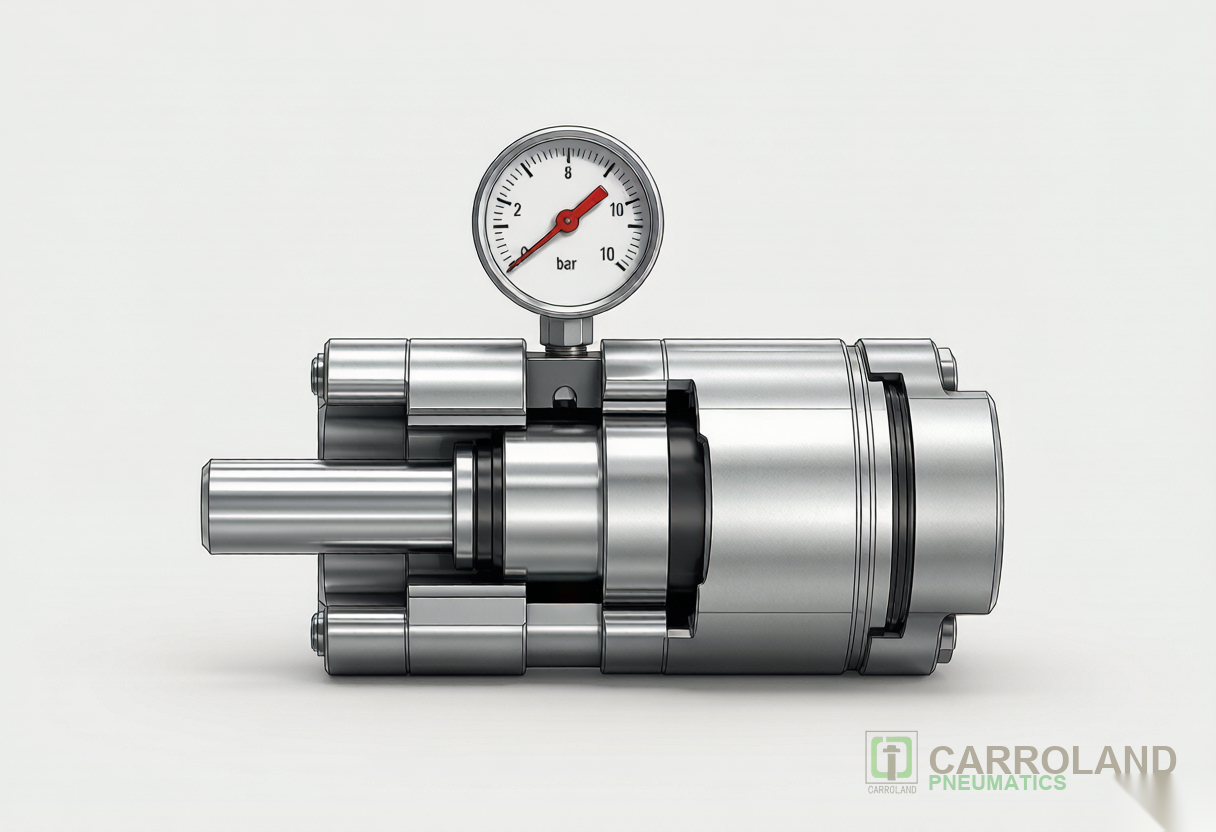
A 10 bar pneumatic cylinder is built to withstand a maximum rated working pressure of 1,000 kPa (10 bar) and is the default pressure class for most industrial ISO 15552 profile cylinders. At Carroland Pneumatics, we machine these actuators for Indian manufacturers who run compressed-air systems at 6–10 bar on shop floors ranging from Pune automotive lines to Chennai packaging plants.
The relationship is straightforward: at 10 bar, a 100 mm bore cylinder delivers roughly 785 N of theoretical push force, compared with about 471 N at 6 bar. That extra pressure lets you use a smaller bore for the same load, or handle heavier pressing, clamping, and lifting tasks without enlarging the actuator footprint.
ISO 15552 and the 10 Bar Pressure Class
ISO 15552:2018 — confirmed current in February 2025 — specifies roundline/profile pneumatic cylinders with detachable mountings for a maximum rated pressure of 1,000 kPa, i.e. 10 bar. The standard covers bores from 32 mm to 320 mm and defines mounting dimensions, port positions, piston-rod threads, and sensor-groove geometry so that cylinders from different sources share the same mechanical interface. You can read the standard scope on the ISO 15552 page.
Key data points for Indian buyers:
- ISO 15552:2018 rated pressure: 10 bar (1,000 kPa)
- Common bore range offered to Indian buyers: 32 mm to 125 mm
- Typical working pressure in India: 6–8 bar; 10 bar reserved for high-force stations
Force Sizing at 10 Bar
Use the formula F = P × A, where F is force in Newtons, P is pressure in MPa, and A is the piston area in mm². For a 10 bar (1.0 MPa) cylinder:
| Bore (mm) | Piston area (mm²) | Theoretical push force at 10 bar | Approx. push force at 6 bar |
|---|---|---|---|
| 40 | 1,257 | 1,257 N | 754 N |
| 63 | 3,117 | 3,117 N | 1,870 N |
| 80 | 5,027 | 5,027 N | 3,016 N |
| 100 | 7,854 | 7,854 N | 4,712 N |
Always apply a safety factor of 1.3–1.5 for friction, pressure drop, and load inertia. Retraction force is lower because the rod reduces the effective piston area.
When Indian Plants Choose 10 Bar
Most Indian factories size for 6 bar because that is the typical compressed-air mains pressure. However, 10 bar-rated cylinders are selected when:
- High-force pressing or staking needs a compact bore
- Local booster circuits deliver 8–10 bar at the actuator
- Machine builders want one cylinder family that can operate anywhere from 4 bar up to 10 bar
Carroland supplies ISO 15552 profile cylinders in anodised aluminium barrels with stainless steel piston rods, tested to Indian buyers’ pressure-cycle requirements. We support documentation such as IS/ISO test reports and material certificates so your FMCS+BIS filing path stays clear — the BIS licence itself sits with the Indian importer, as required by law.
Selection Checklist for 10 Bar Cylinders
- Confirm maximum working pressure, not just nominal 6 bar
- Match bore to force requirement with a 1.3× safety margin
- Specify cushioning type: elastic for low speed, pneumatic for high speed
- Check ambient temperature; standard NBR seals handle +5°C to +60°C
- Order mounting accessories from the same ISO 15552 family to avoid interference
Related Guides
For a broader view of cylinder sizing, read our Pneumatic Cylinder Guide for Indian Manufacturers. You may also find the 3 Stage Telescopic Pneumatic Cylinder guide useful for long-stroke applications.
FAQ
Is 10 bar the same as 1 MPa?
Yes. 10 bar equals 1.0 MPa or 1,000 kPa. ISO 15552 expresses the rating as 1,000 kPa.
Can I run a 10 bar cylinder at 6 bar?
Yes. The 10 bar figure is the maximum rated pressure, not the required pressure. Running at 6 bar simply reduces force proportionally.
What bore gives one-ton force at 10 bar?
About 126 mm bore gives roughly 10,000 N (≈1,020 kgf) theoretical push force at 10 bar before safety factor. A 125 mm ISO 15552 cylinder is the nearest standard size.
Does Carroland hold BIS certification?
No. Carroland manufactures ISO 15552 dimension-compliant cylinders in China and provides IS/ISO test reports. The BIS licence under FMCS is held by the Indian importer.