Different Types of Pneumatic Cylinders: ISO 15552, 6432 and 21287 Compared
The Compressed-Air Backbone of Modern Manufacturing
Pneumatic cylinders convert compressed-air pressure into linear or rotary mechanical work, and they remain the most deployed actuator class on Indian factory floors — from Pune’s automotive tier-1 lines and Chennai’s electronics assembly cells to pharma packaging corridors in Hyderabad. Standardisation around three ISO documents — ISO 6432:2015, ISO 15552 and ISO 21287 — means a Carroland piston rod cylinder with bore 50 mm built to ISO 15552 installs in the same envelope as any other ISO 15552 tie-rod unit from any compliant supplier. Indian manufacturers relying on stable, repairable mounting dimensions find this interchangeability essential, especially when prototyping in 2025–2026 to a global platform and then sourcing locally for volume.
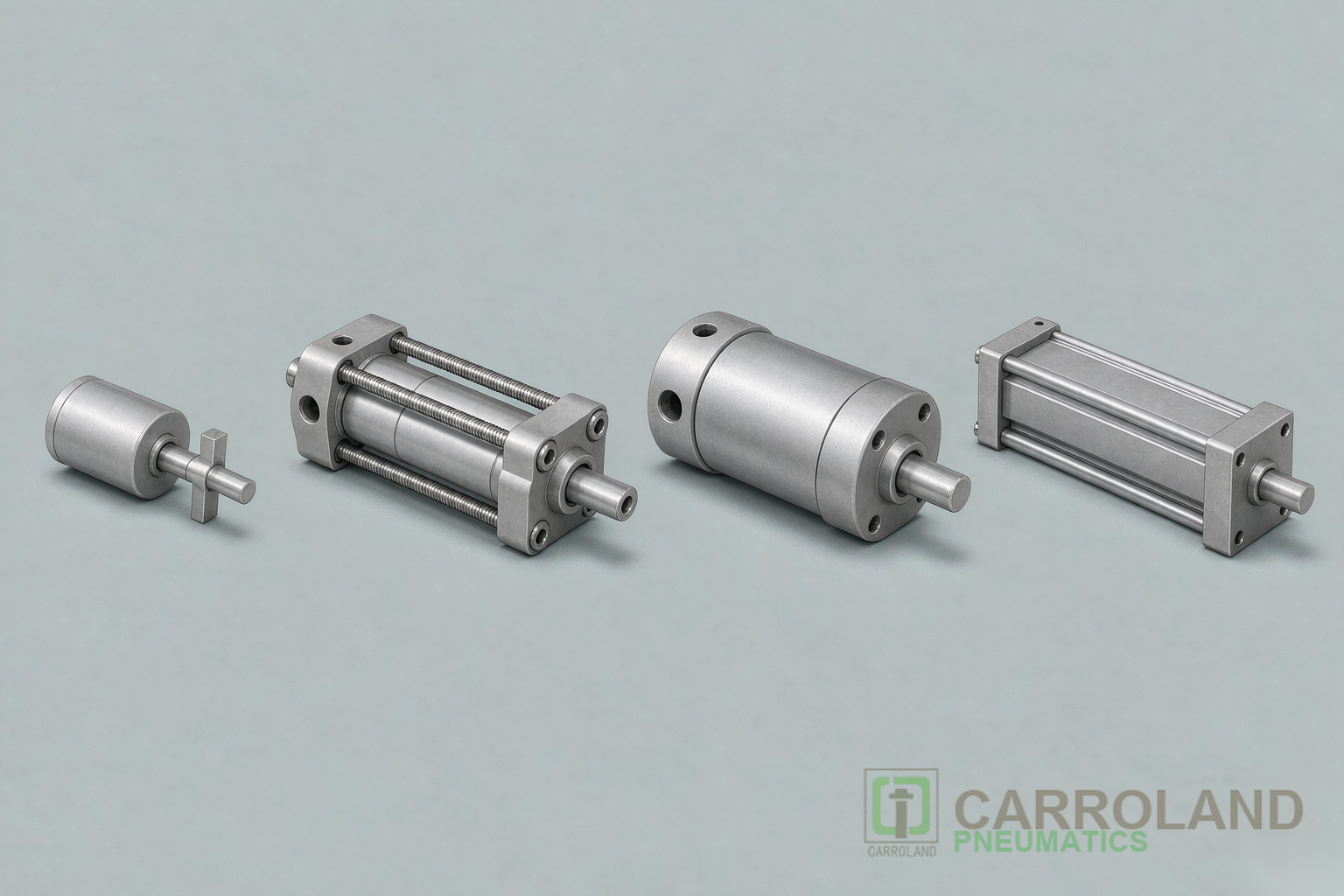
For Indian engineering teams the practical question is not “what is a pneumatic cylinder” but “which type of pneumatic cylinder matches the cycle, the load, and the cabinet space at hand.” The remaining sections walk through the major construction types, how to size them, and where each earns its place on the shop floor.
Core Construction Types Used on Indian Factory Floors
Single-Acting Pneumatic Cylinders (SAC)
A single-acting cylinder admits compressed air through one port to drive the piston in the working direction; a mechanical spring (or in some designs gravity, or an external load) returns the rod. The body needs only one air line, one solenoid valve port, and roughly half the air consumption of a bi-directional unit — but usable stroke rarely exceeds 80 mm because the return spring has to fit inside the bore. SACs are the classic clamping, ejecting, and pin-pressing tool: a holding force, not a moving force. On a 6 bar shop-air line, a Ø50 mm SAC typically delivers about 800 N of effective push force once the spring pre-load is overcome.
Double-Acting Pneumatic Cylinders (DAC) — Including ISO 15552 Tie-Rod and ISO 6432 Mini
A double-acting cylinder admits air on both sides of the piston. Push force uses the full bore area; retract force uses the annular area (bore minus rod), so pull force is always lower than push. The two industrial shapes you encounter in India most often are ISO 15552 (tie-rod profile, 32–320 mm bore, 10 bar series, replaces ISO 6431/VDMA 24562) and ISO 6432 (round-body mini, 8–25 mm bore, 10 bar series). At the pressure commonly available from Indian shop mains (6 bar / 87 psi nominal), a Ø50 mm ISO 15552 cylinder produces roughly 1,178 N on the extend stroke while an Ø80 mm bore produces about 3,016 N. Tie-rod construction is repairable: end caps come off, seals can be swapped, the bore honed — important for high-cycle lines where spare-parts availability is the deciding factor.
Compact (ISO 21287) and Guided Compact Cylinders
Where cabinet space is tight, ISO 21287 compact cylinders save 40–50 mm of length against an equivalent ISO 15552 unit. Bore sizes run Ø20 to Ø100 mm (Ø16 as a manufacturer-specific series), cushioning is rubber-buffer fixed, and magnetic-piston variants accept side-mounted proximity sensors. The trade-off: end caps are non-removable, so a worn seal typically means a full-unit replacement rather than a reseal. Guided compact cylinders add twin guide rods or integrated linear bearings to the compact body, absorbing side loads 4–10× greater than a standard single-rod cylinder of the same bore — the right pick for press feeds and short-stroke pick-and-place stations where rod rotation would otherwise drift the part.
Rodless Cylinders for Long Stroke in a Compact Length
In a rodless pneumatic cylinder the piston is coupled to an external carriage through a magnetic or mechanical band coupling inside a sealed tube. Overall length is approximately equal to the stroke, so a 2 m stroke fits in roughly a 2 m body — half the footprint of a rod cylinder doing the same job. They tolerate up to around 10,000 mm strokes in cleanroom transfer lines (PCB and white-goods assembly), at the cost of alignment sensitivity and the fact that field service usually means a full swap.
How the Pneumatic Cylinder Actually Works
Inside the cylinder barrel, pressurised air is admitted to one chamber while the opposite chamber is exhausted. The pressure differential across the piston face produces a force calculated by F = P × A, where A is the effective piston area. For a single-rod DAC, the extend area is the full bore circle (π·D²/4) and the retract area subtracts the rod. Effective output at the rod is always less than theoretical — a load ratio of 50–70 % is a common design rule to keep headroom for acceleration and seal friction. Cushioning at end of stroke, normally a fixed rubber buffer on compact cylinders or an adjustable pneumatic ring on tie-rod ISO 15552 units, absorbs the kinetic energy of the moving load and is what allows high cycle rates without premature seal failure.
Selection Matrix for Indian Engineering Teams
| Cylinder Family | ISO Standard | Bore Range (mm) | Typical Indian Application |
|---|---|---|---|
| Mini round-body | ISO 6432:2015 | 8–25 | Small actuators, lab/assembly jigs, low-cost OEM kits |
| Tie-rod profile | ISO 15552 | 32–320 | General automation, conveyors, machine builds, FMCG packaging |
| Compact | ISO 21287 | 20–100 | Tight mounting, pick-and-place, 3C assembly cells |
| Guided compact | ISO 21287 (with anti-rotation) | 20–100 | Press feeds, side-load handling, stamping ejectors |
| Rodless | — | 16–80 | Long-stroke transfer lines, cleanroom material handling |
| Rotary / clamping | — | — | Zero-stroke rotary clamping, weld-fixture indexing |
Reading the Data Behind Selection
Three datapoints an Indian buyer should be able to confirm against any shortlist before issuing a PO:
- Force at the actual port pressure. ISO 15552 ties all force calculations to the bore and the pressure actually present at the cylinder port (after FRL pressure drop), not the compressor nominal rating. Plan at 6 bar even if mains is set to 8 bar.
- Cushioning type. ISO 6432:2015 explicitly permits mechanical cushioning only and not adjustable pneumatic cushioning; ISO 21287 compact units typically use rubber-buffer fixed cushioning. Specifying pneumatic-adjustable cushioning on a compact series is a spec deviation worth flagging during indenting.
- Service-life claim. ISO 6432 standard PU-sealed mini cylinders reach 30 million cycles, NBR-sealed 15 million cycles. Anything below 10 million cycles at full rated load is sub-spec for a high-cycle Indian bottling line.
Industry Use in India (Buyer Context)
Tier-1 automotive lines around Pune and Chennai typically combine ISO 15552 double-acting tie-rod units (for press feeds and conveyor lifts) with ISO 21287 compact cylinders (for door-closer stations and short-stroke clamps) in the same machine, leaning on the repairability of the former and the space saving of the latter. White-goods and EMS lines in Noida and Greater Noida prefer the ISO 21287 compact family because the entire factory height allocation is tight. Pharma packaging corridors in Hyderabad often specify stainless-steel AISI 304/316 round-body ISO 6432 mini cylinders with PTFE seals for washdown tolerance, paired with FRL sets at ISO 8573-1 class 2.4.1 to keep airborne oil and particulate out of the cushioning path.
Carroland’s India range — backed by European Technology · China Manufacturing · Since 1992 — mirrors these choices with ISO 15552 tie-rod and ISO 21287 compact families, and ISO 6432 mini sizes for instrumentation, all sharing repairable constructions, magnetic-piston position sensing, and stroke lengths that fall within the ISO 4393 nominals. For an overview of selection criteria that meet global and Indian platforms side-by-side, the Indian pneumatic cylinder selection guide lays out a four-step decision framework.
Frequently Asked Questions
What is the most common pneumatic cylinder in Indian factories?
The double-acting ISO 15552 tie-rod cylinder remains the industrial default. It is repairable, interchangeable across compliant manufacturers, and its bore range (32–320 mm) covers most conveyor, packaging and assembly-line force requirements at 6 bar shop-air pressure.
What is the difference between ISO 15552 and ISO 6432?
ISO 15552 is the profile tie-rod standard covering 32–320 mm bores at 10 bar (it replaced ISO 6431/VDMA 24562). ISO 6432 is the round-body mini standard covering 8–25 mm bores at 10 bar. The two share the 10 bar pressure rating and the magnetic-piston option but are mechanically distinct families. Both revisions current in 2025–2026 are ISO 15552:2018 and ISO 6432:2015.
Can a pneumatic cylinder be repaired in the field?
Tie-rod cylinders (ISO 15552) are designed to be repairable — end caps come off and seals are serviceable items. Compact and rodless units generally are not; field repair usually means swapping the assembly. For Indian buyers managing field service on three-shift lines this is a decisive difference in total cost of ownership.
What pressure should I size a pneumatic cylinder for?
Size against the actual pressure at the cylinder port after FRL line losses, commonly 6 bar nominal in Indian shop installations. Keep a load ratio of 50–70 % of theoretical force to leave margin for seal friction, acceleration, and end-of-stroke pressure transients.
Sources: ISO 6432:2015, ISO 15552:2018, ISO 21287; iso.org; Wikipedia: Pneumatic cylinder.