
Pneumatic FRL Air Preparation Guide: Filters, Regulators & Lubricators
Compressed air is only as good as its preparation. An FRL unit—filter, regulator, lubricator—sits at the head of every pneumatic circuit and decides whether your valves and cylinders see clean, stable, lubricated air or contaminants that kill them in weeks. This guide covers ISO 8573-1 air-quality classes, FRL sizing, and maintenance for industrial and food/electronics lines.
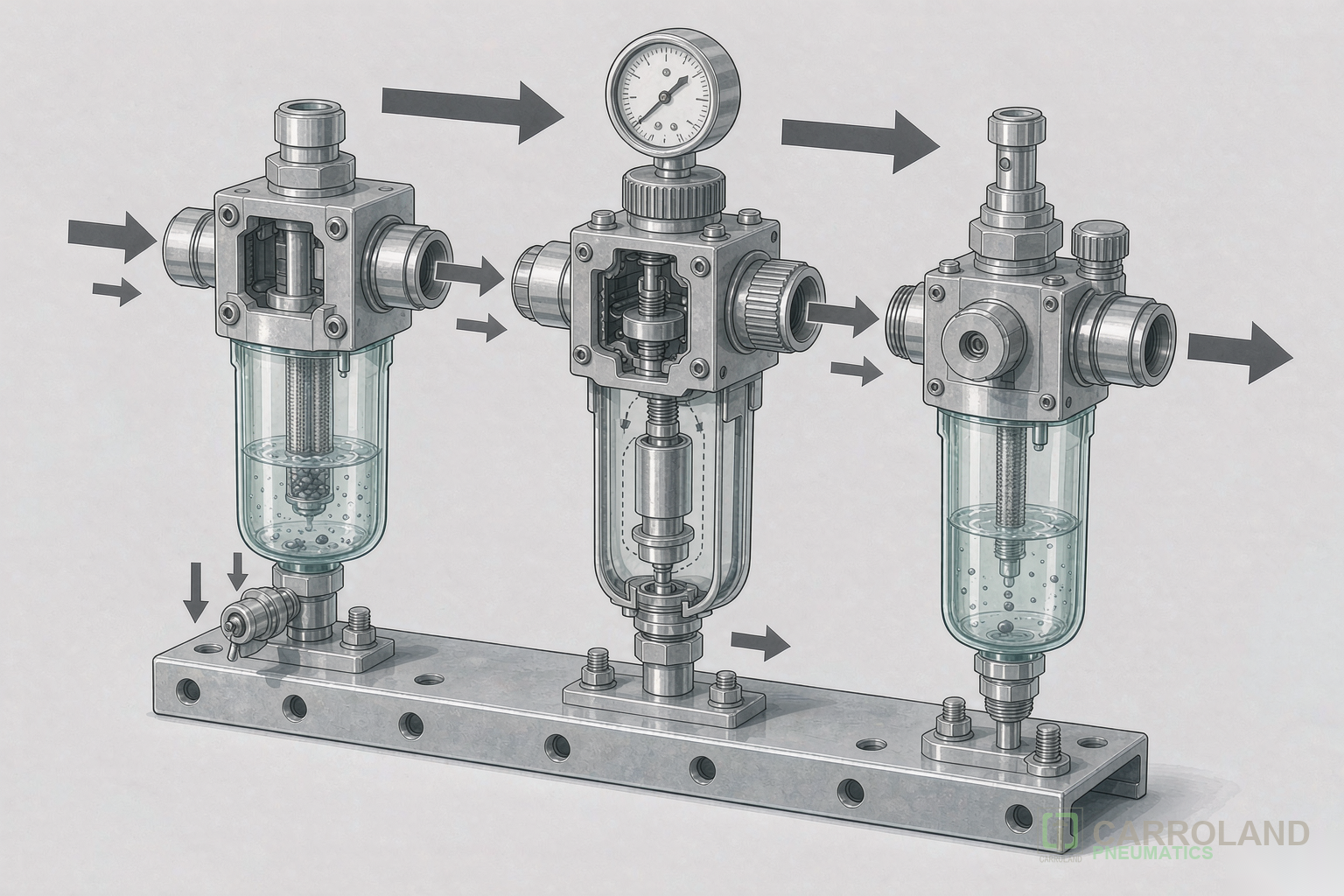
What an FRL Actually Does
- Filter (F): removes particulate and, with a coalescing element, liquid water and oil aerosol.
- Regulator (R): holds downstream pressure steady regardless of supply fluctuation—critical for repeatable force.
- Lubricator (L): injects a fine oil mist to reduce friction on non-lubricated-rated seals (optional on modern lines).
ISO 8573-1 Air Quality Classes
ISO 8573-1 grades air by solid particles, water, and oil. Pick the class your worst component demands:
| Class | Particle (≤ µm) | Water | Oil (mg/m³) | Typical Use |
|---|---|---|---|---|
| Class 3 | 1 | Dewpoint −20°C | 1 | General automation |
| Class 2 | 0.1 | Dewpoint −40°C | 0.1 | Electronics / 3C |
| Class 1 | 0.1 | Dewpoint −70°C | 0.01 | Cleanroom / food contact |
Our air preparation unit guide on ISO 8573-1 classes maps each class to real component life data.
How to Size an FRL
Size the FRL to the circuit’s peak flow, not average. Undersized regulation causes pressure droop during simultaneous actuations—cylinders slow, clamps slip. Steps:
- Sum the CV of all valves that can fire together.
- Convert to required flow at your line pressure.
- Select an FRL with ≥20% headroom and a regulator locked to the minimum stable setpoint.
Filter Selection: Particulate vs Coalescing
A 5 µm particulate filter protects valves. Add a coalescing filter (0.01 µm) before lubricators or sensitive instruments to strip oil aerosol. In food and pharma, skip oil lubrication entirely and use oil-free compressors plus Class 1–2 preparation.
Regulator Types
| Type | Strength | Note |
|---|---|---|
| Relieving | Bleeds excess downstream pressure | Default, safer |
| Non-relieving | Holds pressure tightly | Only with closed systems |
| Precision / pilot-operated | Tight tolerance under flow swing | High-cycle lines |
Lubrication: To Lube or Not
Modern PU and PTFE seals run unlubricated. If you lubricate, use a micro-mist lubricator and never remove it later—seals conditioned to oil will fail dry. For 3C electronics lines, go oil-free to protect product.
Maintenance Interval
- Drain the bowl daily (or fit an auto-drain).
- Replace the filter element every 6–12 months by flow and environment.
- Check regulator creep quarterly; >5% setpoint drift means rebuild.
Related Guides
- ISO 8573-1 Air Quality Classes Guide
- Pneumatic Valve & Solenoid Guide
- Pneumatic Cylinder Selection Guide
- Pneumatic Components Overview
- Pneumatic System Components Explained
Frequently Asked Questions
What does FRL stand for in pneumatics?
FRL is Filter, Regulator, Lubricator—the three-stage air-preparation unit mounted at the start of a pneumatic circuit to clean, stabilize, and (optionally) lubricate compressed air.
Which ISO 8573-1 class do I need for electronics?
Electronics and 3C lines typically need ISO 8573-1 Class 2 (0.1 µm particles, −40°C dewpoint, 0.1 mg/m³ oil). Cleanroom or food-contact demands Class 1.
Should I lubricate a modern pneumatic system?
Only if your seals are conditioned for oil. Most modern PU/PTFE seals run unlubricated; lubricating then stopping will cause failure. For electronics, stay oil-free to protect product.
How often should I change the FRL filter element?
Every 6–12 months depending on flow and ambient dust/moisture. Auto-drain the bowl daily and rebuild the regulator if setpoint drift exceeds 5%.