
Pneumatic Components: The Core Parts of Every Compressed-Air System
Pneumatic components are the building blocks that generate, treat, control, and actuate compressed air on automated lines. A clear view of pneumatic components helps buyers specify reliable systems and avoid costly downtime. In this guide, we list the main pneumatic components, explain their roles, and link each to the selection rules engineers use.
What Are Pneumatic Components?
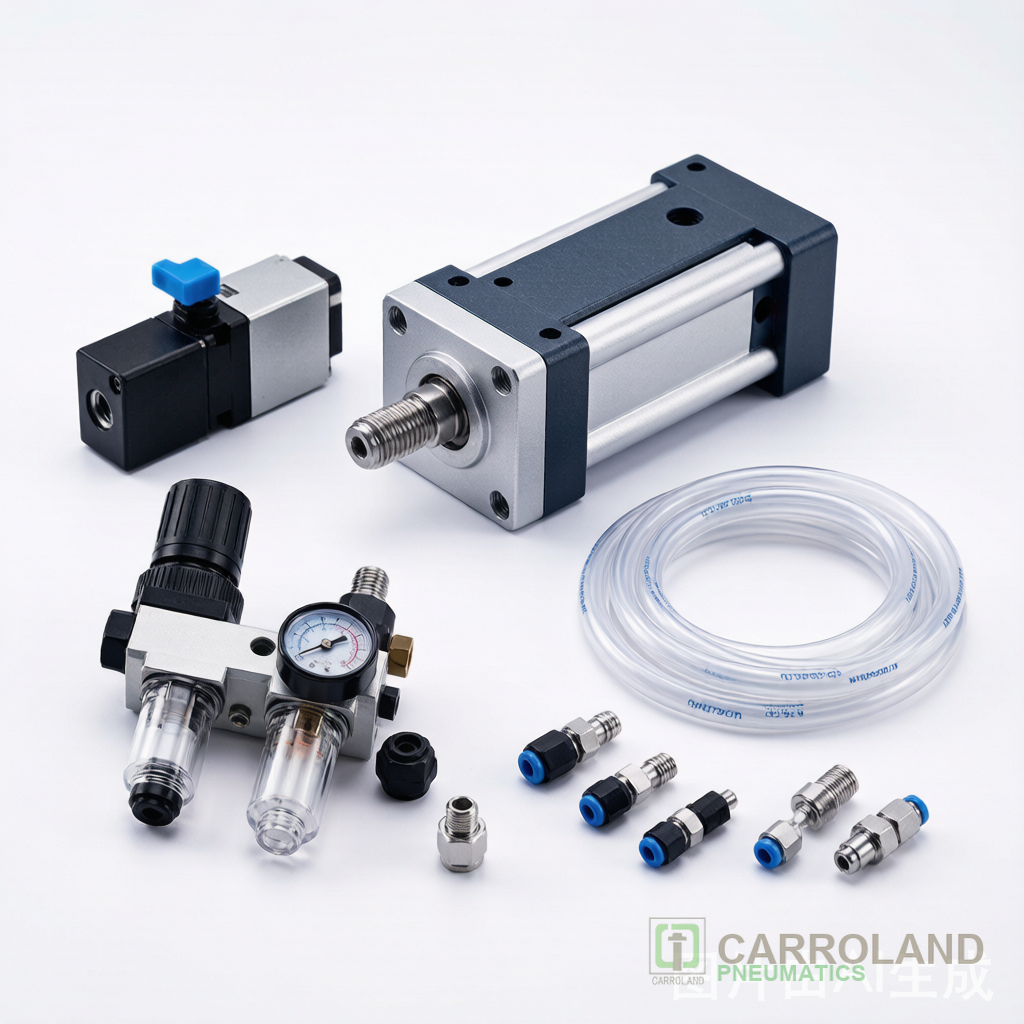
Pneumatic components are the discrete devices in a compressed-air circuit. They range from the compressor that makes air to the actuator that does the work. Specifically, the family splits into four groups: generation, preparation, control, and actuation. Consequently, understanding each group is the first step in system design.
The Four Groups of Pneumatic Components
Generation starts with the compressor and receiver. Preparation then conditions the air through filters, regulators, and lubricators (FRL). Control uses valves and manifolds to route flow. Finally, actuation turns air pressure into motion through cylinders and grippers. For example, a 3C fixture may use a compressor, an FRL, a solenoid valve, and a compact cylinder in one chain.
Common Component Types and Their Standards
Cylinders follow ISO 15552 or the compact ISO 6432. Fittings use push-in or threaded styles. Valves meet ISO 15217-1 for actuators. In addition, air quality is governed by ISO 8573-1, which sets particle and moisture classes. As a result, specifying to standard dimensions ensures interchangeability. Moreover, our ISO 6432 vs 15552 cylinder guide explains which standard fits a given envelope.
How to Evaluate Pneumatic Component Suppliers
Not all pneumatic components are equal. First, check certification such as ISO 9001 and CE. Then review the product range and lead time. Finally, assess technical support. Our pneumatic component supplier evaluation framework gives a five-step checklist for buyers. In short, a certified supplier with responsive delivery reduces line-stop risk.
A Quick Specification Checklist
| Component | Specify by |
|---|---|
| Cylinder | Bore, stroke, ISO standard, mounting |
| Valve | Way/position, Kv, voltage, seal |
| FRL | Flow rate, filtration grade, regulator range |
| Fittings | Tube OD, thread, material |
| Gripper | Force, stroke, payload |
Why Standards Matter for Pneumatic Components
Standard dimensions let you swap a cylinder without redrilling the fixture. Similarly, standard valve ports let you change brand without rewiring the manifold. Therefore, buying to ISO sizes protects you from single-source lock-in. Furthermore, CE and ATEX marks matter for European and hazardous sites, as our certifications page explains.
Generation Components in Detail
The compressor family splits into piston, vane, and screw types. Piston units suit intermittent, lower-flow duty. In contrast, screw compressors serve continuous plant air. Furthermore, a refrigerated or desiccant dryer controls dew point so pipes do not sweat. Therefore, the source stage sets the quality ceiling for everything downstream, and a weak source ruins even the best valve.
Actuation Components in Detail
Cylinders convert pressure to linear force; grippers and rotary actuators convert it to clamp or turn. For example, a parallel gripper lifts a phone frame on an assembly line. Moreover, rodless cylinders save space where the stroke exceeds the envelope. In addition, our cylinder guide covers bore, stroke, and mounting choices for the actuation group.
Sensors and Digital Feedback
Modern pneumatic components report position through IO-Link or inductive sensors. Consequently, a line can confirm a clamp before the next step, which prevents crashes. As a result, adding feedback turns a dumb actuator into a measured one. For communication options, see our valve manifold guide.
Frequently Asked Questions
Are pneumatic components interchangeable between brands?
Often yes, when they follow the same ISO standard and mounting interface. However, sensor and coil options may differ, so confirm before substitution.
Which pneumatic components need the most maintenance?
FRL elements, especially filter bowls, need regular draining. Meanwhile, seals in cylinders wear with cycle count.
How do I start a pneumatic component list for a new line?
Begin from the actuator, then size the valve and FRL to its demand, and finish with distribution fittings. Our fixture design guide walks through a full example.
How to Read a Pneumatic Component Code
Most makers encode bore, stroke, and standard in the part number. For instance, a cylinder tagged “ISO 15552 32×100″ means 32 mm bore, 100 mm stroke. Moreover, valve codes show way/position and voltage. Therefore, learning the code speeds reordering and avoids a wrong fit. In addition, keep the code in your maintenance log next to the serial.
Common Mistakes When Choosing Components
Buyers often pick the cheapest seal, then face early leaks in hot lines. Similarly, they ignore the FRL and blame the valve for short life. As a result, specifying as a system beats hunting faults part by part.
What is the difference between a cylinder and an actuator?
A cylinder is a linear actuator; the term actuator also covers grippers and rotaries. In short, every cylinder is an actuator, but not every actuator is a cylinder.
Should I stock spares for every component?
Stock seals, filter elements, and one spare valve and cylinder per critical station. Consequently, a single failure no longer stops the whole line.
Are aluminium or stainless parts better?
Aluminium suits dry indoor lines; stainless resists washdown and corrosion. Therefore, the environment decides, not the price.
Why does my component fail early?
Usually dirty air or wrong seal for the medium. Therefore, match the FRL grade and seal to duty, not just the price.
See also supplier evaluation framework and custom pneumatics for 3C automation.
Standard: ISO 8573-1 air quality.