

Pneumatic Cylinder Manufacturer China: 5 Selection Criteria for OEM and Automation Buyers
A pneumatic cylinder manufacturer China plays a different role than a regional distributor. The factory writes the drawing, picks the seal compound, and decides the bore tolerance; the warehouse only relabels an existing part. For OEM buyers, automation integrators, and procurement engineers sourcing ISO 15552 and ISO 6432 tie-rod cylinders, that distinction drives total landed cost, lead time, and field reliability. Carroland Pneumatics has built tie-rod and profile cylinders in China since 1992 under European engineering input, supplying automotive welding cells, 3C assembly fixtures, and packaging lines in more than 50 countries. This guide sets out five engineering and commercial criteria that separate a serious pneumatic cylinder manufacturer in China from a trading company that simply adds a label.
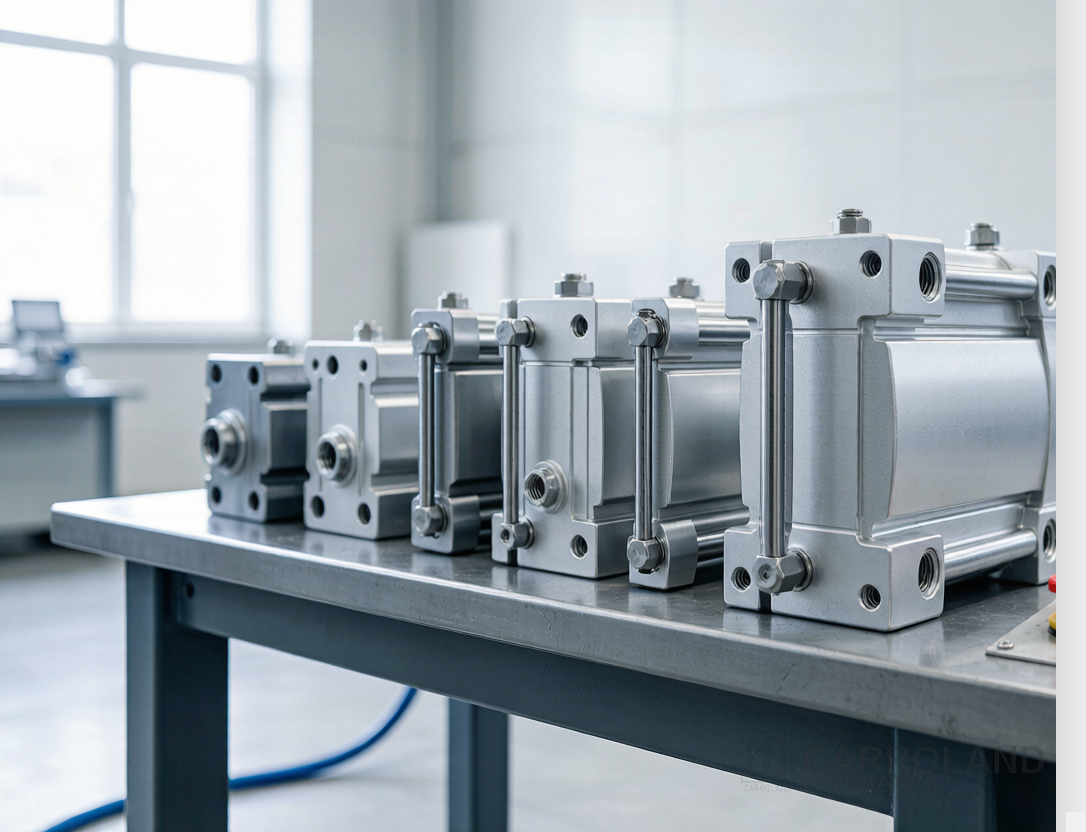
Why the Manufacturer vs. Distributor Question Matters
Most pneumatic cylinder datasheets look identical at first glance. Bore 50 mm, stroke 100 mm, cushioning both ends, magnetic piston, port G1/4 — every catalog lists the same line. The differences hide in three places: the seal compound, the aluminium tube tolerance, and the CNC program that machines the end caps. A factory controls those three; a trading house cannot, because the factory contract does not allow disclosure.
For a buyer, that translates into four measurable outcomes:
- Lead time. A manufacturer builds to order and stocks finished sub-assemblies. Typical build time on a non-standard stroke is 15–25 working days; a distributor must wait for the upstream factory, so the same part lands in 35–60 days.
- Cost of a special bore or stroke. A factory adds a CNC re-program and a short tube cut; a distributor pays the same re-program plus a margin. On 50-unit orders, the spread is 8–18 %.
- Seal life on hot or wet lines. Factory-grade Viton or HNBR seals last 18–24 months in a 60 °C, oil-mist environment; relabeled commodity NBR seals start leaking at 8–12 months.
- Failure analysis and warranty. A factory opens the cylinder, photographs the bore, and replaces the seal kit; a distributor sends a replacement from stock and never reports back to the upstream factory.
This is why OEM and Tier-1 automotive buyers in Europe and Southeast Asia run supplier audits, not just price comparisons. The same logic applies to buyers looking for a pneumatic component supplier across cylinders, valves, and FRL units.
Criterion 1: Engineering Depth on ISO 15552 and ISO 6432
ISO 15552 (the 2021 revision reaffirmed in 2024) defines the bore range 32–320 mm, the port thread per ISO 228, the tie-rod pattern, and the cushion length for double-acting profile and tie-rod cylinders. ISO 6432 covers the smaller round-body cylinders in bore 8–25 mm, often used in clamping and small pick-and-place fixtures. A serious pneumatic cylinder manufacturer China holds the gauge sets for both standards, and the engineering team can read the datasheet drawings in millimetres, not just millimetres-squared.
Engineers should ask for the following during a technical audit:
| Document | What it confirms | Minimum acceptable value |
|---|---|---|
| ISO 15552 dimensional drawing with tolerance | Bore, stroke, port, and tie-rod geometry | ±0.1 mm on port position; ±0.05 mm on tie-rod perpendicularity |
| Seal compound data sheet | Material (NBR, HNBR, FKM/Viton) and temperature rating | −20 °C to +80 °C minimum; Viton for hot/dry air |
| Cushion length chart | Buffer stroke per bore | 27 mm at Ø80, 30 mm at Ø100, 36 mm at Ø125 (ISO 15552 minimum) |
| Test report for thrust and leak | 6.3 bar theoretical force and ≤5 cm³/min leak at 10 bar | Per batch, signed by QC |
| Material certificates for tube and rod | 6063-T5 aluminium, C45 chrome-plated rod | Mill certificate, not in-house statement |
Carroland Pneumatics supplies each OEM order with the five documents above, plus a dimensional inspection record for the batch. For buyers comparing two pneumatic cylinder manufacturers in China, the deciding factor is usually the cushion length chart and the seal compound. A factory that publishes a cushion chart for 32–125 mm covers 90 % of standard applications; a factory that only cites “adjustable cushion” without numbers often runs a single short cushion length on every bore.
Criterion 2: Vertical Integration in Machining and Assembly
Vertical integration is the single biggest cost and quality lever inside a pneumatic cylinder factory. A vertically integrated manufacturer machines the end caps in-house, anodises the aluminium tube, cuts the tie-rods, and assembles the cylinder on a single line. A partially integrated plant buys end caps from a sub-supplier, which then drives the bore-position tolerance.
Buyers should look for five on-site capabilities during an audit or video walk-through:
- CNC turning and milling for end caps. A factory with 5-axis or 3-axis CNC centers on end-cap machining can hold ±0.05 mm on the port perpendicularity. A hand-machined end cap typically holds ±0.15 mm, which is enough to make the port leak under vibration.
- Aluminium tube extrusion sourcing. Direct sourcing from a Tier-1 extrusion mill (6063-T5) gives consistent inner-diameter roundness (≤0.05 mm). Re-sellers that buy tube from a trading house cannot guarantee the roundness lot-to-lot.
- Hard-chrome plating line for piston rods. A 20 µm minimum chrome layer with Ra ≤0.2 µm extends seal life in dirty or dry-air conditions. Buying plated rods from an outside plater is acceptable if the audit includes the plater, not the cylinder factory alone.
- Seal assembly room. Clean bench, humidity 40–60 %, prevents dust contamination on the dynamic seal. A factory that assembles in an open shop floor risks seal damage on the first stroke.
- 100 % leak and stroke test. Every cylinder pressurised to 10 bar for 30 seconds, stroked three times at 6 bar, before packing. Without this, defective units leave the line and the buyer pays the return-freight.
Carroland runs end-cap machining, tube sourcing, rod plating, and assembly on a single site in China. This is the same structure the European pneumatic cylinder manufacturers use, and it is what keeps the bore-position tolerance within ±0.1 mm on the delivered batch.
Criterion 3: Customisation Without MOQ Penalty
Most OEM orders include at least one non-standard requirement: a 175 mm stroke instead of 160, a stainless-steel piston rod for a wash-down line, a Viton seal kit for an oven-area fixture, or a left-handed port pattern to fit a tight envelope. The customisation cost is a function of the engineering time, the tube cut, and the seal change. A factory absorbs the engineering time into the part price; a distributor passes it through as a one-time setup fee.
Three customisation scenarios and the expected response from a competent pneumatic cylinder manufacturer China:
| Customisation request | Typical MOQ at a factory | Typical MOQ at a distributor | Lead time at a factory |
|---|---|---|---|
| Non-standard stroke (e.g. 175 mm instead of 160) | 1 piece | 20 pieces | 10–15 working days |
| Stainless-steel piston rod (SUS 304 / 316) | 5 pieces | 50 pieces | 15–25 working days |
| Viton seal kit for 80 °C ambient | 1 piece | 30 pieces | 7–12 working days |
| Custom port orientation (left-hand thread) | 10 pieces | 100 pieces | 20–30 working days |
| Special painting or colour | 50 pieces | 200 pieces | 25–35 working days |
A buyer who is sourcing from a pneumatic parts supplier that also handles valves and FRLs will see the same MOQ economics on each line item. The factory model compresses MOQ on the engineering changes because the engineering team is internal.
Criterion 4: Engineering Support and Application Drawings
Many Chinese pneumatic cylinder factories quote on a part-number basis: the buyer sends a model code, the factory sends a price. That works for repeat orders of standard parts and fails on first-article OEM orders, where the buyer needs confirmation of cushion length, thrust at working pressure, and the air-consumption per cycle.
A capable manufacturer provides four pre-sale engineering deliverables:
- Thrust calculation. Theoretical force = piston area × working pressure × efficiency factor (typically 0.85 for a lubricated ISO 15552 cylinder). For a Ø63 cylinder at 6 bar, theoretical push force is 1870 N, effective force is 1590 N.
- Air consumption per cycle. Cylinder volume × (working pressure + 1 bar) / atmospheric pressure. A Ø63 × 100 mm cylinder consumes 0.31 L per stroke at 6 bar.
- Cushion absorption chart. Mass × velocity² / 2. The chart converts kinetic energy into a recommended cushion stroke so the buyer does not oversize or undersize the buffer.
- 2D mounting drawing with envelope. Shows tie-rod position, port orientation, magnetic switch slot, and the full length of the assembled cylinder. The drawing goes straight into the buyer’s fixture design.
For an OEM designing a 3C electronics fixture, these four items remove one or two back-and-forth rounds between the buyer and the cylinder supplier. The supplier that ships only a price sheet usually leaves the engineering work to the buyer.
Criterion 5: Export Documentation and After-Sales Coverage
Buyers outside China need three categories of documentation and one service layer:
5.1 Commercial Documents
- Commercial invoice and packing list in English or the buyer’s language.
- Certificate of Origin (Form A, Form E, Form F, or RCEP, depending on the destination).
- Fumigation certificate for wooden cases (ISPM 15).
- CE technical file for European buyers (Machinery Directive 2006/42/EC alignment, EN ISO 12100 risk assessment).
5.2 Quality Documents
- Material certificates (mill certificate for aluminium and steel).
- Dimensional inspection report (per batch).
- Leak test report (per cylinder or per batch).
5.3 Compliance for Special Markets
- India: Carroland supplies cylinders on request that meet the IS 15867 dimensional reference, which corresponds to ISO 15552; the import licence and BIS registration remain with the Indian importer under the FMCS+AIR process.
- Europe: ATEX-rated cylinders for zones 1 and 2 (gas) and zones 21 and 22 (dust) are available on request, with the II 2G c IIB T4 marking for the standard catalogue range.
- Southeast Asia and Latin America: standard ISO 15552 dimensions work without further certification in most jurisdictions.
5.4 After-Sales Coverage
A factory with an in-house engineering team responds to a field failure within 24–48 hours. The first step is a written root-cause analysis (RCA) with a photo of the disassembled cylinder, the second step is a corrective action plan, and the third is a free seal kit or replacement cylinder if the failure is on the factory side. A trading house usually cannot generate an RCA because the upstream factory treats the case as a one-off warranty claim.
Comparing a Manufacturer with a Trading Company
The five criteria above give a structured comparison. A pneumatic cylinder manufacturer China is a factory that owns the design, the machining, the seal selection, and the test. A pneumatic parts supplier or pneumatic components supplier in China is a sales company that buys from a factory, holds stock, and resells. The two look identical on a price sheet for a standard catalog part, but they diverge as soon as the buyer asks for a non-standard stroke, a Viton seal, or a root-cause analysis on a failed cylinder.
| Aspect | Manufacturer | Trading company |
|---|---|---|
| Dimensional control | ±0.1 mm in-house, gauge set on site | Depends on upstream factory, no in-house gauge |
| Seal selection | Factory recommends per application | Limited to catalogue compounds |
| Custom MOQ on stroke | 1 piece | 20 pieces minimum |
| Lead time, non-standard | 10–15 working days | 35–60 working days |
| Test report per batch | Yes, signed by QC | Generic factory report on request |
| Root-cause analysis | Yes, within 24–48 hours | Forwarded upstream; 1–2 week turnaround |
| Cost spread on custom parts | −10 % to +5 % vs. catalogue | +8 % to +18 % vs. catalogue |
For a buyer who sources five or more cylinder lines per project, the cost spread and lead time difference justify a single audit trip to the candidate factory. The audit takes one day on site and saves weeks of back-and-forth during serial production.
Application Snapshot: 3C Electronics Fixture Cylinders
A 3C electronics fixture line uses compact ISO 6432 round-body cylinders (bore 16–25 mm) and short-stroke ISO 15552 profile cylinders (bore 32–50 mm) for clamping, lifting, and ejector motions. On a smartphone assembly line running 1,200 units per shift, the fixture cylinders stroke 1.5–2.5 million times per month. The two failure modes that drive warranty claims are seal wear (NBR softens at 60 °C ambient) and rod scoring (chrome layer below 15 µm wears through on dry air).
For this case, the buyer should specify:
- HNBR or Viton seals for ambient above 50 °C.
- Hard-chrome rod with 20 µm minimum thickness and Ra ≤0.2 µm.
- Magnetic piston for position feedback on every clamping cylinder.
- Filtered air at 5 µm with oil content 0–5 mg/m³ per ISO 8573-1 class 3.
Carroland Pneumatics has supplied ISO 15552 tie-rod and ISO 6432 round-body cylinders into 3C fixture lines since 1992, with European engineering input and China-based manufacturing. The 3C application case is one of the strongest tests of a pneumatic components supplier China because the cycle count is high and the failure cost per minute of line stop is measurable.
Frequently Asked Questions
What is the typical lead time for an ISO 15552 cylinder from a Chinese manufacturer?
For a standard bore and stroke from stock, 5–10 working days. For a non-standard stroke with the same bore, 10–15 working days. For a custom bore or a stainless-steel rod, 15–25 working days. Sea freight from China to most ports adds 18–28 days; air freight adds 3–5 days.
How does an OEM verify that a Chinese cylinder factory is vertically integrated?
Request a video walk-through of the end-cap CNC line, the tube cutting area, the rod plating line, the seal assembly room, and the test bench. A factory that hides one of these areas is likely outsourcing it. A trading company will not own any of the five areas and will refuse the video request.
What is the minimum order quantity for a custom pneumatic cylinder from China?
On a non-standard stroke, 1 piece. On a stainless-steel rod upgrade, 5 pieces. On a custom port orientation, 10 pieces. On a special paint colour, 50 pieces. The MOQ depends on the engineering time, not the production volume.
Can a Chinese manufacturer supply cylinders that meet ATEX or BIS requirements?
ATEX-rated ISO 15552 cylinders are available on request with II 2G c IIB T4 marking for zone 1 and zone 2. For India, the factory supplies cylinders built to ISO 15552 dimensions and supports the IS 15867 dimensional reference; the BIS registration under FMCS+AIR remains with the Indian importer of record.
How is the price of a custom cylinder calculated?
Base price = catalogue unit price for the bore and stroke. Engineering time = one-time setup, usually absorbed if the order exceeds 10 pieces. Material premium = stainless steel, Viton seals, or special paint. Final unit price = (base + material premium) × (1 + margin). A factory typically charges 5–10 % margin on custom parts; a distributor charges 15–25 %.
What warranty terms are standard for Chinese pneumatic cylinders?
12 months from the date of dispatch, or 18 months from the date of manufacture, whichever comes first. Warranty covers material and workmanship defects. Wear parts (seals, rod chrome layer under normal use) carry a 6-month warranty. Misapplication (overpressure, wrong filtration, ambient outside the rated range) is excluded.
Selection Checklist for an OEM Buyer
For an OEM or automation integrator sourcing ISO 15552 and ISO 6432 cylinders, the five criteria above — engineering depth, vertical integration, customisation flexibility, engineering support, and export documentation — separate a pneumatic cylinder manufacturer China from a trading company. The factory model compresses MOQ on engineering changes, shortens the lead time on non-standard parts, and provides the root-cause analysis that warranty claims depend on. Carroland Pneumatics applies all five criteria on a single China-based site, with European engineering input and more than 30 years of cylinder production since 1992. Engineers who need a dimensional drawing, a custom stroke, or a Viton seal kit can send the request to our engineering team for a same-day response.