
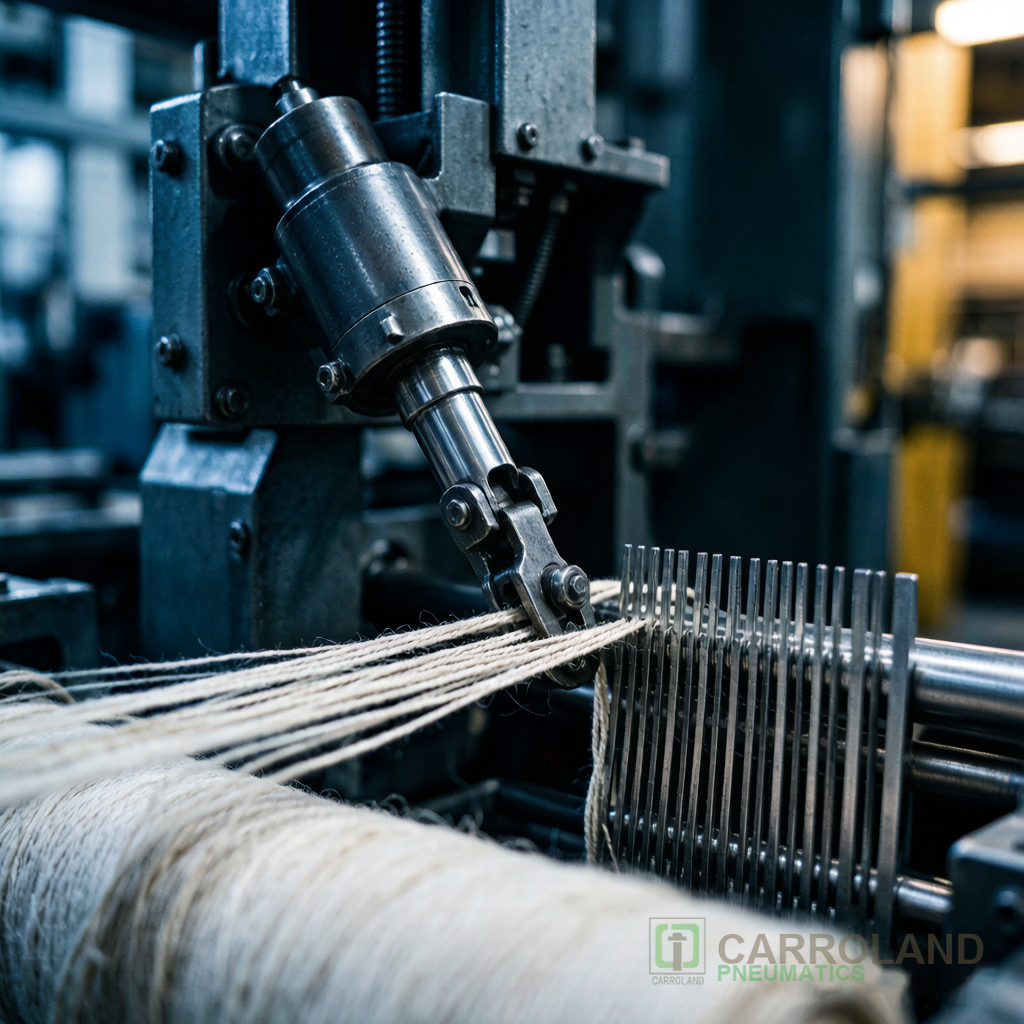
Textile machines operate in dusty, humid and high-vibration environments where electric actuators can fail from lint, heat and moisture. A pneumatic cylinder for textile machine applications drives looms, knitting machines, spinning frames and fabric-handling equipment with simple, robust linear motion. Carroland supplies tie-rod, compact and rodless cylinders to textile OEMs, with dust-resistant seals, corrosion-resistant rods and operating pressures from 0.4 to 1.0 MPa. For a contrasting high-cleanliness application that uses the same rodless and compact profiles, see our pneumatic cylinder for iPhone production range.
Pneumatic Tasks in Textile Machinery
The textile industry uses pneumatics for intermittent, high-force motions that do not need servo precision. The most common applications are:
- Weft insertion and picking — a 50–80 mm bore cylinder accelerates the rapier or projectile across the loom shed in 50–120 ms.
- Selvedge tucking and trimming — short-stroke 25–32 mm cylinders actuate tucking needles and cutter knives at the fabric edge.
- Yarn tensioning and braking — a 40 mm bore cylinder applies controlled pressure to a disc brake to keep yarn tension within 5–15 cN during winding.
- Fabric lay-up and spreading — rodless cylinders or guided actuators move spreading heads over 1,000–2,000 mm strokes.
- Bale pressing and clamping — large-bore 100–125 mm cylinders compress finished fabric bales for strapping and transport.
These motions are often cyclical, with 1,000–2,000 cycles per hour. Pneumatic cylinders tolerate the duty cycle well when paired with water separators, coalescing filters and automatic lubricators.
Sizing for Dust and Vibration
Textile mills generate airborne fiber that quickly abrades exposed rods. We recommend:
- Double rod wiper — a primary metal scraper plus a polyurethane wiper removes lint before it reaches the seal.
- Stainless steel piston rod — 304 or 316 rod material resists the alkaline humidity common in dyeing and finishing areas.
- Bellows or rod boot — a flexible cover over the extended rod keeps fibers off the polished surface.
- Mounting orientation — mount the rod upward or sideways to let gravity and wipers clear debris, and add drain ports if the cylinder will see wash-down.
For a rapier drive requiring 1,200 N peak force at 0.6 MPa, a 63 mm bore cylinder provides about 1,870 N theoretical push, giving a 35% safety margin for friction and acceleration. Stroke is typically 400–800 mm depending on loom width.
Speed and Cushioning
Weft insertion demands rapid but controlled deceleration. We specify cylinders with adjustable pneumatic cushioning for strokes above 200 mm and add external shock absorbers where rapier mass exceeds 2 kg. For 600 rpm looms, the cylinder completes a full cycle in roughly 100 ms, so valve response time below 15 ms is essential to maintain timing.
Carroland Textile Cylinder Solutions
Carroland builds textile cylinders with high-dust seals, stainless rods and optional bellows. We match ISO 15552 mounting dimensions so mills can replace standard actuators without modifying frames, and we offer magnetic pistons for position feedback on automated winding and lay-up lines. Lead time for standard textile cylinders is 10–15 working days, with repair seal kits available to extend service life in 24/7 mills. For drop-in replacement using ISO 15552 mounting dimensions across mills and assembly cells, our ISO 15552 cylinder mounting guide clarifies bore and force envelopes.
FAQ
What rod protection is needed in a textile mill?
At minimum, a double rod wiper and a stainless steel rod. In dusty winding areas, add a rod bellows or boot and mount the cylinder so the rod does not point downward where lint collects.
How fast can a pneumatic cylinder cycle on a loom?
With 2/2 or 3/2 high-flow valves and a 100 mm stroke, cycle times under 100 ms are achievable, supporting loom speeds up to 600 rpm with proper cushioning.
Can pneumatic cylinders survive humid dye-house conditions?
Yes, with stainless steel rods, anodized aluminum or stainless barrels, and FRL units that include water separators and 40 μm filtration. Regular drainage of the FRL bowl prevents internal corrosion.
{
“@context”: “https://schema.org”,
“@type”: “Article”,
“headline”: “Pneumatic Cylinder for Textile Machine: Weaving, Winding & Dust-Resistant Design”,
“description”: “Learn how pneumatic cylinders for textile machines drive weft insertion, yarn tensioning and fabric lay-up. Compare dust-resistant seals, stainless rods and sizing for humid mills.”,
“author”: {“@type”: “Person”, “name”: “Carroland Engineering”},
“publisher”: {“@type”: “Organization”, “name”: “Carroland Pneumatics”, “url”: “https://carroland.net/”},
“datePublished”: “2026-07-27”,
“mainEntityOfPage”: “https://carroland.net/pneumatic-cylinder-for-textile-machine/”
}
{
“@context”: “https://schema.org”,
“@type”: “FAQPage”,
“mainEntity”: [
{“@type”: “Question”, “name”: “What rod protection is needed in a textile mill?”, “acceptedAnswer”: {“@type”: “Answer”, “text”: “At minimum, a double rod wiper and a stainless steel rod. In dusty winding areas, add a rod bellows or boot and mount the cylinder so the rod does not point downward where lint collects.”}},
{“@type”: “Question”, “name”: “How fast can a pneumatic cylinder cycle on a loom?”, “acceptedAnswer”: {“@type”: “Answer”, “text”: “With 2/2 or 3/2 high-flow valves and a 100 mm stroke, cycle times under 100 ms are achievable, supporting loom speeds up to 600 rpm with proper cushioning.”}},
{“@type”: “Question”, “name”: “Can pneumatic cylinders survive humid dye-house conditions?”, “acceptedAnswer”: {“@type”: “Answer”, “text”: “Yes, with stainless steel rods, anodized aluminum or stainless barrels, and FRL units that include water separators and 40 μm filtration. Regular drainage of the FRL bowl prevents internal corrosion.”}}
]
}
Related Guides
- Textile Machinery Pneumatic Upgrade Guide
- Pneumatic Cylinder Selection Guide
- Cylinder Maintenance: Seal Materials and Service Life
Explore Carroland Products
Request a quotation or engineering consultation from the Carroland application team.