
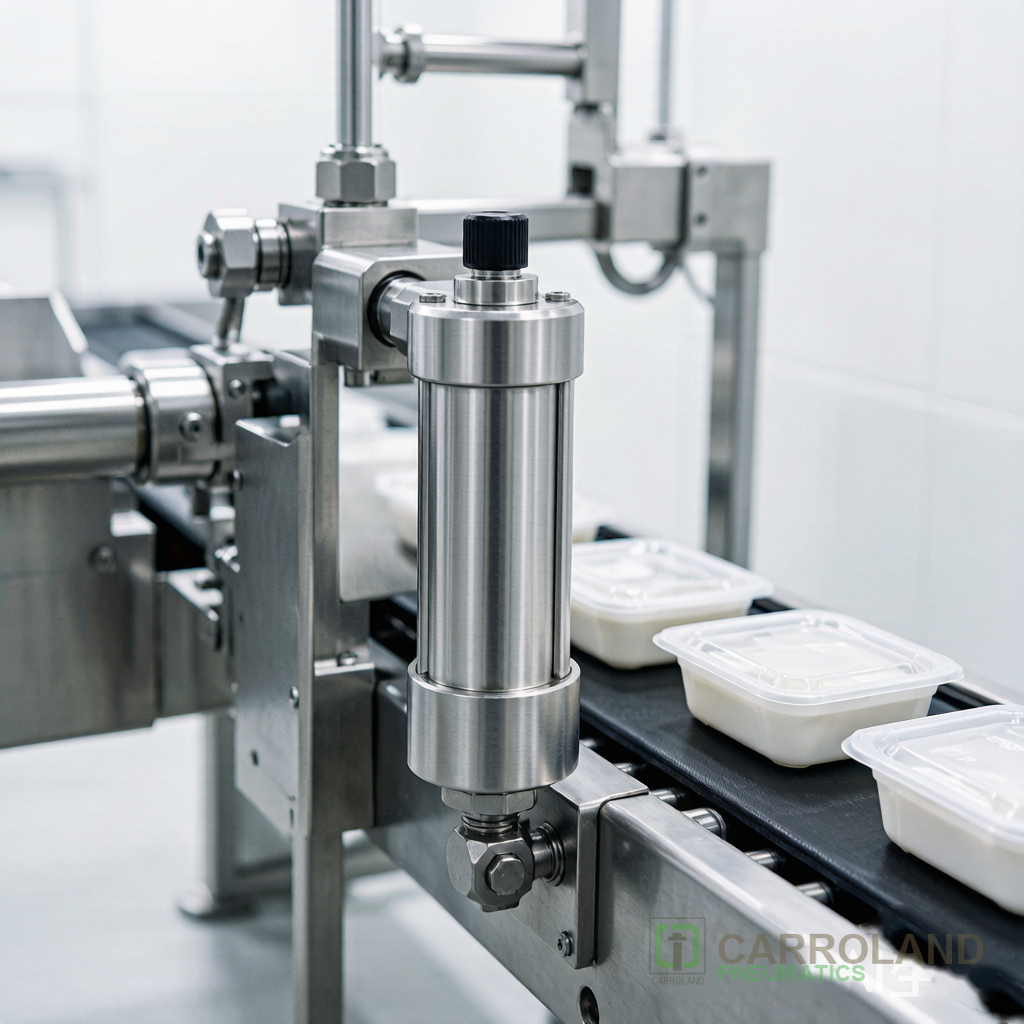
Food processing machines must move quickly, clean easily and avoid contamination. A pneumatic cylinder for food processing operates mixers, slicers, portioning equipment, filling valves and conveyor diverters in wash-down environments where hygiene is non-negotiable. Carroland supplies stainless-steel and hygienic-design cylinders with smooth surfaces, food-grade lubrication and sealed construction to meet HACCP and NSF hygiene requirements. For high-speed indexing that pairs with hygienic cylinders, see our pneumatic cylinder for packaging machines range.
Where Pneumatic Actuators Appear in Food Plants
Food processing combines wet, dry, hot and cold operations. Pneumatic cylinders perform well in all of them because they are sealed, fast and tolerant of temperature swings. Typical applications include:
- Portioning and cutting — a 63 mm bore cylinder drives a guillotine blade through dough, meat or cheese at 0.2–0.4 m/s.
- Filling valve actuation — a 40 mm cylinder opens and closes product valves on sauce, beverage and dairy fillers with 100–200 ms response.
- Conveyor diverting and rejection — a 32 mm short-stroke cylinder pushes rejected packs into a side lane.
- Mixer lid and hatch locking — a guided cylinder clamps lids on batch mixers and kneaders to prevent opening under pressure.
- Packaging infeed pusher — a compact cylinder indexes trays or cartons into wrapping machines.
Because food plants run CIP (clean-in-place) and COP (clean-out-of-place) cycles, cylinders must survive exposure to water, detergents and sanitizers without corroding or leaking lubricant into the product zone.
Hygienic Cylinder Design Requirements
Standard industrial cylinders accumulate residue in crevices around the barrel, tie-rod nuts and end caps. For food processing, we specify:
- Stainless steel 316L or 304 body — corrosion-resistant and compatible with caustic wash-down.
- Smooth, crevice-free profile — round barrel designs with minimal fasteners reduce places where bacteria can hide.
- Food-grade NSF-H1 grease — safe incidental contact with food products.
- High-temperature seals — FKM or silicone seals for zones near ovens, fryers or pasteurizers.
- IP67 rating and water ingress protection — sealed end caps and gaskets prevent water from entering the air side.
For a filling valve actuator requiring 250 N at 0.5 MPa, a 32 mm bore cylinder provides about 400 N theoretical force, leaving a 35% margin after friction losses. Stroke is usually 25–75 mm to match the valve travel.
Air Quality in Food Processing
Compressed air in food zones must be filtered to ISO 8573-1 Class 1.2.1 or better for particles, water and oil. We recommend point-of-use filters with 0.01 μm coalescing elements, and we advise against exhausting contaminated air directly over open product conveyors. Cylinders with ported exhaust collection keep the processing area clean.
Carroland Food-Processing Solutions
Carroland offers hygienic stainless-steel cylinders, wash-down compact actuators and complete FRL/filter packages for food plants. We validate seal compatibility with common cleaning agents and supply documentation for HACCP audits. Standard lead time is 12–18 working days for hygienic stainless models, with 5–7 day sample support for machine trials. For selection between compact ISO 6432 and ISO 21287 profiles used in filling and cutting stations, our ISO 6432 and ISO 21287 compact cylinder guide compares bore, stroke and cleanroom options.
FAQ
Are pneumatic cylinders food-safe?
Yes, when specified with stainless steel bodies, food-grade NSF-H1 lubrication and sealed construction. Incidental contact with food must be assessed against local regulations, but the design minimizes risk.
What air quality class is needed in food processing?
ISO 8573-1 Class 1.2.1 or better for particle, water and oil content is typical for product-contact or high-risk zones, with point-of-use filtration.
Can standard cylinders be washed down in food plants?
Standard aluminum cylinders can survive occasional wash-down, but they will corrode over time. For daily wash-down, use stainless steel or hard-anodized hygienic cylinders with IP67 sealing.
{
“@context”: “https://schema.org”,
“@type”: “Article”,
“headline”: “Pneumatic Cylinder for Food Processing: Hygienic Design, Sizing & Air Quality”,
“description”: “Explore pneumatic cylinders for food processing: hygienic stainless steel designs, food-safe lubrication, sizing for filling and cutting, and ISO 8573-1 air quality guidance.”,
“author”: {“@type”: “Person”, “name”: “Carroland Engineering”},
“publisher”: {“@type”: “Organization”, “name”: “Carroland Pneumatics”, “url”: “https://carroland.net/”},
“datePublished”: “2026-07-27”,
“mainEntityOfPage”: “https://carroland.net/pneumatic-cylinder-for-food-processing/”
}
{
“@context”: “https://schema.org”,
“@type”: “FAQPage”,
“mainEntity”: [
{“@type”: “Question”, “name”: “Are pneumatic cylinders food-safe?”, “acceptedAnswer”: {“@type”: “Answer”, “text”: “Yes, when specified with stainless steel bodies, food-grade NSF-H1 lubrication and sealed construction. Incidental contact with food must be assessed against local regulations, but the design minimizes risk.”}},
{“@type”: “Question”, “name”: “What air quality class is needed in food processing?”, “acceptedAnswer”: {“@type”: “Answer”, “text”: “ISO 8573-1 Class 1.2.1 or better for particle, water and oil content is typical for product-contact or high-risk zones, with point-of-use filtration.”}},
{“@type”: “Question”, “name”: “Can standard cylinders be washed down in food plants?”, “acceptedAnswer”: {“@type”: “Answer”, “text”: “Standard aluminum cylinders can survive occasional wash-down, but they will corrode over time. For daily wash-down, use stainless steel or hard-anodized hygienic cylinders with IP67 sealing.”}}
]
}
Related Guides
Explore Carroland Products
Request a quotation or engineering consultation from the Carroland application team.