
Pneumatic Cylinder Pressure Control: Regulators and Valves
Force in a pneumatic axis is a pressure problem before it is a bore problem. Pneumatic cylinder pressure control keeps clamping force, pressing force and descent speed inside the tolerance the process needs. That stability has to survive a compressor, filters and neighbouring stations that all move the supply pressure. Carroland Pneumatics builds ISO 15552 and ISO 21287 cylinders in China for Indian OEMs and system integrators. This guide compares the three control levels available, shows where each belongs in a pneumatic circuit, and lists the numbers a buyer should demand. European Technology, China Manufacturing, Since 1992.
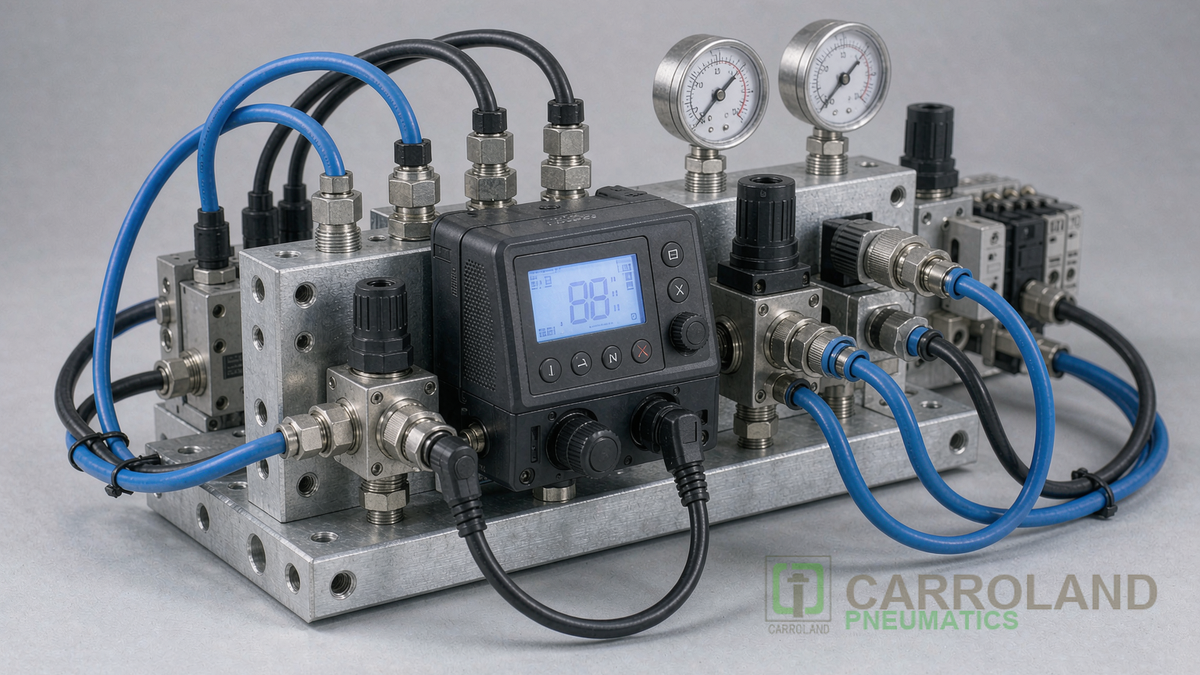
Three Levels of Pressure Control
The simplest level is a manual filter-regulator, set with a screw and read on a gauge. It is accurate to a few percent of full scale, cheap, and the standard choice for a single machine with a stable load. The second level is an electro-pneumatic regulator, which accepts an analogue command of 0 to 10 V or 4 to 20 mA and adjusts output pressure continuously. An internal pressure sensor closes the feedback loop. The third level is a proportional pressure control valve integrated into a valve terminal, where pressure can be regulated per channel and changed between steps of a cycle by the machine program.
The distinction that matters on the plant floor is not resolution but repeatability. A manual regulator holds a pressure; a closed-loop regulator holds a force, because it corrects for the load change that occurs when a clamp closes on a part of varying thickness. Modern electro-pneumatic regulators are quoted with repeatability of a fraction of a percent of setpoint. Industry data on piezo-actuated proportional regulators puts long-term repeatability in the region of plus or minus 0.25 percent.
Closed-Loop Pressure Control and What It Buys
Adding feedback changes the failure modes as well as the accuracy. With a closed loop, hysteresis in the regulator no longer accumulates across cycles, so the thousandth part is clamped at the same force as the first. Load fluctuation caused by a shared supply line is corrected within the valve response time. Diagnostics become available as well. A regulator whose command rises while the output stays flat is telling maintenance that a filter is blocking or a line is leaking, long before a part is rejected.
On the energy side, the published industry figure for digitally controlled proportional pressure regulation is a reduction in compressed air consumption of up to 50 percent in suitable applications. The circuit no longer runs at full line pressure for every step. Piezo-actuated pilot valves consume roughly 95 percent less electrical energy than conventional solenoid pilots and generate no holding heat, which matters where valve terminals are densely packed in a cabinet.
Force Control Instead of Position Control
Many Indian assembly processes are specified in force, not position. Examples include a press-fit that must seat without cracking a housing, a clamp that must not mark a cosmetic surface, and a polishing head that must follow a contour. Controlling the air pressure instead of adding a servo axis gives force proportionality with a very short control loop and much lower cost. The design rule is to size the bore for the maximum force at the highest expected pressure, then regulate down for normal production. The actuator then never runs at the edge of its capability.
Solenoid Control Valve and Actuator Valve Pneumatic Combinations
A solenoid control valve switches direction; it does not set force. The usual architecture places pressure regulation upstream of the directional valve, which stabilises both chambers, or uses two regulators in a metering-out arrangement to give independent extend and retract forces. A 5/3 closed-centre valve adds position holding but not force holding, and internal leakage means a heavy vertical load still needs a mechanical lock. Where a machine has several identical stations, one proportional regulator per station usually costs less than the scrap it prevents. It also lets each station be trimmed without touching the others, which is the arrangement most pneumatic valves and actuators installations settle into.
Where the Regulator Belongs in the Pneumatic Circuit
Air preparation comes first, then regulation, then valves, then the actuator. Putting a regulator after the valve wastes air on every exhaust stroke and cannot stabilise either chamber. Mounting it directly on a manifold that feeds one actuator gives the shortest correction path and the best response. In a pneumatic circuit serving several actuators from one regulator, any cycle that consumes a large volume of air will drag the pressure down for the neighbours. Shared regulation is therefore limited to stations with similar duty.
Long Stroke, Rodless Air Cylinder and Volume Effects
Pressure control becomes harder as cylinder volume grows. A rodless air cylinder with a two-metre stroke contains several litres of air, and the compressibility of that volume introduces a spring-like lag between regulator output and piston force. The countermeasures are practical rather than exotic. Mount the regulator as close to the port as possible, size tubing for flow rather than for convenience, and accept that a long-stroke axis will hold force less precisely than a compact one. Where hold accuracy is critical over a long stroke, a mechanical lock or a position-controlled electric axis is the honest answer.
Specifying with a Pneumatic Manufacturer
Buyers comparing a pneumatic manufacturer on pressure capability should ask for four numbers rather than a catalogue headline. Those numbers are the regulated pressure range and its accuracy, flow capacity at the working pressure, air consumption per cycle, and the repeatability figure with the test method behind it. The same discipline applies when comparing pneumatic cylinder manufacturers and air cylinder manufacturers, since the cylinder’s friction and seal drag set the floor on the smallest force that can be controlled repeatably. A cylinder with stiff seals cannot be turned into a force-controlled actuator by a good regulator.
Applications on Indian Lines
Electronics assembly in Tamil Nadu and Karnataka uses regulated clamping on test fixtures and pickup nests, where marking a component is a reject. Automotive tier suppliers use it on pressing and riveting stations, and pharmaceutical and food lines use it where a seal must be compressed to a defined force rather than a defined position. India’s industrial automation and instrumentation segment consumes the majority of pneumatic components sold in the country. Industry research records the sector shifting steadily from price-only purchasing toward total cost of ownership, which is exactly the calculation that favours force control.
Frequently Asked Questions
Is a proportional valve necessary, or will a regulator be enough?
If the force must change during the cycle, or if several products of different thickness run on one machine, a proportional device earns its cost. If one pressure setting serves one product family for years, a quality manual filter-regulator is the better engineering decision.
How often should pneumatic pressure controls be inspected?
Industry maintenance guidance recommends a general inspection at least once a year, checking supply pressure against the setpoint, cleaning or replacing the filter element, and testing every joint for leaks. New installations should be inspected more frequently until a realistic service interval is established for that environment.
What pressure range should a clamping application specify?
Size the bore so that normal production force is reached at 4 to 5 bar, leaving the 6 to 7 bar region available for the maximum force step. Running at the top of the range leaves no authority for the regulator to correct upward, and it shortens seal life.
Continue with the pillar guide to pneumatic cylinder types for Indian manufacturers, and the companion pages on bore and stroke sizing and air preparation units. The dimensional standards behind these components are published in the ISO standards catalogue, and Indian compliance questions start at the Bureau of Indian Standards.