When Is a 50 mm Stroke Pneumatic Cylinder the Right Choice?
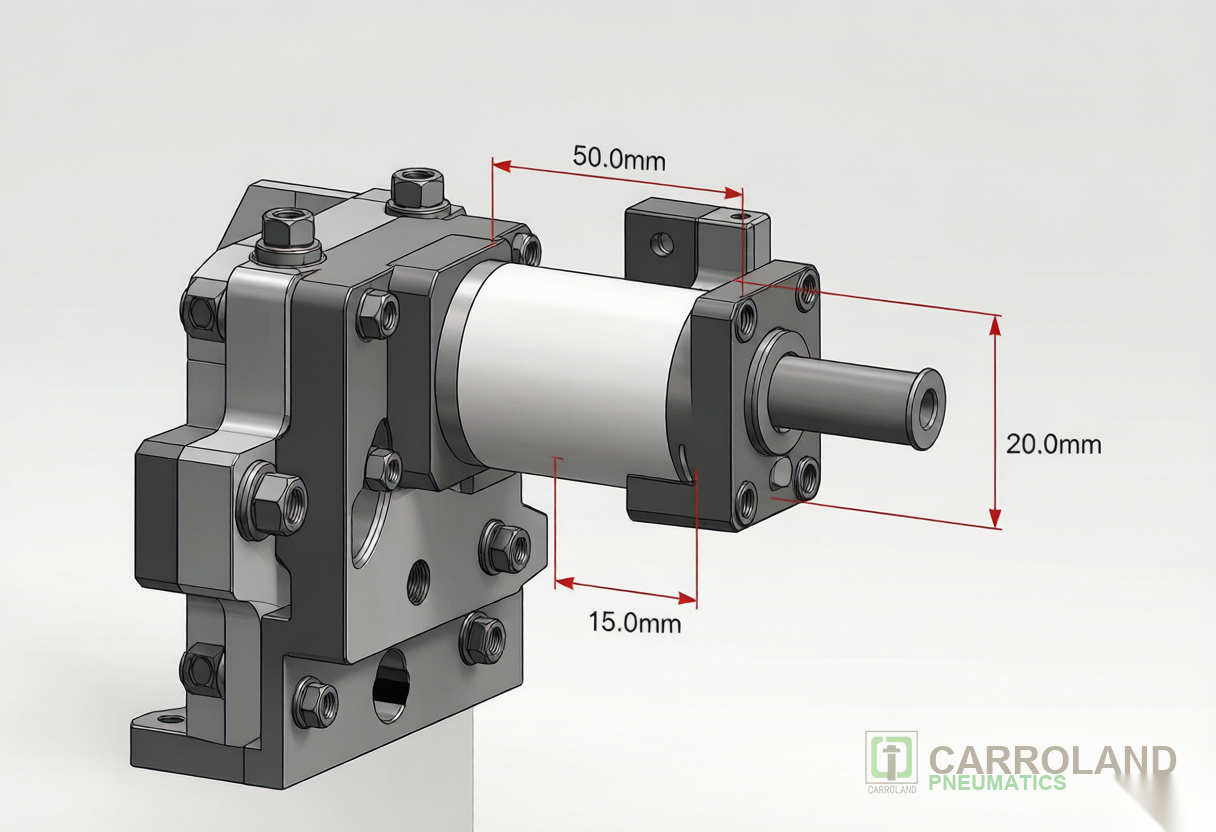
A 50 mm stroke pneumatic cylinder is one of the most common short-stroke sizes in industrial automation. It is short enough for compact clamping, ejection, and indexing stations, yet long enough to handle small part transfer and light pressing in Indian electronics, packaging, and automotive plants.
Carroland Pneumatics manufactures ISO 15552 profile cylinders and ISO 21287 compact cylinders with 50 mm stroke for Indian OEMs. The 50 mm dimension is a standard stock increment, which keeps lead times short and replacement straightforward.
ISO Standards and Stroke Dimensions
ISO 15552 lists preferred strokes including 25, 50, 80, 100, 125, 160, 200, 250, 300, 320, 400, and 500 mm. A 50 mm stroke therefore sits at the compact end of the standard range. ISO 21287 compact cylinders also offer 50 mm stroke in bore sizes from 20 mm to 100 mm for space-constrained designs.
Key data points:
- ISO 15552 standard strokes include 50 mm as a preferred increment
- Typical bores paired with 50 mm stroke: 20–100 mm for compact cylinders, 32–125 mm for ISO 15552
- A 50 mm × 50 mm bore cylinder at 6 bar delivers approximately 118 N theoretical push force
Force Table for 50 mm Stroke Cylinders
Stroke length does not affect force; bore and pressure do. For a 50 mm stroke cylinder, the force available at 6 bar is:
| Bore (mm) | Piston area (mm²) | Push force at 6 bar | Common application |
|---|---|---|---|
| 20 | 314 | 188 N | Precision clamping |
| 32 | 804 | 482 N | Small ejectors |
| 50 | 1,963 | 1,178 N | Part transfer |
| 80 | 5,027 | 3,016 N | Light pressing |
Applications in Indian Automation
Fifty-millimetre stroke cylinders appear in:
- PCB assembly fixtures and test jigs
- Packaging flap folding and sealing
- Small pick-and-place transfer arms
- Textile machine yarn guides and cutters
- 3C automation clamping nests
Carroland’s 50 mm stroke actuators are used by Indian manufacturers who need repeatable short motion without the bulk of a long-stroke cylinder. We supply them with magnetic pistons for sensor feedback and adjustable cushioning to protect tooling at end of stroke.
Compact vs. Standard Profile
Choose an ISO 21287 compact cylinder when installation depth is limited and the load is light. Choose an ISO 15552 profile cylinder when you need larger bores, multiple mounting styles, or the ability to share accessories across a machine line. Both families include 50 mm stroke as a catalog standard.
Selection Checklist
- Confirm the 50 mm stroke covers the required mechanical motion plus clearance
- Size bore by force requirement, not by stroke length
- Specify magnetic piston if position feedback is needed
- Check rod-end thread size for fixture compatibility
- Use ISO-standard accessories to reduce spare-part inventory
Related Guides
See our main Pneumatic Cylinder Guide for Indian Manufacturers for bore sizing. For long-stroke alternatives, read 3 Stage Telescopic Pneumatic Cylinder.
FAQ
Does a 50 mm stroke cylinder have less force than a 200 mm stroke?
No. Force depends on bore area and pressure, not stroke length. Stroke only affects the distance travelled.
What is the shortest standard ISO 15552 stroke?
The preferred ISO 15552 stroke list starts at 25 mm; some suppliers offer shorter custom strokes down to 5 mm.
Can I get a 50 mm stroke with position sensors?
Yes. Specify a magnetic piston and choose a reed or Hall-effect sensor that fits the cylinder groove.
Is 50 mm stroke suitable for high-speed cycling?
Yes, short strokes allow higher cycle rates because the piston has less distance to accelerate and decelerate. Cushioning is still recommended above 0.5 m/s.