How Does an Automatic Reciprocating Pneumatic Cylinder Work?
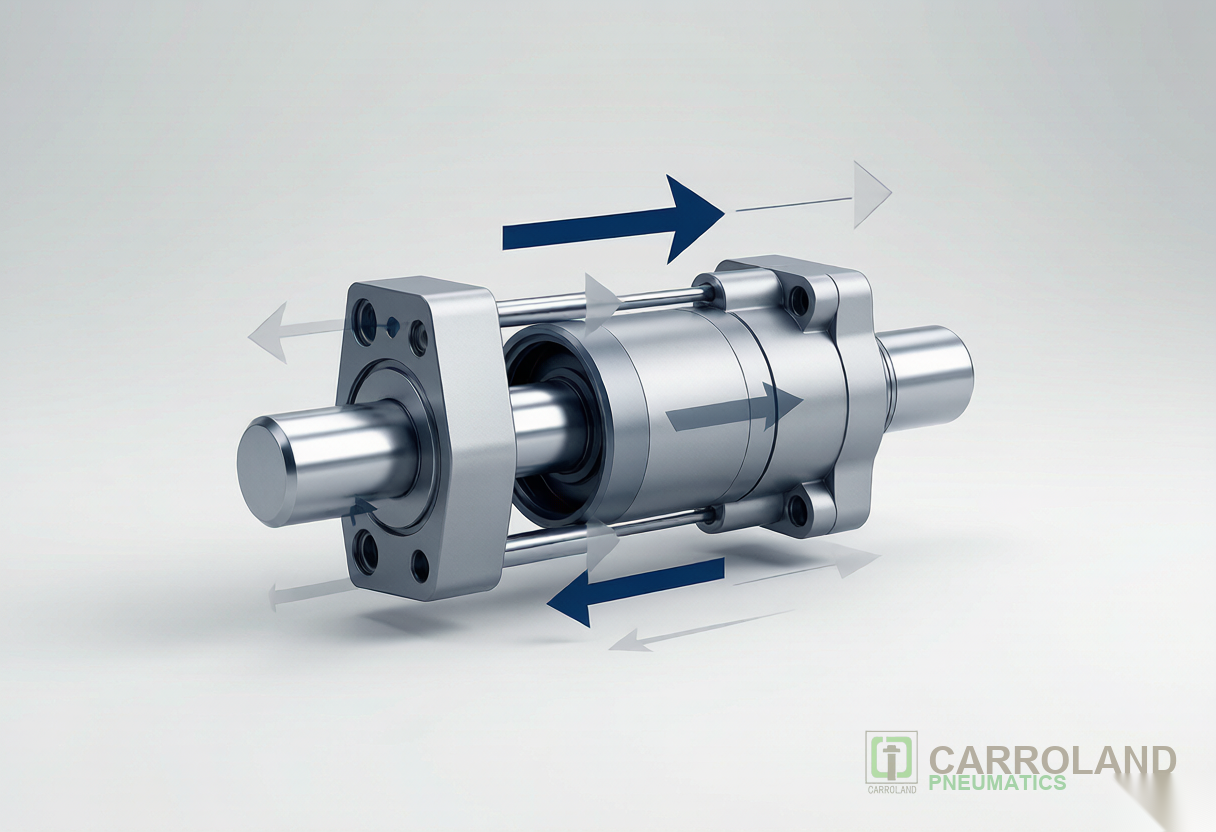
An automatic reciprocating pneumatic cylinder produces repeated back-and-forth linear motion without continuous manual input. The reciprocation is created by alternating compressed air between the two sides of the piston, usually controlled by a 5/2-way valve, shuttle valve, or pilot-operated circuit.
Carroland Pneumatics manufactures double-acting ISO 15552 cylinders for Indian machine builders who need reliable reciprocation in pressing, feeding, cutting, and transfer applications.
Working Principle of Reciprocation
In a double-acting cylinder, pressurising the cap side pushes the piston rod out; pressurising the rod side pulls it back. Repeating this cycle creates reciprocating motion. The switching can be triggered by:
- Solenoid valve + PLC: precise, programmable cycle control
- Pilot-operated valve: air pilot signals from the cylinder end position
- Mechanical limit valve: cam or flag on the load activates the valve
- Timer-based valve: fixed-frequency oscillation for simple applications
Each cycle consists of an extension stroke, a brief dwell, a retraction stroke, and another dwell. The dwell time and stroke length determine the output rhythm.
ISO 15552 and Performance Data
ISO 15552:2018 defines double-acting profile cylinders with a 10 bar rating, making them suitable for continuous reciprocation. Key figures:
- ISO 15552 maximum rated pressure: 10 bar
- Typical reciprocating speed range: 50–500 mm/s
- High-speed applications may exceed 1,000 mm/s with proper cushioning
- Cycle frequency in small-bore systems: up to 10 Hz with short strokes
Common Reciprocating Applications in India
Indian factories use automatic reciprocating cylinders for:
- Conveyor pusher and indexer mechanisms
- Cutting and shearing machines
- Pressing and riveting fixtures
- Textile beating and winding drives
- Packaging flap tucking and sealing
Carroland supplies these actuators with adjustable pneumatic cushioning at both ends, which reduces impact wear during the constant direction changes of reciprocating duty.
Design Considerations for Continuous Reciprocation
| Factor | Recommendation |
|---|---|
| Cushioning | Use pneumatic cushioning on both ends above 0.3 m/s |
| Seals | Specify polyurethane seals for wear resistance |
| Lubrication | Maintain clean, filtered, lightly lubricated air |
| Alignment | Guide the load externally to avoid rod side-load |
| Cycle count | Size bore and valve for expected lifetime cycles |
Speed and Cushioning
Without cushioning, a fast reciprocating piston will hammer the end caps at each reversal, shortening seal and bearing life. Adjustable cushioning traps a small volume of exhaust air near end of stroke, creating a controlled deceleration zone. For strokes under 50 mm at moderate speed, elastic bumpers may be sufficient; for longer or faster strokes, pneumatic cushioning is essential.
Related Guides
Read the Pneumatic Cylinder Guide for Indian Manufacturers for bore sizing, and Automatic Pneumatic Cylinder for sensor and PLC integration.
FAQ
What creates reciprocating motion in a pneumatic cylinder?
Alternating air pressure on each side of the piston, controlled by a directional valve that switches at the end of each stroke or on a timed signal.
Can a single-acting cylinder reciprocate automatically?
Not without a return mechanism. Single-acting cylinders rely on a spring for one direction, so continuous reciprocation requires a double-acting cylinder.
How do I control reciprocation speed?
Use exhaust flow-control valves on each cylinder port. Controlling exhaust air is more stable than restricting inlet air.
Why does my reciprocating cylinder fail at high cycle rates?
Common causes are insufficient cushioning, contaminated air, side loading on the rod, or an undersized valve causing slow switching.