Guided Compact Pneumatic Cylinder: Side Load and Anti-Rotation for Indian Automation
Where Side Load, Anti-Rotation and a Short Body All Matter
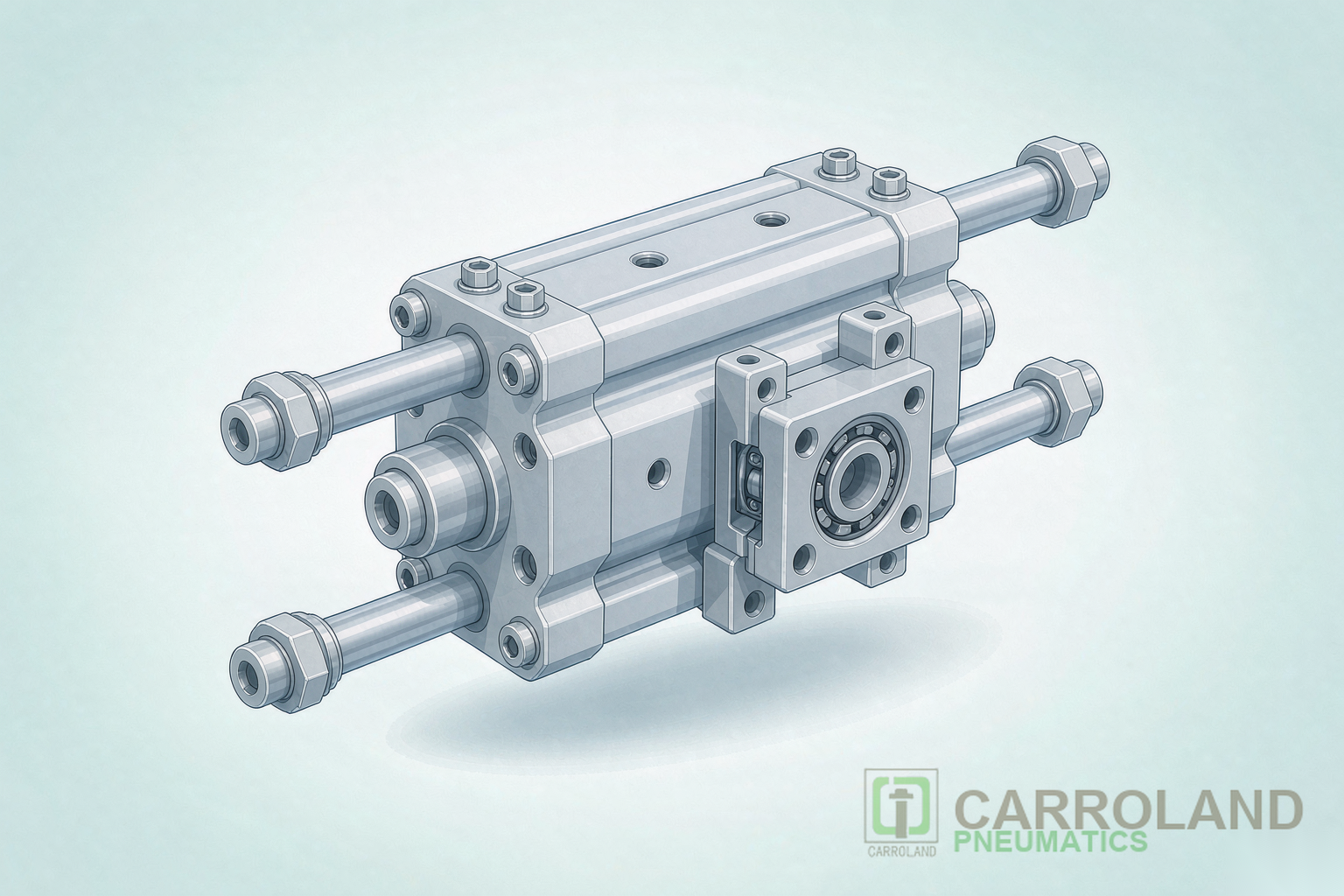
The guided compact pneumatic cylinder is the answer when an Indian line builder needs the space-saving envelope of an ISO 21287 compact cylinder together with the side-load handling and anti-rotation behaviour that a plain rod cylinder cannot deliver. In a guided compact, twin guide rods or an integrated linear-bearing carriage run alongside the cylinder body, absorbing lateral forces 4–10 times greater than a single-rod cylinder of the same bore and preventing the piston rod from rotating as it strokes. The construction is mapped to ISO 21287 for installation dimensions, with bore sizes spanning 20–100 mm across the major compliant series (Ø16 is offered by specific series).
Across Pune’s automotive welding cells, Noida’s EMS pick-and-place lines and Chennai’s white-goods assembly, guided compact cylinders are the standard pick for stamping ejectors, press feeds, short-stroke pick-and-place stations, and any application where side load or rod rotation would otherwise drift the part or wear the seal prematurely. Carroland’s cylinder selection guide treats guided compact as one of the four primary form factors alongside ISO 15552 tie-rod, ISO 6432 mini and rodless.
Construction of a Guided Compact Cylinder
Body and Barrel
Anodised aluminium profile or round barrel, end caps in die-cast zamak (smaller bores) or aluminium (32–100 mm). Bore sizes follow ISO 21287: Ø20, 25, 32, 40, 50, 63, 80 and 100 mm. Operating pressure is the standard 10 bar / 1000 kPa series; common Indian shop-air set points are 6 bar nominal. Operating temperature spans roughly −20 °C to +80 °C with NBR seals, extendable to +150 °C with FKM/FPM seals and down to −40 °C with low-temperature polyurethane.
Guide Element Options
Two architectures are common in Indian indents. Twin guide rods are stainless-steel or hard-chrome-plated steel rods running parallel to the piston rod, with linear bearings or polymer bushings supporting the carriage. They deliver very high side-load capacity and good moment resistance. Integrated slide unit cylinders carry a carriage riding on linear bearings or recirculating ball rails directly on the body, providing a flat mounting surface for tooling or workpiece fixtures. Both reduce total installed length against a guided rod-cylinder assembly with separate external linear guide.
Cushioning and Sensing
Rubber-buffer fixed cushioning is the standard on most ISO 21287 compact series; adjustable-pneumatic cushioning is offered on premium variants. Magnetic pistons are standard on most series, with sensor slots cast into all four sides of the profile barrel so that reed or Hall-effect switches can be repositioned without re-plumbing.
How the Guide Geometry Controls Side Load
Side load handling is the principal argument for specifying a guided compact over a plain ISO 21287 compact. A plain single-rod cylinder of same bore can typically tolerate only modest lateral force on the rod before the rod end begins to deflect; the seal and the rod bearing both wear prematurely. The guided compact with twin guide rods can absorb 4–10× that lateral force before the carriage begins to deflect off its design axis. For press feeds and stamping ejectors where a part swings into the path of the rod, or for short-stroke horizontal-thrust applications where gravity applies a constant bending moment, the guided configuration is what lets the cylinder stay inside its rated cycle life.
Sizing Worksheet for a Guided Compact Application
| Step | Procedure | Worked Example (Ø50, 6 bar) |
|---|---|---|
| 1. Required thrust force | Set by load + safety factor | 600 N working load → 720 N target |
| 2. Theoretical push force | F = P × π·D²/4 | F ≈ 1,178 N at 6 bar |
| 3. Apply load ratio (≈ 0.6) | Fdesign ≈ 0.6 × F | Fdesign ≈ 707 N — meets target |
| 4. Side-load check | Compare to manufacturer side-load chart | Twin-rod guide rated 800 N lateral at 100 mm overhang — supports 600 N side load |
Selection Factors Specific to Guided Compact
| Decision | Guided Compact Cylinder (ISO 21287) | Plain Compact Cylinder (ISO 21287) |
|---|---|---|
| Side-load capacity (typical) | 4–10× plain rod cylinder of same bore | Limited to seal/beating tolerance |
| Anti-rotation | Yes (twin rods or integrated slide) | No — needs external anti-rotation |
| Installed length vs ISO 15552 | Saves 40–50 mm | Saves 40–50 mm |
| Repairability | Replace as unit (compact body) | Replace as unit |
| Typical use | Press feeds, side-load handling, stamping | Pick-and-place, light assembly |
Industry Use in India
The pattern in Indian factory floors is consistent. Tier-1 automotive welding cells in Pune and Chennai use guided compact ISO 21287 units as weld-gun approach cylinders and door-closer stations, where the rod’s potential rotation would otherwise misalign the clamp with the workpiece. EMS and 3C assembly in Noida and Greater Noida use guided compact cylinders for component-insertion heads where a vertical orienting motion is needed without risk of rod spin during the stroke. FMCG bottling and packaging lines use guided compact for high-speed conveyor stops, where side load on the stop arm is significant and the rod bearings of a plain compact would wear in under a year of three-shift service.
Carroland India’s guided-compact family is built to European Technology · China Manufacturing · Since 1992 with the same ISO 21287 dimensions, NBR or FKM sealing options and magnetic-piston position sensing that the rest of the compact series uses — interchangeable mountings, accessories and sensors across the catalogue. For a broader view of the compact family and its relationship to ISO 15552 tie-rod and rodless alternatives, see the parent pneumatic cylinder selection guide.
Frequently Asked Questions
What is a guided compact pneumatic cylinder?
An ISO 21287 compact cylinder integrated with twin guide rods or a linear-bearing carriage, providing side-load capacity 4 to 10 times greater than a plain single-rod cylinder of the same bore, with anti-rotation of the piston rod.
What is the difference between a guided cylinder and a slide unit?
A guided cylinder has two parallel guide rods supporting the rod end or a carriage. A slide unit has a carriage mounted on the cylinder body riding on linear bearings or ball rails. Both deliver anti-rotation and high side-load capacity; the slide unit typically offers a flat mounting surface for tooling.
Which ISO standard covers guided compact cylinders?
ISO 21287 covers compact cylinders in 20 to 100 mm bore. Guided compact designs from major series suppliers stay within this standard for mounting dimensions.
When should I choose a guided compact over an ISO 15552 tie-rod cylinder?
Choose a guided compact when the installation envelope is constrained and side-load or anti-rotation is a concern. Choose an ISO 15552 tie-rod cylinder when high force, large bore or field-repairable construction is the priority.
Sources: ISO 21287; iso.org; Wikipedia: Pneumatic cylinder.