What Continuous Reciprocating Pneumatic Cylinders Actually Do
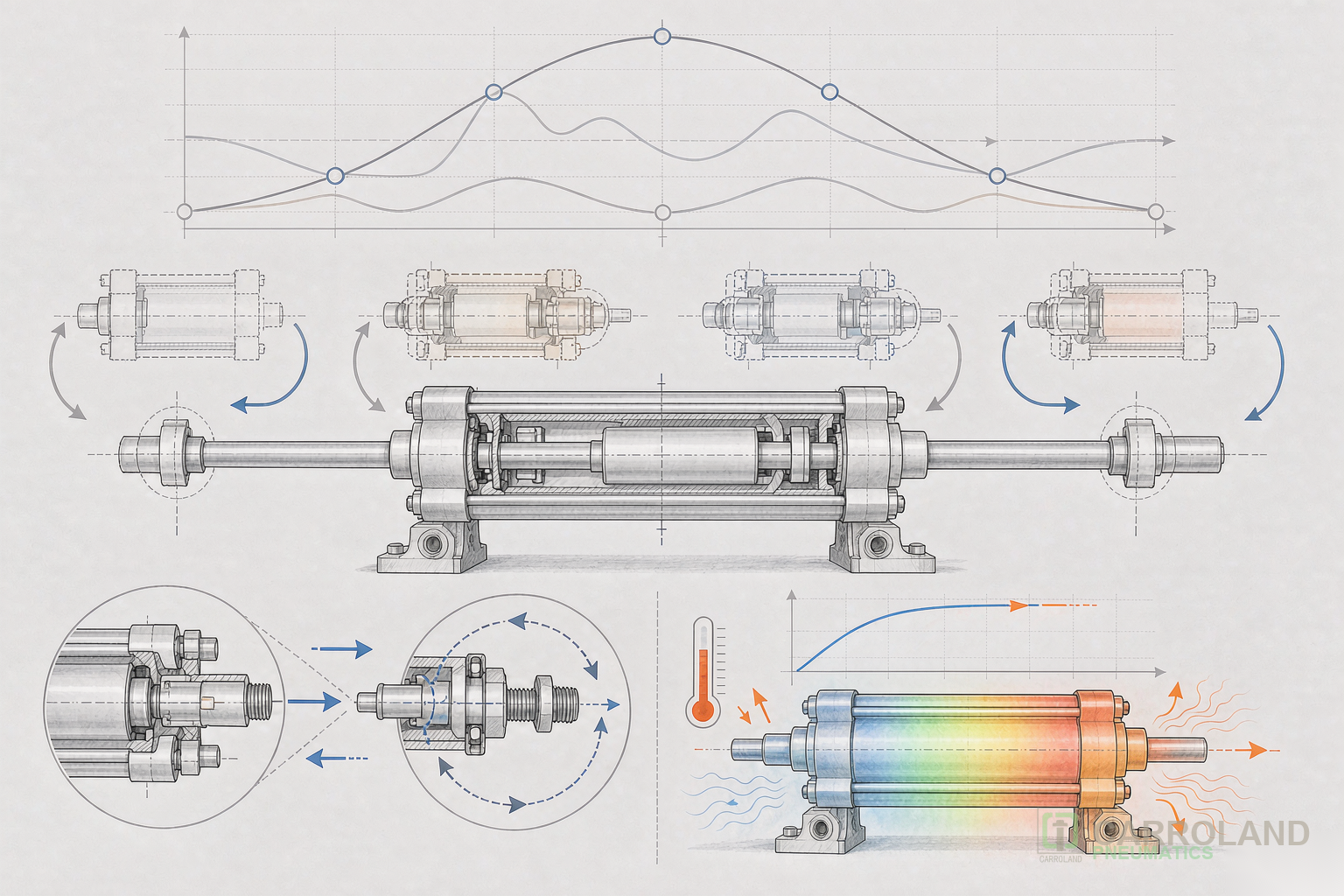
A continuous reciprocating pneumatic cylinder is a double-acting pneumatic cylinder that runs back and forth on a fixed cycle, with the control system providing the reciprocating logic rather than the cylinder itself. The “continuous” word refers to the duty pattern, not to a special cylinder geometry: any standard ISO 15552 double-acting pneumatic cylinder can be set up for continuous reciprocation. The engineering question is how the cylinder has to be built and supplied so that the reciprocating cycle does not overheat the seals, over-cycle the cushions, or starve the air supply.
Indian production engineers specify continuous reciprocation for conveyor transfers, indexing tables, labelling heads, and certain welding and assembly cells. Carroland Pneumatics supplies ISO 15552 and ISO 21287 cylinders for these duties, plus the matching solenoid valves and FRL modules that the reciprocating cycle depends on.
How a Continuous Reciprocating Cycle is Built
A continuous reciprocating pneumatic cylinder needs four things to keep running:
- A clean dry air supply at a stable pressure (typically 6 bar).
- A 5/2 way solenoid valve that flips the air routing on each cycle, or two 3/2 valves in alternating logic.
- Cylinder cushioning to absorb end-of-stroke kinetic energy.
- A position sensor or time-based controller to issue the direction-flip signal.
Without a stable air supply, the cylinder stalls or chatters. Without proper cushioning, the rod nose takes the impact on every cycle and the rod bearing fails early. Without an accurate direction-flip signal, the cycle shortens and the line stalls.
Why Cylinder Construction Matters for Continuous Duty
A continuous reciprocating cylinder is the same hardware as a standard ISO 15552 profile cylinder, but a few details matter more than they would in a less frequent duty cycle:
- Cushion profile: adjustable pneumatic cushions at both ends absorb the end-of-stroke kinetic energy. A missing or mis-adjusted cushion cuts seal life by 50% or more.
- Seal material: NBR seals for clean dry air, FKM for hot or oily air. The wrong seal material is the top reason a continuous-duty cylinder starts leaking after a few weeks.
- Magnetic piston: lets a magnetic-reed or solid-state sensor read the end-of-stroke position. Without it, the cycle relies on time-based logic and ends up either overshooting or wasting time.
- Surface finish on the rod: hard-chrome-plated, ground to a tight tolerance (Ra 0.2 to 0.4 µm). A rougher rod wears out the rod seal far faster.
| Cycle Frequency | Recommended Cylinder Class | Cushion | Sensor |
|---|---|---|---|
| Below 30 cycles/minute | Standard ISO 15552 double-acting | Standard cushion | Time-based logic acceptable |
| 30 to 90 cycles/minute | Standard ISO 15552 + adjustable cushion | Adjustable cushion required | Magnetic-piston position sensor |
| 90 to 200 cycles/minute | Compact ISO 21287 short-stroke | End-of-stroke rubber bumper | Solid-state position sensor |
| Above 200 cycles/minute | Special high-frequency short-stroke | External shock absorber | High-speed position sensor |
Building the Reciprocating Circuit
The parts of a pneumatic system that surround the cylinder must be sized for the cycle frequency. At 60 cycles per minute the FRL has to deliver dry air at 6 bar to a 32 mm bore cylinder four times a second; the supply line should be sized for at least 100 NL/min per cylinder, and the receiver tank should be 4× the cylinder swept volume to absorb the demand spikes. A 5/2 way pneumatic valve with a manual override plus a magnetic-piston sensor on each cylinder closes the loop. For two-cylinder alternating duty, the control logic is usually a flip-flop or a PLC timer. For three or more cylinders, the control logic moves to a PLC or a dedicated pneumatic sequencer.
Continuous Duty on Indian Production Lines
Three common Indian applications:
- Conveyor indexing: 32 to 50 mm bore, 50 to 100 mm stroke, 30 to 60 cycles per minute, ISO 15552 profile cylinder.
- Labelling head advance: 25 to 40 mm bore, 25 to 50 mm stroke, 60 to 90 cycles per minute, ISO 21287 compact cylinder.
- Pick-and-place transfer: 16 to 32 mm bore, 25 to 50 mm stroke, 90 to 180 cycles per minute, compact cylinder with rubber end-caps.
Each of these needs a matched FRL, a 5/2 way valve on a manifold, and at least one position sensor. Carroland supplies these as a coordinated package, with ISO 9001:2015 documentation and dimensional reports on every shipment.
Common Failure Modes and How to Avoid Them
- Seal blow-by: caused by misadjusted cushion or undersized supply line. Symptom: rod seal bubbles or slow leak.
- Rod bearing wear: caused by side load on the rod. Symptom: rod nose wobble visible at full extension.
- Cushing piston cracking: caused by impact loads at the end of stroke. Symptom: knocking sound at one or both ends.
- Sensor miss-fire: caused by coil voltage drop on long cables. Symptom: cycle stutter or direction flip missed.
Each is preventable with proper sizing and routine visual inspection. For deeper guidance, see the Pneumatic Cylinder Types Guide and the Solenoid Valve Working Guide.
FAQ
Is a continuous reciprocating cylinder a special cylinder?
No. Any ISO 15552 double-acting pneumatic cylinder can run in continuous reciprocation. The right cushion, seal, and sensor package is what matters.
How fast can a 32 mm bore cylinder reciprocate?
A standard 32 mm bore cylinder with adjustable cushion can run at 60 to 90 cycles per minute continuously. Compact ISO 21287 cylinders can run faster but with shorter strokes.
What air supply is needed for continuous reciprocation?
Clean dry air at 6 bar, sized to the cylinder swept volume. Add a receiver tank four times the swept volume to absorb the demand spikes.
Can Carroland supply a complete reciprocating package?
Yes. Carroland supplies the cylinder, the 5/2 way valve, the FRL, and the position sensor as a matched assembly with shared documentation.