What the Butterfly Valve Pneumatic Actuator Solenoid Valve Stack Does
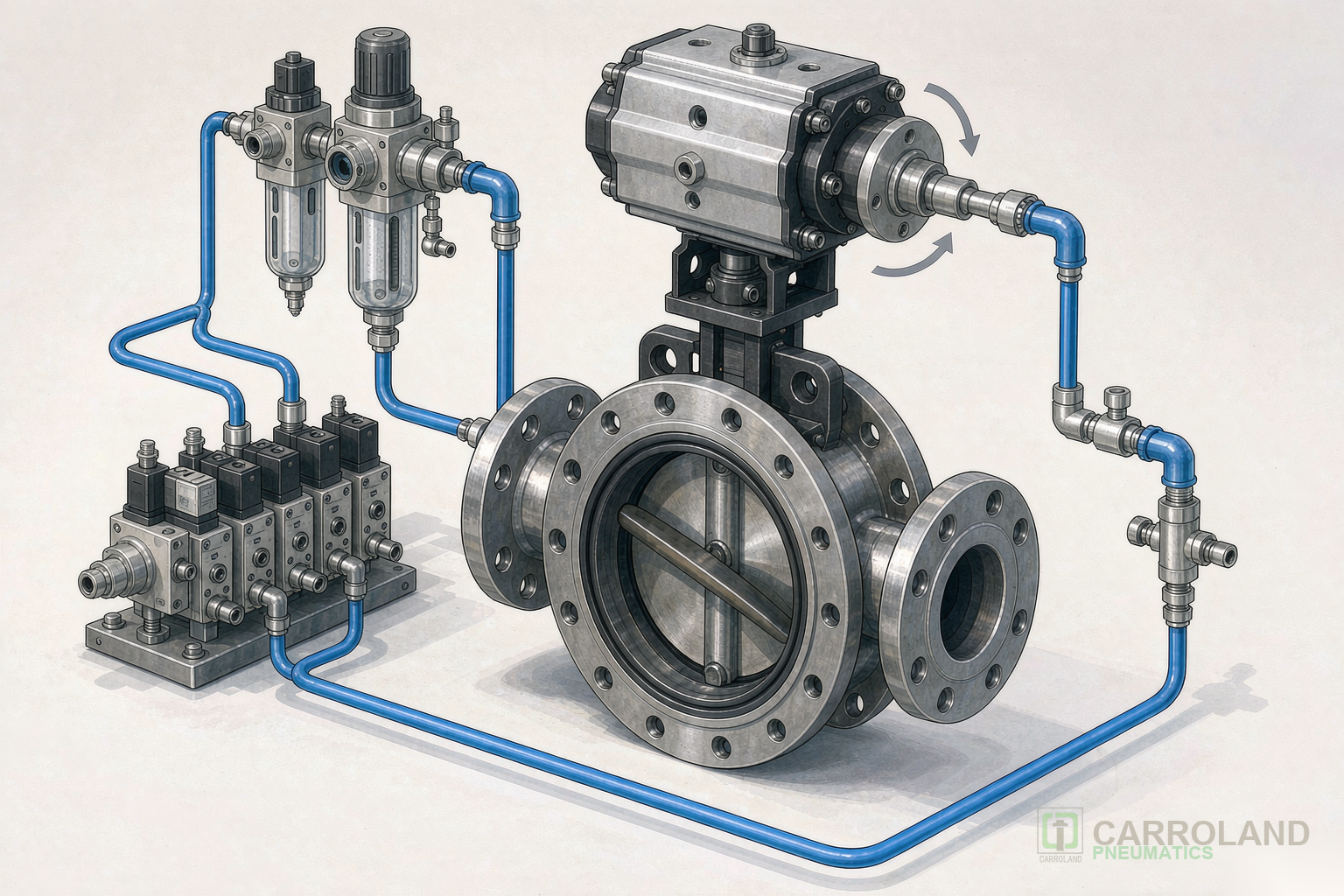
On a fluid line the butterfly valve pneumatic actuator solenoid valve stack is a compact way to combine flow shut-off, mechanical torque, and electrical control into a single skid. The butterfly valve gives on/off flow control with a 90-degree quarter-turn disc. A pneumatic actuator bolted on top of the valve converts air pressure into the rotational torque that drives the disc through that quarter turn. A solenoid valve on the supply line moves air into and out of the actuator ports so the actuator knows when to open and when to close. Without the pneumatic actuator, the butterfly valve is a manual handwheel. Without the solenoid valve, the pneumatic actuator has no air routing signal. Without the butterfly valve, neither component has a flow element to act upon.
Indian process plants use this stack on water lines, HVAC systems, and chemical dosing skids. Carroland Pneumatics supplies pneumatic actuators and solenoid valves for Indian skid builders and OEM machine manufacturers who need ISO-standard mounting and export documentation.
Main Components and Their Roles
- Butterfly valve: a disc that rotates 90 degrees between open and closed. Available in wafer, lug, and flanged body styles. Sizes DN 50 to DN 600 are common.
- Pneumatic actuator: a rack-and-pinion or scotch-yoke mechanism that converts linear air force into rotational torque. Double-acting uses air for both directions; spring-return uses air for one direction and a spring for fail-safe return.
- Solenoid valve: a 5/2 or 5/3 way valve that routes supply air to either side of the actuator. Usually 24 VDC for cabinet integration.
- Position feedback: optional limit switches or a positioner that tell the control system whether the disc is fully open, fully closed, or somewhere in between.
Why Use a Pneumatic Actuator on a Butterfly Valve
Compared with a manual handwheel, the pneumatic actuator adds speed, repeatability, and remote control. A typical rack-and-pinion pneumatic actuator turns the disc 90 degrees in 1 to 3 seconds at 6 bar. For an automation line, that speed is repeatable across thousands of cycles. For a chemical skid, the actuator can be tied to a direct acting solenoid valve signal and a positioner to land at intermediate angles for proportional control.
Sizing the Pneumatic Actuator Correctly
Actuator sizing has three inputs: the break-torque of the butterfly valve at the working pressure, the safety factor expected by the spec (commonly 1.5 to 2), and the supply air pressure (commonly 6 bar). Actuator torque is proportional to bore area times pressure. A DN 100 butterfly valve in water service typically needs 80 to 120 Nm torque; a DN 300 valve in slurry can need 800 to 1200 Nm. Add at least 30% margin if the fluid contains solids.
| Butterfly Valve Size | Typical Break-Torque (Nm) | Match Double-Acting Actuator (Nm) |
|---|---|---|
| DN 50 (2″) | 10 to 25 | 40 to 60 |
| DN 100 (4″) | 80 to 120 | 200 to 240 |
| DN 150 (6″) | 180 to 260 | 450 to 500 |
| DN 300 (12″) | 800 to 1200 | 2000 to 2400 |
How the Solenoid Valve Drives the Actuator
The solenoid valve supplies or vents air to the actuator ports. The common configuration uses a 5/2 way single solenoid valve for double-acting actuators or a 5/2 way valve plus a spring for spring-return actuators. The coil voltage typically runs at 24 VDC, 110 VAC, or 220 VAC. Power consumption sits between 2 W and 6 W for continuous-duty DC coils. For hazardous areas, the coil needs ATEX or PESO certification; for general industrial lines, IP65 is sufficient. The result is that the butterfly valve cycles as fast as the air supply and the PLC can deliver.
India-Specific Sourcing Considerations
Indian skid builders often import the butterfly valve from a domestic supplier and the pneumatic actuator and solenoid valve from an overseas supplier such as Carroland. The pneumatic actuator follows the ISO 5211 mounting interface, so it bolts to any butterfly valve with the matching flange. The solenoid valve follows ISO 5599 or NAMUR for the pneumatic port pattern, which makes cabinet integration straightforward. Documentation to expect from Carroland: ISO 9001:2015 certificate, material and dimensional certificates, pressure-test reports at 1.5x working pressure, and a packing list suitable for Indian customs.
For a deeper walk through valve selection, see our Solenoid Valve Working Guide. For pneumatic actuator duty cycles and double-acting cylinder selection, the double-acting air cylinder reference covers the matching force and stroke logic.
FAQ
What is the typical air pressure for an actuator on a butterfly valve?
Most rack-and-pinion pneumatic actuators are rated for 6 bar working pressure. Some heavy-duty actuators accept up to 8 bar. Always check the actuator nameplate before specifying air supply.
Do I need a 5/2 or 5/3 solenoid valve for a spring-return actuator?
A spring-return actuator only needs a 3/2 or 5/2 single-solenoid valve because the spring handles the return stroke. A double-acting actuator without spring needs a 5/2 dual-solenoid valve for hold-position when both ports are blocked.
Can Carroland supply an electromechanical actuator instead?
Carroland focuses on pneumatic actuators. For Indian customers who need electrical actuation, we typically supply a separate motorised actuator from a specialist supplier and integrate it into the cabinet ourselves.
What fail-safe position is recommended for a butterfly valve?
Spring-return actuators fail closed by default. If the line needs to fail open (for example, on a cooling-water dump line), specify a spring-return actuator with the air supply port on the opposite chamber. Add a manual override for maintenance.