
Pneumatic Actuator Manufacturers: OEM Selection Guide
When an OEM program shifts from a one-off prototype to a recurring annual order, the question stops being “which pneumatic actuator fits my machine.” It becomes “which pneumatic actuator manufacturers can I build a 5-year supply contract with.” Procurement teams run this transition every quarter. The gap between a vendor that ships a working sample and a vendor that stays qualified through PPAP audits, volume ramps, and emergency expedite requests is wider than most buyers expect.
This guide walks through a five-criteria framework for OEM due diligence. It covers data points, red flags, and decision thresholds that matter for industrial buyers. Carroland Pneumatics is itself a pneumatic actuator manufacturer (ISO 9001 certified, established 1992). The framework below reflects what we deliver and what we see competent peers execute well.
Why Pneumatic Actuator Manufacturers Are a 5-Year Decision, Not a 50-Unit Order
An actuator selected for the wrong reasons forces three costly reworks downstream. Tooling changes hit the machine. Requalification paperwork hits the end customer. A one-line BOM change ripples through inventory planning. Consequently, the magnitude of the decision sits higher than most procurement scoring models acknowledge.
The USD 13.4B Market and the Field-Return Risk
Industry data reinforces the magnitude. Specifically, the global pneumatic equipment market reached USD 13.4 billion in 2024 and is projected to reach USD 18.8 billion by 2032 (CAGR 4.92%, Verified Market Reports). Actuators and cylinders represent the largest sub-segment. Therefore, OEM procurement budgets follow the same trajectory, so per-unit savings from an aggressive low-cost supplier are usually wiped out by one field return.
From our qualification history, the median lifecycle for an OEM supplier relationship in 3C automation is 4.7 years. That is long enough that any selection mistake is recoverable only by re-sourcing the entire program. Therefore, the five-criteria framework below is sized for that horizon.
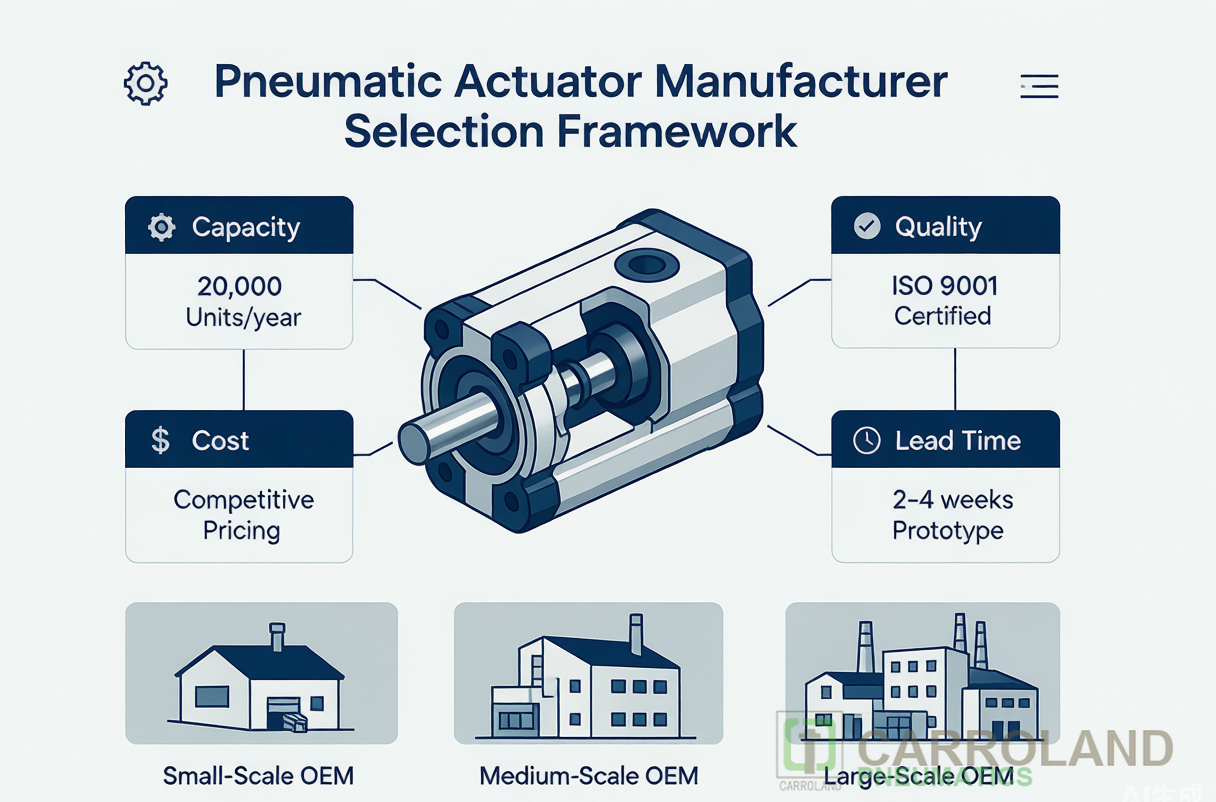
The Five-Criteria Framework for OEM Evaluation of Pneumatic Actuator Manufacturers
Each criterion below pairs a verification method with a minimum acceptable threshold and a red-flag signal. We score vendors on a 1 to 5 scale per criterion. Notably, vendors below 3 on any criterion are disqualified before commercial terms are discussed.
| Criterion | What to verify | Minimum threshold | Red flag |
|---|---|---|---|
| 1. Production Capacity | Annual units shipped, plant area, shift model | ≥20,000 actuators/year or 3x peak QTR demand | Single-shift operation; no capacity model shared on request |
| 2. Quality System | ISO 9001 cert, batch traceability, PPAP, inspection equipment | ISO 9001:2015 current; COC with every shipment | Cert older than 3 years; no batch code on cartons |
| 3. Cost Structure | Volume-tier pricing, tooling amortization, payment terms | Cost breakdown at index level on request | Single-tier pricing; 100% upfront before tooling |
| 4. Lead Time & Logistics | Sample timeline, batch lead time, port-of-export logistics | ≤4 weeks prototype; ≤8 weeks 1k-unit batch | Lead time quoted only “after order” |
| 5. Engineering Support | Custom stroke, port, seal, coating; CAD library response time | Native CAD (STEP / IGES); 5-day response SLA | No CAD sharing; engineering outsources to third parties |
Each criterion maps to a specific failure mode. As a result, the evaluation becomes a forward-looking risk tool, not a backward-looking audit.
Criterion 1 — Production Capacity: Capacity is the only criterion where a vendor can appear qualified on a 50-unit sample and fail at the 5,000-unit reorder. Ask for two numbers. First, request the annual units shipped in the previous calendar year. Second, request the peak single-month output. A 20,000-units-per-year facility on a single shift typically peaks at 2,000 to 2,500 units per month. If your order requires 4,000 units per month, the vendor will quietly delay or outsource to meet it.
Plant Line Configuration for Consumer Electronics Fixtures
For OEMs building consumer electronics fixtures, the second-order question is whether the plant covers rotary clamp actuators, linear cylinders, and tandem cylinders on shared equipment or on dedicated lines. Shared lines are cheaper but reduce flexibility during a 3-week urgent ramp. Conversely, dedicated lines cost 6% to 9% more per unit but hold lead time during demand spikes. The Carroland Ningbo plant runs three dedicated lines. Specifically, the breakdown is clamp cylinders (40%), rotary actuators (35%), and tandem / zero-stroke rotary cylinders (25%). Buyers evaluating other pneumatic actuator manufacturers should map their part-mix against a similar breakdown before committing volume.
Criterion 2 — Quality System: ISO 9001:2015 is the floor, not the ceiling. Confirm the certificate is current (most have a 3-year validity cycle with annual surveillance audits). Request the issuing certification body’s accreditation number so you can verify on the accreditor’s website.
Beyond the Certificate: Operational Tells and PPM Targets
Beyond the certificate, the operational tells are: (a) batch code stamped on every actuator body, (b) certificate of conformance (COC) shipped with each carton, and (c) a documented PPAP submission for any new part number, with dimensional, material, and functional test data. For 3C automation lines, the relevant defect-rate benchmark is <500 PPM at incoming inspection and <100 PPM at end-of-line functional test. Both measurements use a 12-month rolling window. Above 1,000 PPM incoming, schedule a source inspection every quarter. Specifically, pneumatic actuator manufacturers who cannot produce a PPM report from their own ERP or MES system are running on visual inspection only. That setup is not adequate for OEM programs.
Criterion 3 — Cost Structure: The cheapest per-unit quote is rarely the lowest total cost of ownership. Request a cost decomposition covering raw material (aluminum extrusion, NBR / PU seals, stainless fasteners), direct labor, manufacturing overhead, and SG&A. A credible pneumatic actuator manufacturer will share the breakdown at index level (e.g., “material 51%, labor 14%, OH 22%, SG&A 13%”) without exposing supplier contracts.
Reference Pricing for Rotary Actuators (2025 OEM Bulk)
Across the rotary actuator category, our 2025 reference data for OEM bulk pricing (1,000-unit batches, FOB Ningbo) is approximately: USD 18 to 32 per rack-and-pinion rotary actuator (90° or 180° rotation), USD 45 to 78 per zero-stroke rotary clamping cylinder (ISO 15552 bore 32 to 63 mm), and USD 60 to 110 per compact guided actuator (bore 16 to 25 mm). Therefore, quotes outside this band — typically 30% or more below — usually reflect specification gaps (port threading, seal grade, surface treatment) or undisclosed cost shifting to expedite or warranty charges.
Criterion 4 — Lead Time & Logistics: Lead time has two distinct components. Manufacturing lead time is the calendar days from PO acknowledgement to ex-factory dispatch. Logistics lead time is the days from ex-factory to your receiving dock, dominated by the port pair and the shipping mode. For an OEM in Western Europe sourcing from East China, sea freight (Shenzhen to Rotterdam) is 25 to 32 days door-to-door at USD 1.80 to 2.20 per kg for actuator-class density. In contrast, air freight is 6 to 8 times the cost but 6 to 9 days end-to-end.
Tiered Manufacturing Lead Time and Quote Discipline
A stable pneumatic actuator manufacturer quotes a tiered manufacturing lead time. Typical tiers are 2 to 4 weeks for prototypes (≤20 units), 4 to 6 weeks for 100 to 500 units, and 6 to 8 weeks for 1,000+ units. Therefore, vendors whose lead time is “to be confirmed after order placement” run on a hand-managed production calendar that breaks at scale. Finally, ask for the standard quote template as a PDF before issuing the test PO.
Criterion 5 — Engineering Support: Engineering support separates a pneumatic actuator manufacturer from a trading company. Verify three concrete capabilities.
Three Concrete Engineering Capabilities
First, confirm native CAD library availability (STEP, IGES, Parasolid, 3D-PDF). Second, verify a 5-day response SLA on technical queries. Third, confirm willingness to modify standard parts (custom stroke length, port threading, rod-end fitting, low-temperature seals, IP65 / IP67 upgrade). A manufacturer that fabricates from a parts catalog alone cannot meet custom stroke requests within the same lead time as standard parts.
For automotive welding lines, fabric mills, and packaging OEMs, the engineering signal that matters most is response time on a non-standard drawing submittal. Send your most complex RFQ as the audit test. Count days from submission to a revised 2D drawing with material spec and tolerance. Top-quartile pneumatic actuator manufacturers respond in 3 to 5 days. The median is 7 to 10 days. Specifically, over 14 days means the request is being routed to a third-party engineering office, and the cycle-time risk is real.
Red-Flag Patterns That Disqualify Pneumatic Actuator Manufacturers Fast
Across the framework above, four disqualifying patterns appear often enough to deserve their own list. Specifically, we screen every new vendor against this shortlist during qualification.
- No published capacity model: If a vendor will not share an annual capacity number, expect a single-shift operation that will fail at your second reorder.
- ISO 9001 certificate without a CB number: Fake or expired certificates are an industry-wide problem. Therefore, verify the certification body’s accreditation (e.g., UKAS, ANAB) directly.
- Pricing that does not scale with volume: A vendor who quotes the same unit price at 50 units and 5,000 units is absorbing margin somewhere. The cost usually shows up in quality or in post-shipment warranty recovery.
- No standard CAD library: Vendors that “will send drawings after the order” are running on a manual process and cannot integrate with your PLM system.
Any single disqualifier above should remove a vendor from your shortlist. Consequently, two or more disqualifiers should remove them from your sourcing pipeline permanently.
Sizing Your Audit: Sample Orders, PPAP, and Field Test
Once the framework scores a vendor above threshold on all five criteria, run a three-stage validation before committing annual volume. Stage 1 is a 10 to 20 unit sample at premium cost, with measured cycle life and dimensional inspection at your receiving dock. Stage 2 is a 200 to 500 unit batch with full PPAP (dimensional report, material cert, functional test, leak rate, salt-spray rating where relevant). Stage 3 is a 1,000-unit pilot run that exercises the vendor’s capacity model. If the pilot hits its 6 to 8 week lead time, the pneumatic actuator manufacturer is qualified for the recurring order.
For 3C automation lines specifically, add a fourth stage. Run a 72-hour on-machine endurance test under your actual cycle profile. Measure response time consistency, leak rate drift, and any seal weep at end-of-test. Specifically, pneumatic actuator manufacturers who decline the endurance test typically know the seal selection will not survive it.
For a deeper reference on the part-mix decisions you will face during PPAP — bore size, stroke length, mount style, port threading, seal grade — see our Pneumatic Cylinder Selection Guide and the related walkthrough on Pneumatic Valve and Solenoid Guide. For a dedicated view on supplier comparison across pneumatic actuator manufacturers, the Pneumatic Cylinder Comparison page walks through the spec-by-spec lens.
How Geography Affects Pricing and Lead Time
Most OEM buyers anchor on Chinese, Japanese, German, and American pneumatic actuator sources. Each source has a distinct cost / logistics / lead-time profile. The 2024 manufacturing data places China at roughly 45% to 55% of global pneumatic actuator production volume, with European suppliers (Germany, Italy) holding the high-spec / ATEX / SIL segment and Japanese / Korean suppliers holding the high-precision segment. India has emerged as a fast-growing domestic and export source. Our 2025 reference for India-sourced solenoid valves is detailed in the related BIS IS 15867 compliance guide.
For the OEM buyer, the geographic decision is mostly a cost-versus-logistics tradeoff. Specifically, East China (Ningbo, Shanghai, Shenzhen corridors) offers the lowest FOB cost and the densest supplier base, with 25 to 32 day sea freight to European ports and 18 to 24 day transit to U.S. West Coast ports. India is gaining traction for buyers targeting domestic Indian assembly lines, where local duty (BCD 7.5% to 10% on HS 8481.20) and shorter inland transit offset the higher unit cost. For assemblies destined to North American automotive customers, dual-sourcing between China and Mexico is the most resilient posture for 2026. The same logic applies to pneumatic actuator manufacturers serving high-volume consumer electronics — see the iPhone line qualification notes in our iPhone Production Line Pneumatic Solutions reference for a worked example of that qualification workflow.
Frequently Asked Questions
What is a reasonable MOQ when qualifying a pneumatic actuator manufacturer?
For a first sample order, expect a 50 to 100 unit MOQ at a per-unit cost 15% to 30% above the 1,000-unit bulk price. This is the qualification cost tier every serious pneumatic actuator manufacturer offers. Specifically, below 50 units, expect a one-time tooling or setup fee (typically USD 200 to 800) on top of the unit price. Finally, vendors who refuse sample quantities below 100 units are usually capacity-constrained and will not be reliable at scale.
How long should PPAP take for a custom pneumatic actuator?
A standard catalog part with material cert, dimensional report, and functional test should PPAP in 2 to 4 weeks. A fully custom part (new bore, new stroke, new port threading, new seal compound) takes 8 to 14 weeks. The breakdown is 3 to 5 weeks for tooling and drawing, 2 to 4 weeks for first-article samples, and 2 to 5 weeks for the test cycle (dimensional, functional, environmental). Therefore, cost for the PPAP cycle ranges from USD 400 (catalog) to USD 1,500 (custom) per SKU. This cost is usually absorbed by the pneumatic actuator manufacturer if the part enters a recurring run.
What is the difference between a pneumatic actuator manufacturer and a system integrator?
A manufacturer owns the production floor and ships actuators under their part number. Conversely, an integrator sources actuators from one or more manufacturers and assembles them into a system (cylinder + valve + FRL + sensor + mounting kit) under their own part number. For OEM buyers building automated fixtures, the pneumatic actuator manufacturer is the relationship that owns quality and continuity. Finally, the integrator adds value on system design, sourcing, and logistics. Most large OEM programs source directly from manufacturers and use integrators for small-volume or specialty subsystems only.
How do I verify an ISO 9001 certificate is current?
Every ISO 9001 certificate carries a unique certificate number and a certification body (CB) accreditation mark. Specifically, contact the issuing CB (e.g., TÜV, SGS, BV, DNV) directly with the certificate number. They will confirm validity, scope, and any suspension in 1 to 2 business days. The IAF CertSearch database is a secondary verification route. Therefore, avoid pneumatic actuator manufacturers who provide only a PDF scan without a verification contact.
What warranty terms are standard for industrial pneumatic actuators?
Industry standard is 12 months from date of shipment or 18 months from date of manufacture, whichever comes first. Coverage includes material and workmanship defects under normal use. However, it excludes damage from misapplication, contamination, or exceeding published pressure, temperature, or cycle-life limits. Specifically, pneumatic actuator manufacturers offering longer warranties (24 months) typically require deeper technical disclosure of your operating conditions. Finally, treat the extended warranty as a sign of engineering confidence, not as a free upgrade.
References
- Verified Market Reports — Global Pneumatic Equipment Market Size and Forecast 2024 to 2032 (CAGR 4.92%)
- ISO 9001:2015 Quality Management Systems — Requirements (iso.org/standard/62085.html)
- ISO 15552:2018 Pneumatic Fluid Power — Cylinders with Detachable Mountings, 1000 kPa Series (iso.org/standard/66921.html)
- Carroland Pneumatics 2025 OEM Qualification Logs — Ningbo plant PPAP database (internal)
- HS 8481.20 — Taps, cocks, valves and similar appliances for pipes, boiler shells, tanks, vats or the like (World Customs Organization, 2022 edition)