A cheap pneumatic cylinder is a recurring search from Indian procurement teams that need to keep fixture cost low without accepting random quality. The honest answer is that cylinder pricing is dominated by three line items — aluminium barrel stock, the piston-rod chrome-plating line, and the seal pack — and the cheapest credible cylinders on the Indian market source those same three components to a defined cost floor. Below that floor, something is being cut, and the article below explains where. Carroland Pneumatics supplies ISO 15552 profile-barrel cylinders to Indian buyers at the cost-engineered end of the market, with the documentation that audit-conscious Indian OEMs require.
What drives pneumatic cylinder cost
An ISO 15552 cylinder in a 50 mm bore, 100 mm stroke, double-acting magnetic configuration has a bill of materials that looks roughly like the table below. The numbers are illustrative for an Indian buyer’s benchmarking exercise; actual supplier pricing varies with order quantity, surface finish specification and seal compound.
| Component | Typical share of total cost | What the cheap option cuts |
|---|---|---|
| Aluminium barrel stock (extruded profile) | 22-28 % | Reverts to lower-grade 6063 alloy with thinner wall |
| End caps (front + rear, machined) | 15-18 % | Switch from forged to cast, or reduce machining passes |
| Piston rod (chrome-plated carbon steel) | 12-16 % | Drop to 0.5 µm chrome instead of 1.0 µm, or skip the plating on the rod end |
| Seal pack (NBR or PU) | 8-12 % | Move from branded NBR to generic compound, drop the wiper seal |
| Piston, magnet ring, fasteners | 10-14 % | Reduce magnet grade or skip magnetic option |
| Labour + assembly + test | 18-24 % | Skip 100 % pressure test, skip run-in cycle |
The cheapest credible pneumatic cylinder on the Indian market in mid-2026 sits around INR 2 800-3 500 for a 50×100 double-acting ISO 15552 cylinder in lot quantities of 50-100. Below INR 2 500 for that spec, the supplier has cut at least one of the items above — and the buyer should know which one.
Where cheap cylinders actually fail
Empirical failure data from Indian automotive and packaging customers shows four predictable failure modes in low-cost cylinders, and they line up exactly with the line items most often cut.
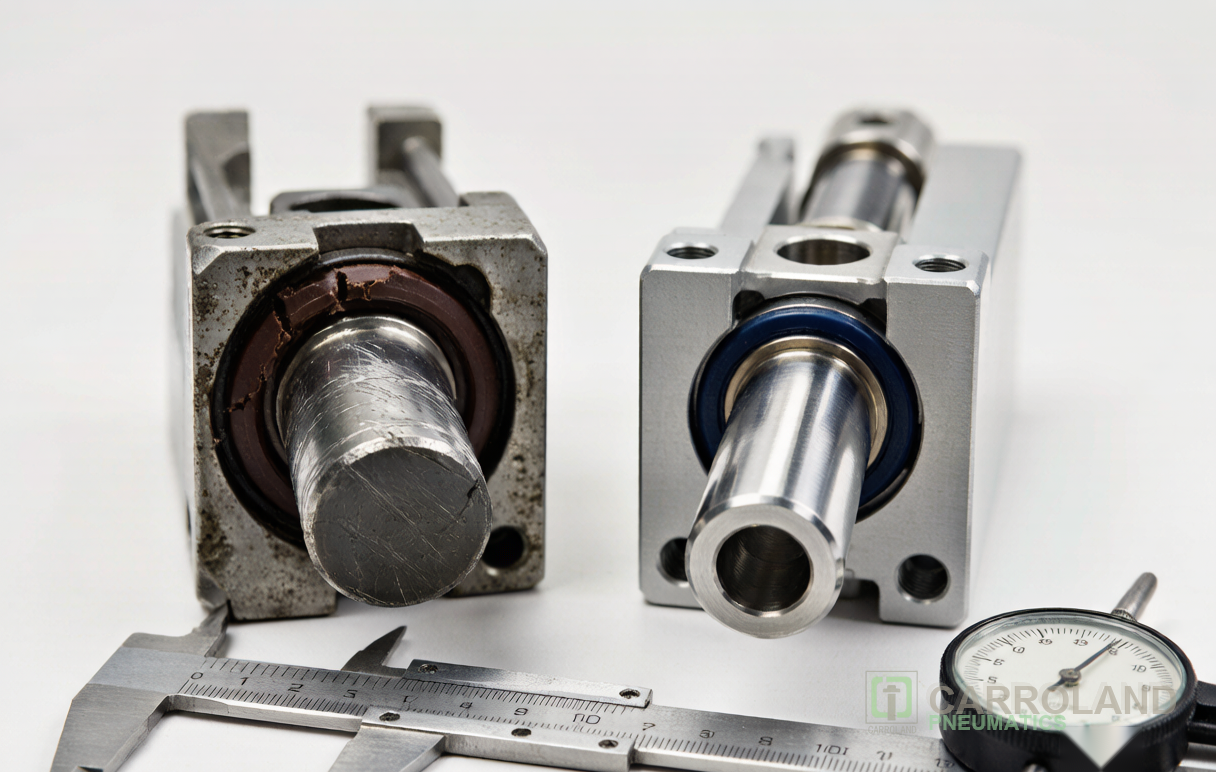
- Rod seal bypass inside 6 months. The seal is generic NBR rather than a branded hydrogenated nitrile (HNBR). The cheaper compound swells in oil-aerosol-contaminated air and loses compression set. The factory’s first signal is a slow drip at the rod end.
- Piston-rod scoring. The chrome plating is below 0.5 µm instead of the standard 1.0 µm. Once the thin plate wears through, the underlying carbon steel rusts within weeks, and the rust particles score the primary seal from the inside.
- Barrel porosity. Low-grade aluminium extrusion has microscopic porosity that passes air under pressure. The cylinder passes the factory leak-down test, then starts leaking at the seam within 500 hours of operation.
- End-cap thread pull-out. Cast end caps with reduced machining have thinner port threads. After 50-100 port retightenings, the thread strips. The cylinder cannot be repaired — only replaced.
The total cost of ownership question
A cheap cylinder that fails after 6 months and causes a 4-hour production stop has a fully-loaded cost to an Indian automotive line of around INR 35 000-60 000 (line stop + emergency replacement + electrician callout). Over a 3-year horizon, the “cheap” cylinder that fails twice costs more than the spec-grade cylinder that runs the full 3 years without service.
The honest calculation is straightforward. Take the cylinder purchase price, add the expected failure-rate × line-stop cost over the planning horizon, and divide by the planning horizon. The minimum-cost option is rarely the cheapest purchase price.
What Indian buyers should ask a low-cost supplier
Five questions filter out the uncreditworthy low-cost suppliers without needing a factory audit.
- What is the chrome plating thickness on the piston rod? A credible answer is 0.8-1.0 µm, verified by salt-spray test per ISO 9227. Vague answers or “as per industry standard” are a red flag.
- What compound is the seal pack? A credible answer is a named brand (Trelleborg, Parker, NOK) or a specific NBR/HNBR/FKM grade with a temperature range stated.
- Is the cylinder 100 % pressure tested at the factory? The honest answer is “yes, at 1.5× rated pressure for 30 seconds” with a documented test log.
- What is the dimensional tolerance on the bore? ISO 15552 specifies H7 tolerance on the bore (0 to +30 µm for a 50 mm bore). The supplier should be able to state this.
- Is the aluminium alloy 6063-T6 or equivalent? Cheaper extrusions drop to 6063-T5 or unspecified 6xxx-series alloy, with measurably lower fatigue life.
Carroland’s position on the cheap cylinder question
Carroland Pneumatics supplies ISO 15552 profile-barrel cylinders engineered to a defined cost floor — the same floor where every reputable Indian and Chinese OEM cylinder supplier lands. The cost engineering is in the supply chain (mill-direct aluminium stock, in-house chrome plating, vertically integrated seal sourcing) rather than in the material specification. Indian buyers get a cylinder with documented 1.0 µm chrome, branded NBR seal pack, 100 % pressure test and 12-month warranty — at a unit price inside the credible low-cost band. See the broader guide on pneumatic cylinders for the Indian market.
FAQ
What is the cheapest credible ISO 15552 cylinder in India?
For a 50 mm bore, 100 mm stroke, double-acting magnetic configuration in lots of 50-100, the floor in mid-2026 sits around INR 2 800-3 500 ex-works. Below INR 2 500 the buyer should assume at least one specification item has been cut.
How long should a cheap pneumatic cylinder last in India?
A spec-grade ISO 15552 cylinder in a benign Indian packaging-line environment typically runs 3-5 years between seal-pack replacements and 8-12 years before retirement. A genuinely cheap cylinder with cut specifications can fail inside 6-12 months.
Are Chinese-made pneumatic cylinders acceptable for Indian industry?
For general-purpose industrial applications, yes. The credible Chinese ISO 15552 cylinder makers supply into European, North American and Indian OEM lines under their own part numbers. The differentiator is not country of origin but the supplier’s willingness to publish material certificates, dimensional reports and pressure-test logs.
What is the most common cost-cutting mistake to watch for?
Skipping the wiper seal at the rod end. The wiper is the cheapest seal in the pack but the most important one for keeping lint, dust and moisture out of the cylinder. A cylinder sold without a wiper seal will fail prematurely in any Indian shop-floor environment.