

ISO 8573-1 Air Quality Classes: Specifying FRL for Pneumatic Systems
ISO 8573-1 is the standard that classifies compressed air purity by three contaminant groups — solid particles, water and oil — each expressed as a numbered class, with lower numbers denoting tighter limits. Specifying an air quality class is the step that turns a vague “clean air” requirement into a measurable acceptance criterion for the FRL (filter-regulator-lubricator) set and the downstream pneumatic equipment.
Most pneumatic failures traced back to “the air” are in fact specification failures: the system was built without a stated class, so filters were sized by habit rather than by requirement. This article sets out how to read a class designation, how to match it to an application, and where the FRL set does and does not solve the problem.
1. What ISO 8573-1 actually classifies
The standard treats compressed air purity as three independent contaminant groups rather than a single grade. Each group carries its own class number, and a complete specification names all three.
| Contaminant group | What it covers | Class numbering |
|---|---|---|
| Solid particles | Particulate carried in the air stream, characterised by size and concentration | Classes 1–5, with class 0 reserved for tighter limits agreed between supplier and user |
| Water | Moisture content, expressed as pressure dew point | Classes 1–6, with class 0 for tighter agreed limits |
| Oil | Total oil content, covering liquid oil, aerosol and vapour | Classes 1–4, with class 0 for tighter agreed limits |
The class number is a limit band, not a performance promise. A component described as “suitable for class 2” is a statement about what the component can tolerate or deliver under the standard’s test conditions — it is not a certificate that the installed system meets that class.
2. Reading a class designation
A complete designation names the three classes in the order particle : water : oil. Where a group is not specified, the specification is incomplete and the requirement is unverifiable, regardless of how the equipment was selected.
- A designation covering only particles leaves moisture and oil uncontrolled — the two groups most often responsible for seal swelling and valve stiction.
- A designation covering only oil leaves particle ingress uncontrolled, which is the usual cause of spool scoring in directional valves.
- Where a tighter limit than class 1 is needed, class 0 is used, but class 0 must be defined numerically by agreement between the supplier and the user; it has no default meaning.
Writing the three-part class into the purchase specification is what makes acceptance testing possible at commissioning.
3. Matching the class to the application
Over-specifying is as costly as under-specifying: tighter classes require more filtration stages, more drainage and more maintenance. The table below maps typical applications to the group that usually governs the decision.
| Application | Governing contaminant group | Consequence of under-specifying |
|---|---|---|
| General industrial automation (clamping, fixturing) | Solid particles | Spool scoring, cylinder scoring, reduced service interval |
| Outdoor or humid installations | Water | Corrosion, emulsion formation, winter freezing of drain lines |
| Food and beverage contact zones | Oil | Product contamination, seal incompatibility |
| Paint and coating lines | Oil and water | Finish defects, fisheye and craters |
| Instrument air and precision positioning | All three | Drift, stiction, inconsistent cycle timing |
4. Where the FRL set fits — and where it does not
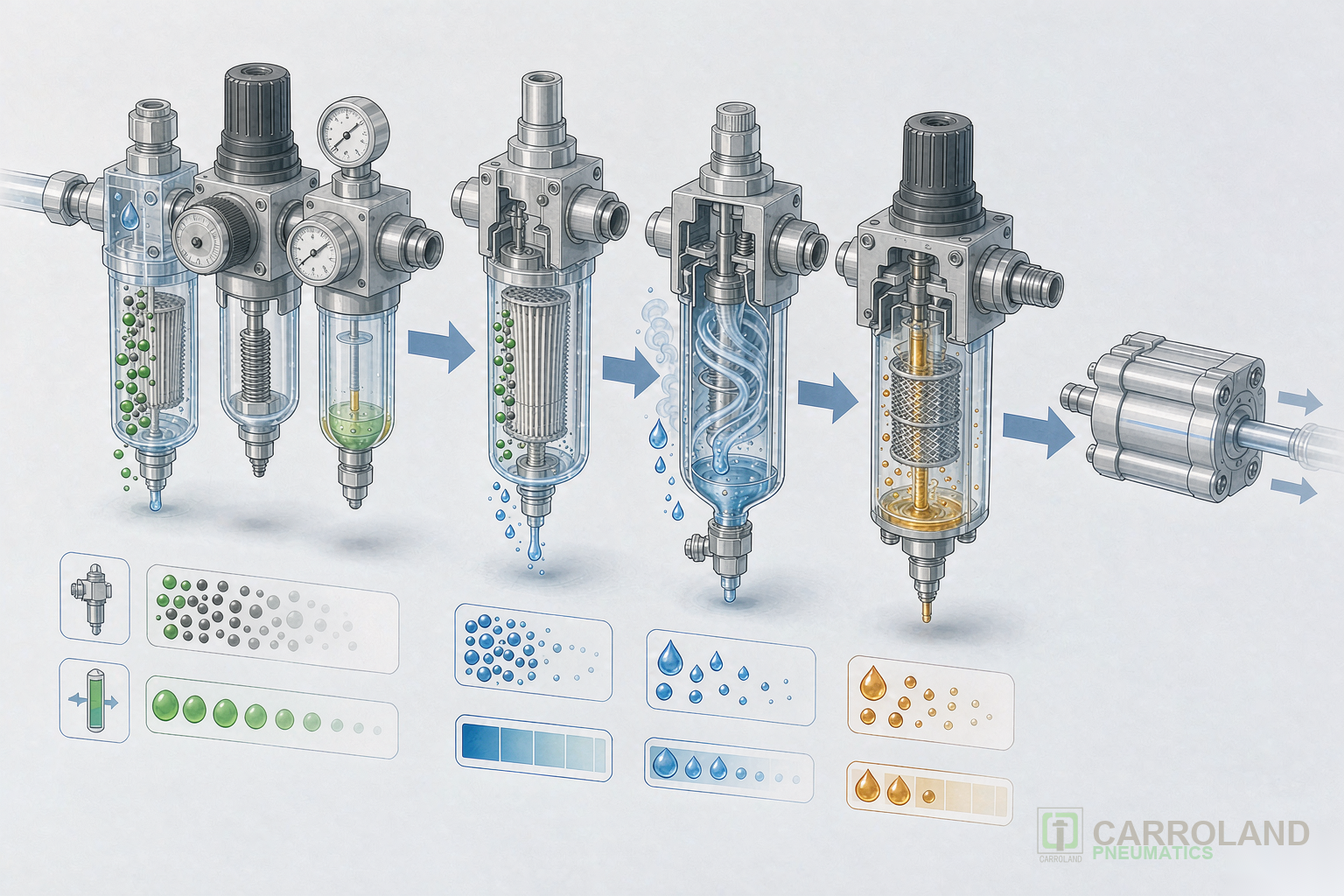
The FRL set addresses the supply side of the specification. Each element has a defined job, and none of them substitutes for a stated class.
- Filter — removes solid particles to the level the element is rated for; the rating must be matched to the specified particle class.
- Regulator — stabilises working pressure; pressure stability is a system requirement governed by ISO 4414, not by ISO 8573-1.
- Lubricator — introduces oil deliberately where the downstream equipment requires it; where the oil class is tight, a lubricator upstream of that equipment is a contradiction and must not be installed.
Where the required water class cannot be reached by a refrigerated or desiccant dryer downstream of the compressor, no filter in the FRL set will close the gap. Similarly, oil vapour requires adsorption, not coalescing filtration. The honest specification states which stage achieves which class, so that no single component is expected to For element-level sizing and configuration, our complete FRL air preparation unit guide covers the same three elements from the selection side.
5. Frequently asked questions
Is ISO 8573-1 a product certification?
No. It is a classification standard for compressed air purity. A component stated to be “suitable for” a class is a claim about the component under test conditions, not a certification of the installed system, and no certificate is issued by the standard itself.
Why must the designation name all three groups?
Because the three contaminant groups are independently specified in the standard. Naming only one leaves the others uncontrolled, and an incomplete designation cannot be verified at commissioning.
Does a lower class number always mean better air?
A lower number denotes a tighter limit band, yes — but class 0 has no default meaning and must be defined numerically by agreement. Specifying class 0 without that agreement creates a requirement that cannot be tested.
Summary
The practical sequence is: name the three-part class in the specification → select filtration and drying stages that each achieve the group they are responsible for → verify at commissioning against the stated class. A class written into the specification is measurable; a requirement stated as “clean, dry air” is not. The downstream payoff is component life: our pneumatic cylinder maintenance guide explains how seal material and air quality set service intervals.