
Complete engineering guide to pneumatic cylinder sizing calculations. Force formulas, bore selection tables, stroke length determination, cushioning calculations, and air consumption estimation for industrial automation.
Force Calculation
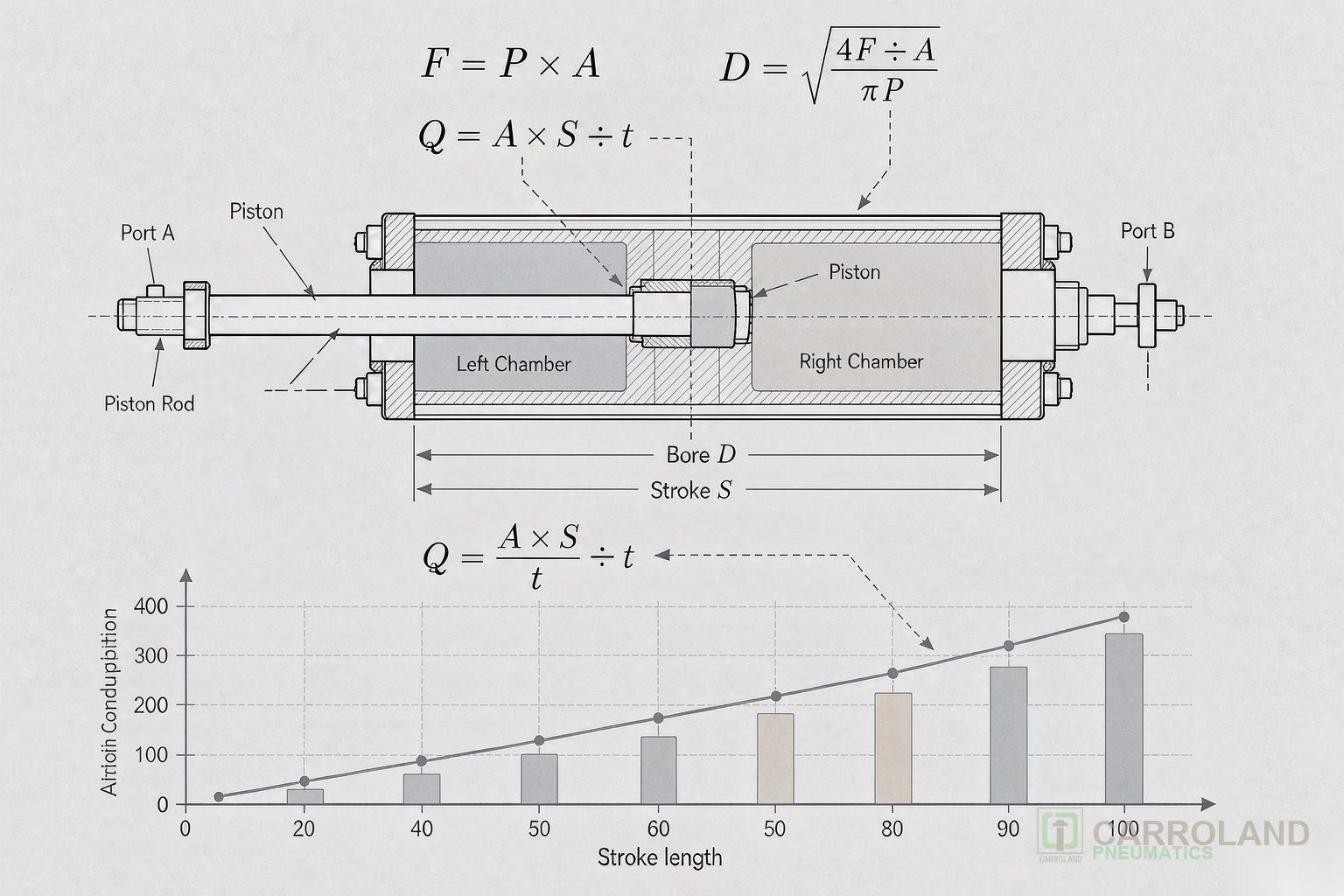
Theoretical force F = P × A, where P is operating pressure and A is effective piston area. For double-acting cylinders, extend force uses full bore area while retract force subtracts rod area.
Bore Selection
Select bore size based on required force plus safety factor (1.25-1.5 for dynamic, 1.5-2.0 for static applications). For a complete comparison of ISO 6432, ISO 15552, and compact cylinder types, see our pneumatic cylinder selection guide. Standard bores: 16, 20, 25, 32, 40, 50, 63, 80, 100mm.
Air Consumption
Q = A × S × N × P, where S is stroke, N is cycles per minute, P is absolute pressure. Accurate estimation helps size compressors and FRL units correctly, and directly informs solenoid valve selection for automation systems.
When evaluating double acting pneumatic cylinder wholesale price for volume procurement, buyers should compare total cost of ownership — not just unit price. A typical ISO 15552 double-acting cylinder from a Chinese manufacturer like Carroland offers OEM quality at 40-60% below European brand pricing, with wholesale discounts available for orders exceeding 100 units. Key factors affecting wholesale pricing include bore size (32mm to 200mm), stroke length, cushioning type (adjustable vs. rubber), and material (aluminum alloy vs. stainless steel). Request a volume quote with EXW or FOB terms for accurate cost comparison.
Selecting the correct pneumatic rotary actuator for conveyor system requires understanding both torque requirements and rotation angle specifications. Conveyor diverter gates, stop-and-go mechanisms, and pallet turning stations commonly use rack-and-pinion rotary actuators with 90° to 270° rotation angles. The critical sizing parameters include: required torque (Nm), operating pressure (typically 4-7 bar), rotation time, and load inertia. A typical conveyor diverter using a 200mm bore cylinder driving a 30kg package through 90° requires approximately 12-18 Nm of torque, matching to a 20mm rack-and-pinion actuator. Carroland’s CRA series rotary actuators deliver rated torque from 3 Nm to 120 Nm at 6 bar, compatible with inductive proximity sensors for position feedback in automated conveyor systems.
When sourcing a pneumatic cylinder with magnetic sensor manufacturer, buyers should verify three critical specifications: sensor type compatibility (reed switch vs. solid-state PNP/NPN), sensing distance (typically 2-5mm for T-slot cylinders), and repeatability (±0.1mm for precision applications). ISO 15552 cylinders with integrated T-slots for magnetic piston sensing are increasingly preferred over band-type or tie-rod mounted sensors, offering better alignment accuracy and reduced installation labor. Leading Chinese manufacturers such as Carroland supply their entire CAL and CRA series cylinder lines with pre-installed magnetic rings, compatible with industry-standard 8mm slot sensors from premium European brands (D-M9N), premium Japanese brands (SME-8), or universal equivalents, enabling seamless integration into existing automation systems without sensor bracket customization.