
Normally Closed Solenoid Valve: How NC Valves Work and When to Specify Them
A normally closed solenoid valve stays shut when de-energized and opens only when the coil receives current. This fail-safe behaviour makes the NC configuration the default choice for most pneumatic and fluid-power systems. In this guide, we explain how a normally closed solenoid valve operates, compare it with the normally open type, and show the selection rules engineers use on automated production lines.
What Is a Normally Closed Solenoid Valve?
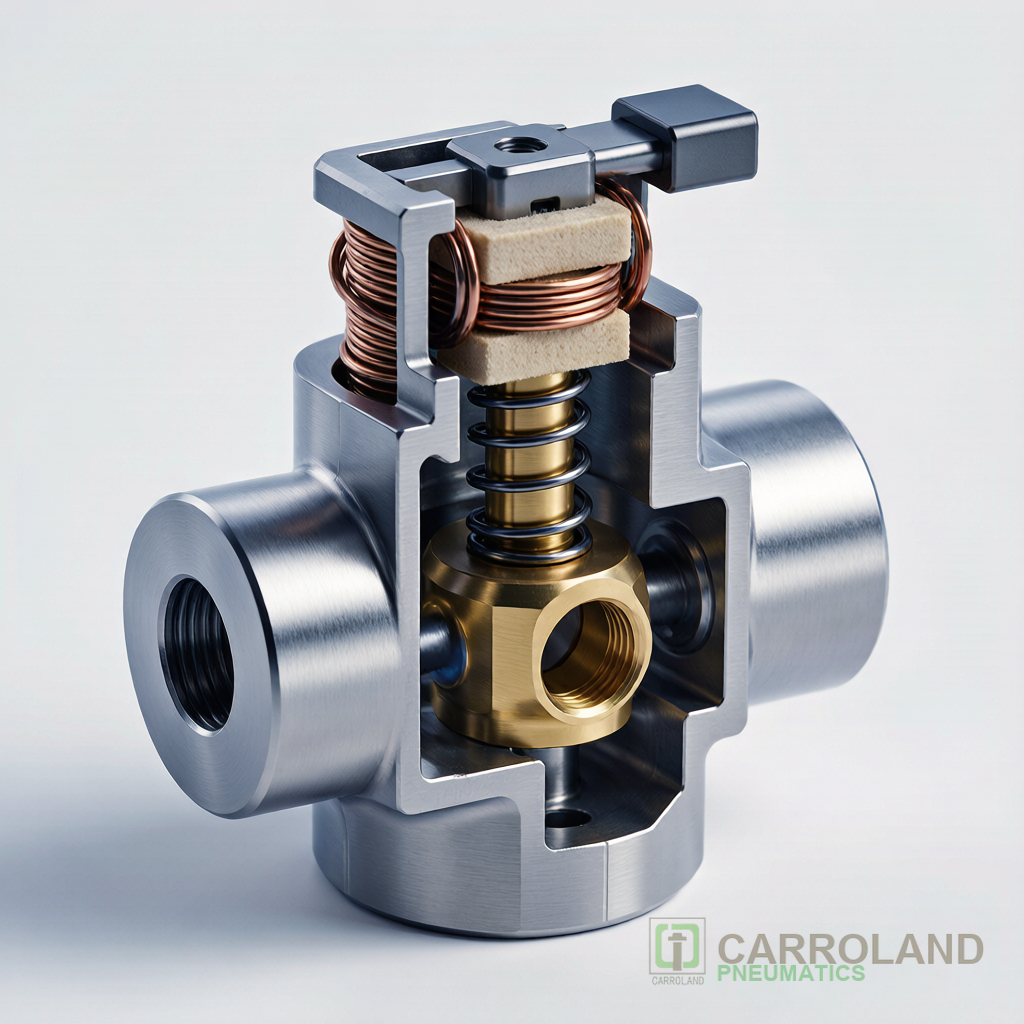
A normally closed (NC) solenoid valve blocks flow in its resting state. The spring-loaded plunger presses the seal against the orifice, so no medium passes until the solenoid coil is energized. When current flows, the magnetic field lifts the plunger and opens the path. Consequently, a power loss automatically returns the valve to the closed position.
This is why the “nc solenoid valve” abbreviation describes the same device: NC simply means normally closed. The term appears in datasheets, pneumatic circuit diagrams, and spare-part lists. For buyers, recognizing NC versus NO avoids ordering the wrong fail state for a safety circuit. In short, NC is the conservative default whenever an uncontrolled release would be unsafe.
How a Normally Closed Solenoid Valve Works
The mechanism has three clear stages. First, the de-energized spring holds the seal closed. Then, applying voltage builds a magnetic field in the coil. Finally, that field overcomes spring force and lifts the plunger.
According to ISO 15217-1, which standardizes solenoid actuator dimensions, the response time of a small NC valve typically falls between 5 ms and 30 ms depending on bore and pressure. In addition, the return spring guarantees the valve reseats even during a control-system fault. As a result, the NC type is the safest default wherever a loss of air or fluid would cause damage or injury.
NC vs NO: Which Configuration Should You Choose?
The choice depends on the failure mode you must protect against. For example, a coolant or compressed-air line should close on power loss to prevent flooding or uncontrolled actuation. In contrast, a purge or vent line often uses a normally open valve so it keeps flowing during a fault.
| Property | Normally Closed (NC) | Normally Open (NO) |
|---|---|---|
| Rest state (no power) | Closed (blocked) | Open (flowing) |
| Energized state | Open | Closed |
| Fail-safe behaviour | Stops flow on fault | Keeps flow on fault |
| Typical use | Coolant, clamp, air supply | Vent, purge, bleed |
Selection Criteria for an NC Solenoid Valve
Engineers specify an NC valve by matching four parameters. First, the port size and orifice must suit the required flow rate. Second, the coil voltage (12 V DC, 24 V DC, or 110/230 V AC) must match the controller. Third, the seal material needs compatibility with the medium, with NBR for air and oil and FKM for aggressive fluids. Finally, the duty cycle and ambient temperature define the coil rating. Specifically, continuous-duty coils need derating in hot cabinets above 50 °C.
Key Datasheet Parameters to Check
Before purchase, read the datasheet for these values:
| Parameter | Why it matters |
|---|---|
| Orifice diameter (mm) | Sets maximum flow (Kv) |
| Operating pressure range | Confirms it covers your line |
| Coil voltage and power (W) | Matches the PLC and thermal budget |
| Response time (ms) | Limits cycle speed |
| Seal material | Medium compatibility |
| Protection class (IP) | Dust and washdown resistance |
Installation and Wiring Tips
Mount the valve where the coil stays cool and dry. Moreover, use a surge-suppression diode on DC coils to protect the PLC output. In addition, label the port letters (P, A, R) on the manifold so maintenance staff reconnect correctly. Finally, torque fittings to spec to avoid micro-leaks that waste compressed air and lower line pressure.
Common Applications on Automation Lines
Normally closed solenoid valves appear wherever a fail-closed default improves safety. For instance, clamp circuits on a fixture hold the part only while energized, then release on e-stop. Similarly, dispensing nozzles stop adhesive flow the moment power drops. As a result, NC valves dominate pick-and-place, dosing, and isolation duties on 3C automation lines.
Troubleshooting an NC Valve
If the valve sticks open, check for debris on the seat or a weak return spring. However, if it never opens, test coil resistance and supply voltage first. Therefore, a multimeter reading outside the datasheet range points to a failed coil rather than a mechanical fault.
Frequently Asked Questions
Is a normally closed solenoid valve the same as an NC valve?
Yes. “NC” is the standard abbreviation for “normally closed.” Both terms describe a valve that blocks flow until the coil is energized.
Can an NC valve leak when closed?
A small seat leakage is possible if the seal wears. However, ISO 15217-1 classifies leakage limits, and quality seals keep passing rates within specification for millions of cycles.
What coil voltage should I choose?
Most automation panels run 24 V DC. Therefore, a 24 V DC NC coil is usually the safest match for PLC-controlled solenoid valves.
Can I use an NC valve for vacuum?
Yes, but confirm the seal and body rating. For vacuum duties, a direct acting type often performs better because it does not rely on line pressure.
Need a fail-safe pneumatic component for your line? Review our pneumatic component supplier evaluation framework or explore custom pneumatics for 3C automation. For valve selection by use case, see our solenoid valve application guide.
For the international standard, see ISO 15217-1 solenoid actuator dimensions.