
Single Acting Pneumatic Cylinder: Working Principle & Selection Guide
A single acting pneumatic cylinder generates force in one direction using compressed air and returns to its start position through an internal spring, external load or gravity. Engineers choose this design when the application demands simple clamping, ejection or positioning with minimal air consumption and lower component cost. In this guide we explain the working mechanism, compare single acting and double acting architectures, and provide a data-driven selection framework based on ISO 15552 and ISO 6432 standards.
How a Single Acting Pneumatic Cylinder Works
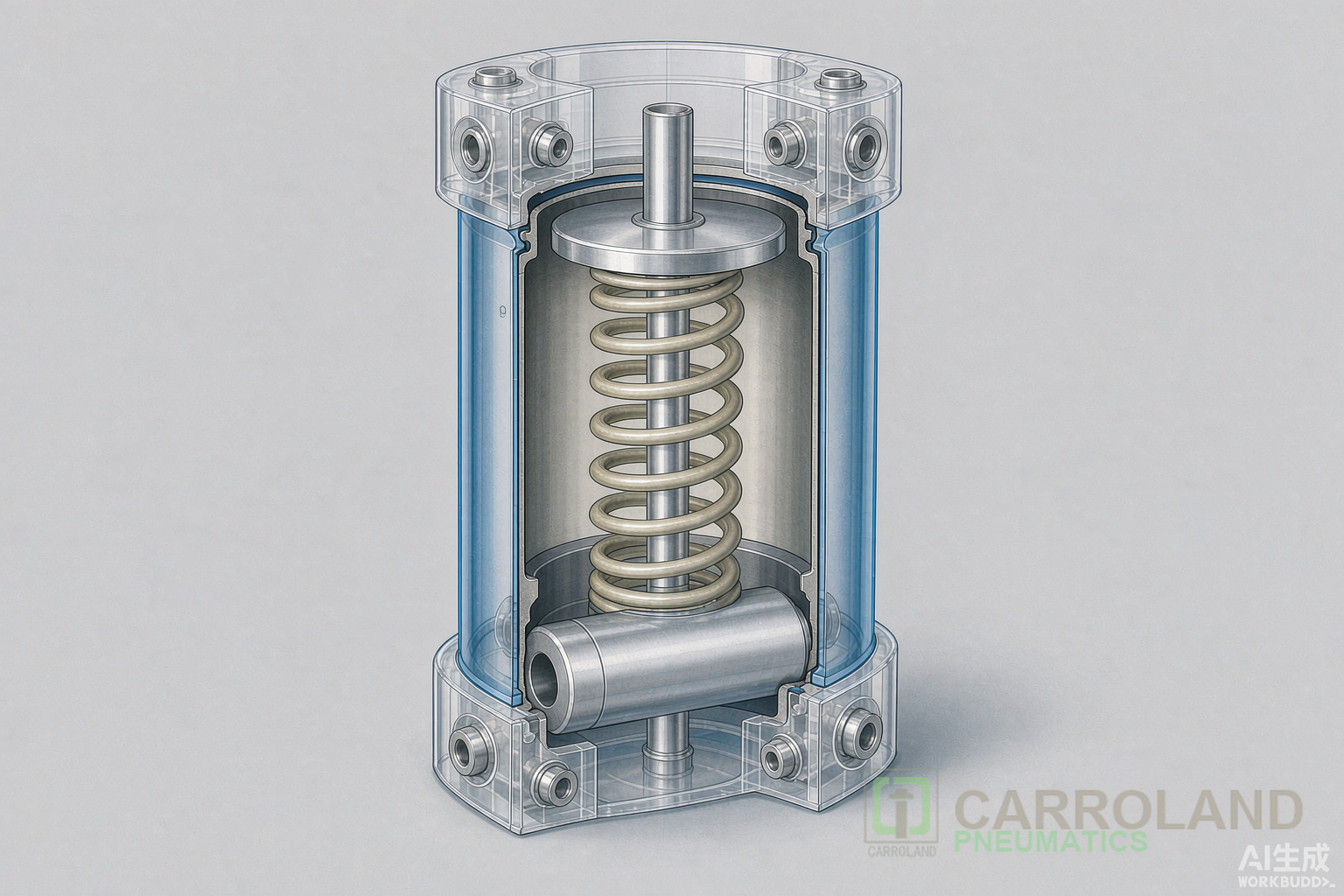
The core of an air cylinder working cycle is the conversion of compressed air pressure into linear mechanical force. In a single acting design, air enters through one port only. The pressure differential across the piston face produces thrust according to the formula F = P × A, where P is the supplied pressure in bar and A is the effective piston area in square millimetres. For a 40 mm bore cylinder at 0.6 MPa (6 bar), the theoretical extending force equals approximately 754 N.
Once the control valve exhausts the pressure chamber, the return mechanism takes over. The most common configuration is the spring return type: a coil or conical spring, preloaded during the extension stroke, pushes the piston back to the retracted position. Spring return force typically ranges from 10% to 30% of the air-driven extending force, which means the net available thrust diminishes as the spring compresses. For this reason, single acting cylinders suit short-stroke tasks where the load requirement is modest and consistent.
Alternative return methods include gravity return in vertical mounting orientations and external force return through mechanical linkages. Each method changes the effective duty cycle and response time. Gravity return eliminates spring fatigue but restricts mounting to rod-down configurations, while external force return requires an auxiliary mechanical system.
Cylinder Barrel Construction & Key Components
The pneumatic cylinder barrel is the central structural tube that houses the piston and guides the piston rod. Barrel inner diameter defines the bore size and therefore the force output. Surface roughness of the inner wall must remain below Ra 0.8 micrometres to minimise seal friction and prevent premature wear. Aluminium alloy extrusions dominate the ISO 15552 profile range (32 mm to 320 mm bore), while stainless steel or brass barrels appear in food-grade and wash-down environments.
Front and rear end caps close the barrel assembly. The rear cap contains the single air port and, in spring-return models, the spring seat. The rod-side end cap integrates a rod wiper, a polyurethane or NBR seal, and a plain bearing or ball bushing to guide the piston rod. A vent port, often labelled the R port or breather hole, allows the spring chamber to inhale and exhale freely during cycling. Engineers must protect this port with a sintered bronze filter to block particulate contamination.
Piston seals in single acting cylinders experience asymmetric pressure loading: the air side sees full system pressure, while the spring side operates near atmospheric pressure. Seal material selection therefore prioritises low-friction compounds such as filled PTFE or hydrogenated nitrile rubber (HNBR) for temperatures up to 80 degrees Celsius. Viton (FKM) variants extend the range to 150 degrees Celsius in high-temperature automation cells.
Single Acting vs Double Acting: When to Choose Which
Understanding the difference between a compressed air cylinder in single acting and double acting form is fundamental to system design. The table below summarises the engineering trade-offs.
| Parameter | Single Acting | Double Acting |
|---|---|---|
| Air ports | 1 | 2 |
| Force direction | Extension only (air); retraction by spring/gravity | Bidirectional (air on both strokes) |
| Typical cost | 60% to 80% of equivalent double acting unit | Baseline |
| Air consumption per cycle | ~50% lower (one chamber fill) | Two chamber fills |
| Maximum stroke | Usually under 100 mm (spring limit) | Up to 2,800 mm (ISO 15552) |
| Force consistency | Declines with stroke (spring preload) | Constant (both directions) |
| Mid-position control | Not possible | Possible with 5/3 valve + sensors |
| Fail-safe behaviour | Spring returns to home position on air loss | Stops at last position |
| Typical duty cycle | Moderate (spring fatigue) | 100% continuous |
Single acting cylinders win in applications that need automatic fail-safe retraction, simple two-position control and low air consumption. Double acting cylinders dominate where bidirectional force, long stroke and precise intermediate positioning are mandatory.
How to Select a Single Acting Pneumatic Cylinder
How to select pneumatic cylinder specifications for a single acting design follows a five-step process.
Step 1: Define the motion profile. Record the required stroke length, the cycle time and the orientation (horizontal, vertical rod-up or vertical rod-down). Vertical rod-down mounting can exploit gravity return and extend spring life, whereas horizontal mounting relies entirely on the internal spring.
Step 2: Calculate the theoretical force. Use F = P × (π × d² / 4) for the extending stroke, then subtract the spring preload force at the start of the stroke and the spring compressed force at the end of the stroke. The result is the net force available to move the load. A safety margin of 1.5 to 2.0 is standard practice to compensate for seal friction, pressure fluctuations and load inertia.
Step 3: Choose the bore diameter. Common ISO 6432 round body sizes are 8 mm, 10 mm, 12 mm, 16 mm, 20 mm and 25 mm bore. ISO 15552 profile cylinders extend the range from 32 mm to 320 mm. For light clamping in 3C automation, 16 mm to 25 mm bores are typical. For heavier ejection tasks in packaging machinery, 32 mm to 50 mm bores deliver adequate force margins.
Step 4: Verify the stroke limit. Spring length constrains the practical stroke of spring-return single acting cylinders. Standard catalogues list maximum strokes between 25 mm and 100 mm. Exceeding this range causes spring buckling and side loading on the piston rod. For strokes beyond 100 mm, engineers should switch to a double acting cylinder or specify a custom dual-spring design.
Step 5: Specify mounting and accessories. ISO 15552 defines foot, flange, clevis and trunnion mountings. Rod-end accessories include male/female threaded adapters, spherical rod eyes and fork joints. Magnetic piston bands enable reed or Hall-effect position sensing for PLC feedback loops.
Spring Return, Locking & Special Variants
The single acting spring return cylinder category splits into two subtypes. Spring-extend models (sometimes designated T-type) use air pressure to retract the rod against a spring that pushes the rod outward when pressure exhausts. Spring-retract models (S-type) use air to extend the rod and the spring to pull it back. S-type is more common in clamping fixtures because the retracted position is the safe default.
A locking air cylinder adds a mechanical brake or collet clamp that holds the piston rod in position regardless of air pressure status. This feature is critical in vertical lifting applications where a power failure must not allow the load to drop. Carroland supplies locking units as bolt-on modules designed to fit standard ISO 15552 tie-rod bodies, enabling retrofit without cylinder replacement.
Other special variants include high-temperature models with FKM seals for paint-shop lines, corrosion-resistant stainless steel barrels for marine environments, and low-friction designs with PTFE-lined barrels for delicate force control in electronics testing fixtures.
Round Body & Compact Designs
The round body air cylinder conforms to ISO 6432 and is characterised by a smooth cylindrical aluminium barrel, compact end caps and minimal overall length. Bores from 8 mm to 25 mm make these units ideal for dense automation layouts such as PCB testing stations, semiconductor pick-and-place heads and medical device assembly lines. Round body cylinders typically use non-repairable construction: the barrel is crimped or rolled into the end caps, reducing unit cost but preventing field seal replacement.
ISO 21287 compact cylinders bridge the gap between ISO 6432 miniatures and ISO 15552 full-size profiles. With bores from 20 mm to 100 mm and non-adjustable rubber bumper cushioning, these units fit tight machine frames without sacrificing the force output of a full-size actuator. Compact single acting variants are available in spring-extend and spring-retract configurations for packaging and textile machinery.
Industry Applications
As a cylinder actuator in industrial automation, the single acting pneumatic cylinder serves four primary use cases.
Clamping and fixturing: In CNC machining centres and assembly stations, single acting cylinders push clamp arms against workpieces. The spring-return default releases the part when air pressure drops, providing inherent safety during emergency stops.
Part ejection: Injection moulding machines and stamping presses use short-stroke single acting cylinders to knock finished parts out of dies. The brief extending stroke needs minimal air volume, and the spring automatically resets the ejector pin between cycles.
Sorting and diverting: Conveyor lines employ single acting cylinders to activate pneumatic paddles or gates that route packages to different lanes. The low duty cycle and two-position requirement match the single acting operating envelope perfectly.
Door and gate control: Enclosure doors on test rigs and protective covers on machine tools open via air pressure and close via spring return when the operator releases the valve. The spring ensures the protective cover closes even during air-supply interruptions.
FAQ
What is the maximum stroke for a single acting pneumatic cylinder?
Standard spring-return single acting cylinders offer strokes up to 100 mm. Beyond this length, spring buckling and side loading reduce reliability. For longer strokes, specify a double acting cylinder or a custom dual-spring design from your manufacturer.
Can I use a single acting cylinder in a vertical mounting with the rod facing up?
Yes, but the spring must overcome gravity during the return stroke. The effective spring force must exceed the weight of the piston rod assembly plus any attached tooling. If gravity exceeds spring force, the rod will not retract fully. In such cases, specify a stronger spring or switch to a double acting model.
How much air does a single acting cylinder save compared to a double acting unit?
Air consumption per cycle equals V = (π × d² / 4) × L × P_abs, where d is bore diameter, L is stroke and P_abs is absolute pressure. Because a single acting cylinder fills only one chamber, it consumes roughly 40% to 50% less compressed air than an equivalent double acting cylinder per cycle.
What seal materials suit high-temperature single acting cylinders?
HNBR handles continuous operation up to 80 degrees Celsius. For paint-shop or sterilisation lines up to 150 degrees Celsius, specify FKM (Viton) piston and rod seals. PTFE-filled compounds reduce stick-slip in low-speed precision positioning below 5 mm per second.
Does ISO 15552 cover single acting cylinders?
ISO 15552 primarily addresses double acting tie-rod and profile cylinders with bores from 32 mm to 320 mm. Single acting variants built on the same ISO 15552 footprint exist but are not explicitly standardised within the norm. For round body single acting designs, refer to ISO 6432 (8 mm to 25 mm bore).
How do I calculate the net force of a spring-return single acting cylinder?
Net extending force = (air pressure × piston area) minus spring preload force at the retracted position. Net force declines throughout the stroke because the spring compresses further. Use the minimum net force at full extension to verify that the cylinder can still move the load at the end of its travel.
What causes a single acting cylinder to extend slowly or not fully?
Common causes include insufficient air pressure (check regulator setting), an oversized load relative to net force, a weak or fatigued spring, a blocked breather port on the spring chamber, or excessive seal friction from dry or swollen seals. Inspect and replace seals every 5 million cycles under normal factory conditions.
Can I add position sensing to a single acting cylinder?
Yes. Order the cylinder with a magnetic piston band factory-installed. Mount a reed switch or solid-state Hall sensor on the exterior barrel groove. The sensor triggers when the piston magnet passes, providing a discrete position signal to the PLC. Ensure the sensor voltage (typically 5 to 30 V DC) matches your control architecture.
For more pneumatic system guidance, see our Pneumatic Cylinder Selection Guide and Pneumatic System Components overview. Carroland Pneumatics supplies ISO 15552 and ISO 6432 single acting cylinders with spring-return and locking options for automation lines worldwide.