
Pneumatic Actuator Price Guide 2026: Cost Drivers and MOQ
Pneumatic actuator price is the quoted unit cost of a compressed-air-driven actuator. In 2026 it spans three orders of magnitude: US$16–30 FOB for a commodity double-acting rack-and-pinion body, and US$100–10,000 for a complete valve-and-actuator assembly. Process certifications push the ceiling several multiples higher. B2B marketplace listings dated mid-2026 and distributor catalogues both document this spread. It is therefore the first number a sourcing engineer should internalize before comparing vendors. This guide breaks the quote into its measurable drivers: torque class, spring-return hardware, body material, certification, and accessories. Procurement teams can then benchmark quotations against data instead of instinct.
The market context supports this exercise. The global rack-and-pinion pneumatic actuator segment was valued at approximately USD 1,180 million in 2025. Market Research Intellect projects USD 2,080 million by 2035, a 5.8% CAGR. In mature markets, replacement demand accounts for 55–65% of annual unit volume. Most purchases are therefore re-specification decisions, and a disciplined cost model pays off quickly.
What Determines Pneumatic Actuator Cost
Pneumatic actuator cost is the sum of five specification decisions, and each one can be quantified before a supplier ever names a number. Five levers explain almost every quote delta a buyer will see on a request for quotation:
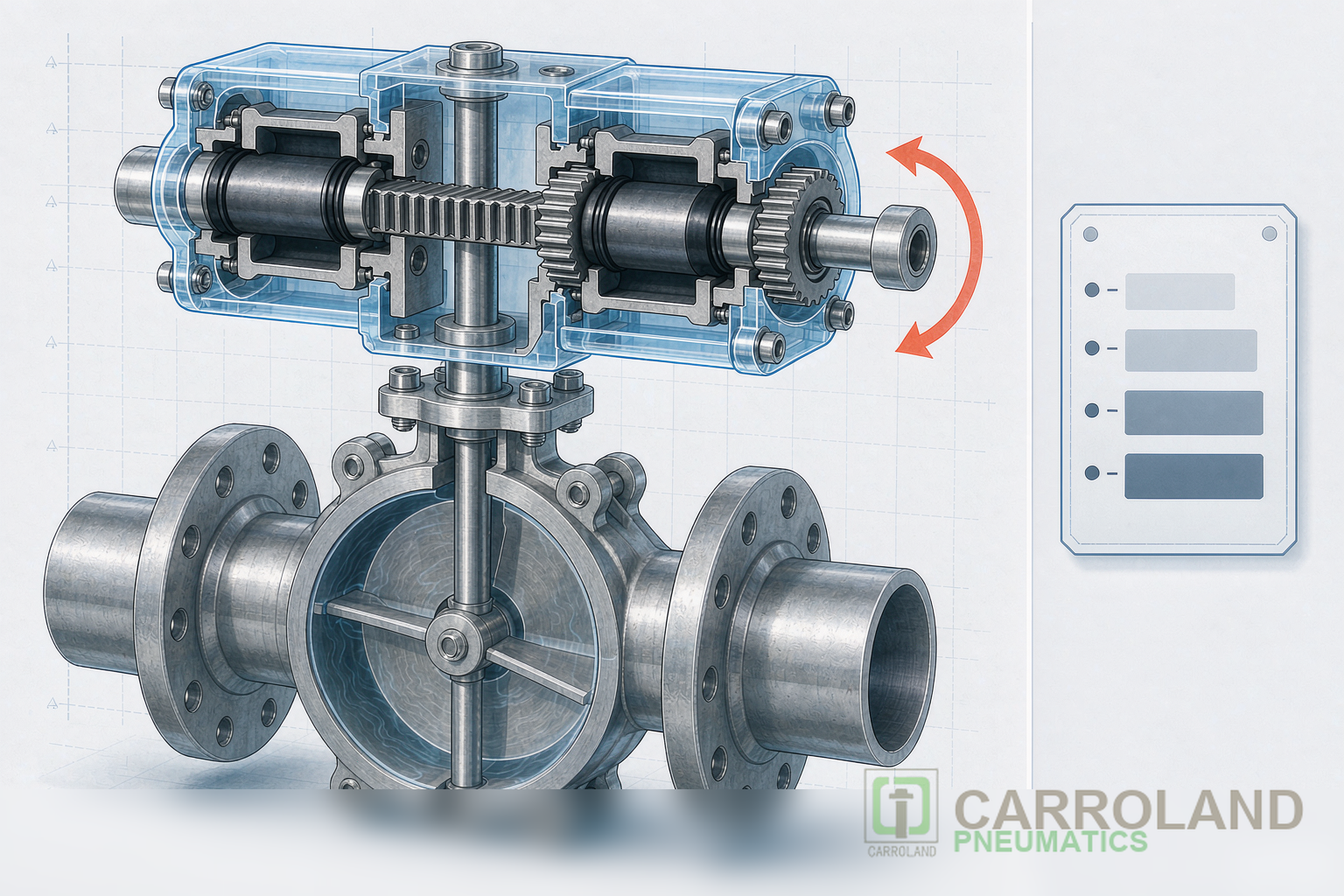
- Torque output. Breakaway torque at the valve seat sets the piston size. Hard-anodized aluminum rack-and-pinion bodies serve torque duties to roughly 2,500 Nm. Epoxy-coated iron or ductile-iron builds extend to about 5,000 Nm, and Scotch yoke mechanisms take over above that band.
- Spring-return vs double-acting. A spring-return fail-safe module adds a spring pack and roughly 15–30% to the body price in commodity builds. SIL-rated variants increase the gap considerably.
- Body material. Stainless or exotic-alloy bodies for sour service, offshore, or hygienic duty push the line item 2–5× above an aluminum equivalent before certification is even added.
- Certification stack. ATEX/IECEx for hazardous areas, NACE MR0175 for sour gas service, and SIL ratings for safety functions each add engineering, testing, and documentation cost.
- Accessories. Integrated positioners, digital fieldbus interfaces (PROFIBUS, Modbus, IO-Link), and IP66/IP67 sealing carry price premiums of 30–60% over baseline models, per 2026 UK market data.
flowchart LR
    A[RFQ received] --> B{Torque class?}
    B -->|below 2,500 Nm| C[Aluminum rack-and-pinion]
    B -->|2,500 to 5,000 Nm| D[Epoxy-coated iron]
    B -->|above 5,000 Nm| E[Scotch yoke]
    C --> F{Fail-safe required?}
    F -->|yes| G[Spring-return: +15-30%]
    F -->|no| H[Double-acting: base price]
    G --> I{Hazardous area or sour service?}
    H --> I
    I -->|yes| J[ATEX / NACE / SIL: 2-5x body]
    I -->|no| K[Accessories: +30-60% if positioned]
    J --> L[Final quote band]
    K --> L
Pneumatic Actuator Price Bands by Type and Torque Class
In valve automation, a price band is the dollar range that corresponds to one construction tier, and 2026 catalogue data places those tiers as follows:
| Construction | Torque class | Typical 2026 price | Notes |
|---|---|---|---|
| Compact rack-and-pinion, double-acting, cast aluminum | to ~2,500 Nm | US$16–30 FOB per piece | 1-piece MOQ on B2B listings |
| Spring-return rack-and-pinion | to ~2,500 Nm | +15–30% over double-acting | Fail-safe on air loss |
| Scotch yoke, double-acting, process grade | high breakaway torque | US$100–10,000 per set | Ball, butterfly, and plug valves |
| Stainless / alloy process builds | sour service | 2–5× aluminum body | Before ATEX/NACE/SIL |
| Distributor retail, spring-return, 51 mm bore | small bore | ~US$359 retail (list) | About 10× commodity FOB |
The last row deserves attention. A 51 mm spring-return rack-and-pinion unit listed at a New Zealand distributor costs about US$359 at retail. That sits roughly ten times above the Chinese commodity FOB floor, and the gap is mostly channel margin, local stock, and warranty handling — not hardware. Therefore, buyers who understand their own logistics and quality processes can decide consciously which parts of that premium they need.
The same construction logic applies to linear hardware. Double acting cylinder cost follows bore and stroke instead of torque. The material and certification multipliers remain nearly identical, which lets procurement teams reuse the same cost model across product families.
How MOQ and Contract Volume Move the Quote
MOQ pricing is the discount structure a supplier applies as order volume rises, and 2026 market data quantifies its effect with unusual precision:
- OEM contracts for 100 or more units per year achieve discounts of 10–20% off list prices.
- Service and validation add-ons — factory acceptance testing (FAT), material certification, extended warranties — add 5–15% to transaction values. They belong in the comparison, not in the fine print.
- One-piece MOQ is common on commodity B2B listings, yet the per-unit price at that tier is the least representative number on the page; volume tiers compress the curve quickly.
- Landed-cost factors remain elevated. Freight and customs clearance for imported units stabilized in 2026 but still run 20–30% above pre-pandemic levels. Currency movements alone have added 3–8% to effective prices in recent years.
A practical benchmarking method: pull a pneumatic cylinder price list china suppliers publish on B2B portals to set the floor for linear hardware. Then add your own freight, duty, inspection, and warranty line items. Use the list as a reference floor rather than a contract price, because unlisted specification changes — seal material, port size, cushioning — are exactly where cheap quotes fail.
Budgeting the Whole Actuation Package
An actuation package is the actuator plus every control component attached to its ports, and the budget should be assembled the same way. The actuator body is rarely the majority of the system cost once instrumentation enters the picture:
- Pilot and control valves. The solenoid price of the pilot stage is a small line item at commodity volume. The solenoid coil price for spare coils depends mainly on wattage and voltage class; 5–20 W coils at 24 VDC are the common range. Our solenoid valve cost guide benchmarks that pricing and MOQ in detail.
- Integrated valve assemblies. A butterfly valve with pneumatic actuator price spans US$100–10,000 FOB in 2026 listings, driven by valve size and actuator class rather than by the actuator alone.
- Grippers for 3C automation. Pneumatic gripper price scales with jaw force, stroke, and sensor options. For electronics assembly lines, cleanroom-compatible materials and switch integration are the usual premium drivers; our air grippers selection guide covers the trade-offs.
- Rodless actuators. Rodless pneumatic cylinder price carries a premium over round-body equivalents because of the sealing band and guide carriage — a mechanical complexity premium, not a margin trick.
As a result, comparing the cost of pneumatic actuator quotes in isolation invites false economies; two quotes can match on the actuator line and differ by 40% on the complete package.
How to Get an Accurate Quote in Five Steps
An accurate pneumatic actuator quote is a specification package that answers five questions before the supplier opens a price file:
- Calculate torque with a safety factor. Size for breakaway plus running torque with a 1.25–1.5 factor; undersized actuators fail at the seat, which costs more than the saving.
- Declare the fail-safe mode. State spring-return or double-acting explicitly; the 15–30% premium must be priced, not discovered.
- Specify material and media. Aluminum for neutral media and sheltered service; iron/epoxy for outdoor chemical duty; stainless for sour or hygienic service.
- List certifications as requirements, not wishes. ATEX/IECEx, NACE MR0175, and SIL each carry cost; listing only the ones the duty actually needs is the cheapest specification decision available.
- State annual volume and Incoterms. Quote at 100+ units per year to unlock the 10–20% tier, and compare FOB versus CIF on identical terms.
Buyers who want the upstream engineering context — torque matching, air supply sizing, duty selection — will find the selection logic in our pneumatic actuator types and standards guide. That guide also covers duty-cycle matching, which directly changes the spring-return decision above.
Frequently Asked Questions
How much does a pneumatic actuator cost in 2026?
Commodity double-acting rack-and-pinion bodies list at US$16–30 FOB per piece, while complete valve-and-actuator assemblies span US$100–10,000 per set. Stainless or certified process builds run 2–5× the aluminum body price before ATEX/NACE/SIL charges are added.
Why is a spring-return actuator more expensive than a double-acting unit?
The spring pack adds hardware and body volume, which raises the commodity build price by roughly 15–30%. SIL-rated variants increase that premium further because of testing and documentation requirements.
How much do volume discounts reduce pneumatic actuator price?
2026 UK market data shows OEM contracts for 100 or more units per year achieve 10–20% off list prices. Validation add-ons such as factory acceptance testing add 5–15% back if they are specified.
Which certification adds the most cost to a quote?
The combination of ATEX/IECEx with a SIL rating adds the most, because both require independent assessment and traceable documentation. NACE MR0175 applies specifically to sour service and usually arrives together with the stainless-body tier.