

ISO 15552 Pneumatic Cylinder Dimensions: A Reference Guide
Engineers specifying a 10 bar pneumatic cylinder for a global production line usually start from one document: the iso 15552 pneumatic cylinder dimensions standard, currently published as ISO 15552:2018 and reaffirmed at Stage 90.93 on 2025-02-04. This guide consolidates the dimensional reference data and shows how the standard functions as a compliance anchor for export-focused manufacturers serving India, Southeast Asia, and the European Union.
Carroland Pneumatics has built cylinders to ISO 15552 geometry since the standard was introduced as ISO 6431 in the early 1990s. We serve export-focused OEMs and contract manufacturers with geometry-aligned product lines, dimensional drawings, and conformity documentation — without claiming any in-country certification entity. That said, this guide is intended to be useful to any engineer, regardless of supplier.
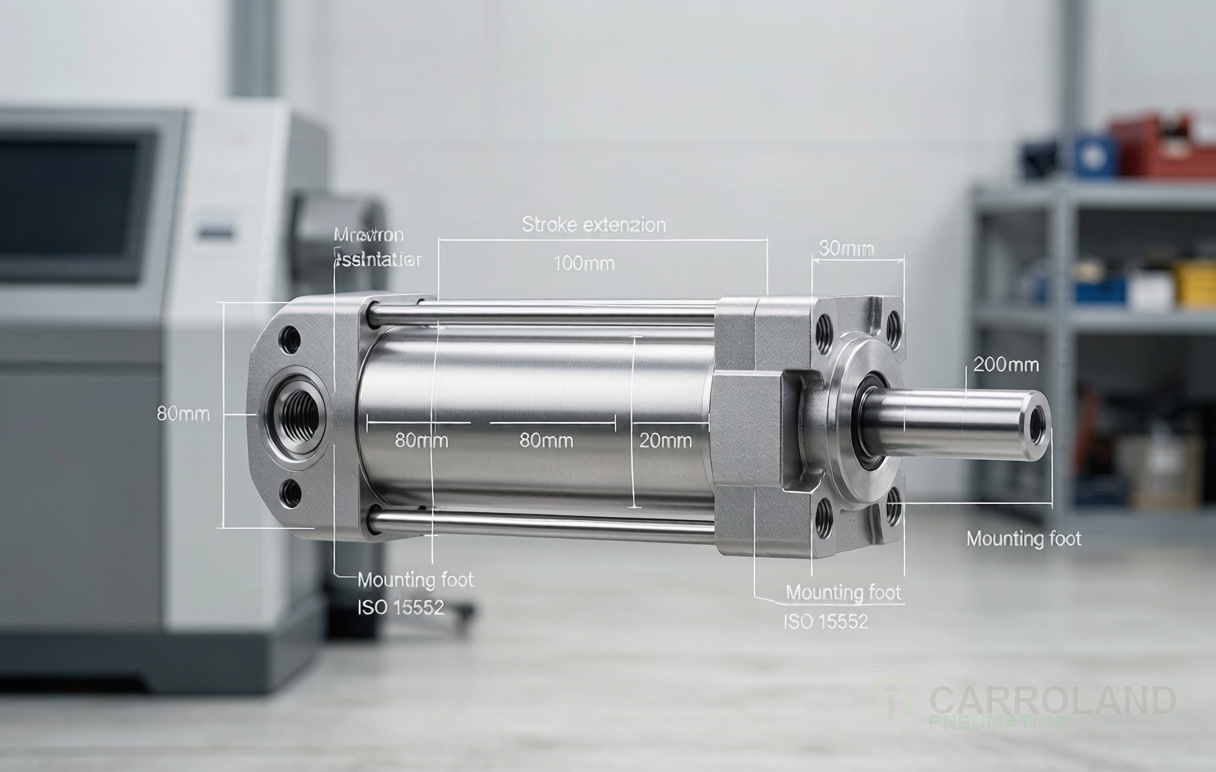
What ISO 15552 Specifies: Scope, Pressure Class, and Geometry Framework
ISO 15552 is the metric dimensional standard for pneumatic fluid-power cylinders with detachable mountings intended for a maximum rated pressure of 1 000 kPa (10 bar). The 2018 second edition (18 pages, ISO/TC 131/SC 3) covers single- and double-rod cylinders used in factory automation, with or without provision for magnetic position sensors. The original ISO 15552:2018 reference document is hosted on iso.org and is the authoritative source when disputes arise between supplier drawings and the published geometry.
Three design points make the standard uniquely useful across borders:
- Interchangeability: bore, stroke, rod, and mounting dimensions are fixed, so a cylinder sourced from one supplier can be replaced with another without re-engineering the manifold or fixture.
- Sensor readiness: the standard reserves a sensor slot on the barrel profile, so retrofits do not require machining the tube.
- Detachable mountings: flange, foot, trunnion, and clevis mounts share common geometric envelopes, which simplifies spare-part stocking for plants running multiple product families.
The 10 bar pressure class is the practical ceiling for general factory automation. Lighter-duty applications often drop to ISO 6432 (miniature series, 8 or 10 mm to 25 mm bore). Heavier-duty applications beyond 10 bar typically fall under non-ISO vendor-specific heavy series or hydraulic cylinders. ISO 15552 sits exactly in the productivity sweet spot, which is why it became the de-facto international reference.
ISO 15552 Standard Bore Sizes, Rod Diameters, and Force Ratings
The standard defines seven primary bore sizes — 32, 40, 50, 63, 80, 100, and 125 mm — and extends the family in commercial implementations to 160, 200, and 250 mm. The table below consolidates the bore-rod-thread geometry with the corresponding theoretical thrust at the 6 bar working pressure most factories use. For a deeper primer on force calculation, mounting options, and seal selection, see the complete pneumatic cylinder guide.
| Bore (mm) | Piston Rod (mm) | Rod Thread | Theoretical Force @ 6 bar (N) | Typical Application |
|---|---|---|---|---|
| 32 | 12 | M10x1.25 | 480 | Light assembly, small-parts handling |
| 40 | 16 | M12x1.25 | 750 | Clamping, light positioning |
| 50 | 20 | M16x1.5 | 1,180 | Material handling, medium-duty assembly |
| 63 | 20 | M16x1.5 | 1,870 | Heavy clamping, press operations |
| 80 | 25 | M20x1.5 | 3,020 | Heavy material handling, stamping |
| 100 | 25 | M20x1.5 | 4,710 | Large presses, heavy equipment |
| 125 | 32 | M27x2 | 7,360 | Very heavy applications, large machinery |
The theoretical thrust uses the formula:
Force (N) = Pressure (bar) × Piston Area (cm²) × 10
This formula is a starting point. Real-world thrust must deduct the rod area for the return stroke of a double-acting cylinder and account for friction losses (typically 3–10% depending on seal type) and pressure drop across the FRL unit. We typically design with a 1.5× safety margin above the calculated requirement.
Stroke Tolerance by Length
ISO 15552 specifies a stroke-tolerance window that depends on total stroke length. Most reputable suppliers follow the same window even when not explicitly asked:
| Stroke Range (mm) | Tolerance (mm) |
|---|---|
| 0 – 250 | 0 / +1.0 |
| 251 – 1000 | 0 / +1.5 |
| 1001 – 1500 | 0 / +2.0 |
Tighter tolerance is achievable on request but adds cost. If your application depends on a precise end position, the answer is usually position sensing, not tighter tolerance machining.
How ISO 15552 Geometry Aligns with IS 15867 for Indian Buyers
Indian buyers frequently reference IS 15867, which is the Indian Standard adoption of ISO 15552 for 1 000 kPa cylinders. Geometrically, a cylinder built to ISO 15552 dimensions is dimensionally aligned with IS 15867. The bolt-circle, foot-mount envelope, rod thread, and sensor slot all carry over. For the Indian-specific compliance pathway including the Foreign Manufacturers Certification Scheme, see our BIS IS 15867 compliance guide.
IS 15867 does not impose a mandatory certification by default, but two practical scenarios apply when ISO 15552-built product is in scope:
- Voluntary IS 15867 declaration: most general-purpose cylinders are supplied with manufacturer-declared conformity, including test reports and drawings. This is the standard route for Indian manufacturers importing cylinders from a foreign supplier.
- FMCS / ISI mark route: if a specific product category is brought under a Quality Control Order (QCO), foreign manufacturers must apply under the Foreign Manufacturers Certification Scheme and appoint an Authorized Indian Representative (AIR) to hold the licence on their behalf. Typical industry timelines run 10–12 weeks from sample arrival in India to licence grant.
From a planning standpoint, specifying to ISO 15552 / IS 15867 dimensions gives Indian maintenance teams a clear path to local replacement sourcing and avoids the lock-in that comes from cylinders built to non-standard geometry.
Export Compliance Pathways Built on ISO 15552 Geometry
Geometry is the foundation, but most export programmes also require a conformity statement. Three frameworks build on ISO 15552 dimensional data without changing the part.
CE Marking for the European Union
The Machinery Regulation (EU) 2023/1230 references EN ISO 15552 as one of the harmonised standards giving presumption of conformity for pneumatic cylinders used in machinery. A Declaration of Conformity, supported by test reports against EN ISO 15552:2018, typically accompanies each shipment. Buyers expect:
- EU Declaration of Conformity citing EN ISO 15552
- Technical file with bore, stroke, rod, and force data
- Material certificates for body and rod (EN 10204 3.1 typical)
CE marking is not a quality mark in itself; it is a regulatory statement that the part meets applicable directives. Pair the Declaration of Conformity with the OEM’s installation manual and the cylinder slots straight into a CE-marked machine.
ATEX for Explosive Atmospheres
Cylinders used in zones with combustible dust or gas require ATEX conformity under Directive 2014/34/EU. ISO 15552 builds the geometry layer; ATEX adds the ignition-risk assessment. Most general ISO 15552 cylinders are not ATEX-certified by default and the buyer must specify the requirement upfront — typically through a model code suffix.
BIS FMCS for the Indian Market
Where a Quality Control Order makes BIS certification compulsory for a specific pneumatic-component category, the Foreign Manufacturers Certification Scheme route applies. An Authorized Indian Representative holds the licence and acts as the local point of contact for surveillance testing. Lead times run 10–12 weeks on average for established product categories, longer for new applications.
Industry 4.0 Integration: Smart Sensors on ISO 15552 Cylinders
The global pneumatic cylinder market reached an estimated USD 1.34 billion in 2025, with a forecast CAGR of 4.92% lifting it to USD 1.88 billion by 2032. Asia Pacific accounted for the largest regional share (USD 496.9 million in 2025), and industrial automation and robotics applications represented 35.4% of 2025 demand. Within that growth, double-acting cylinders held 62.2% of the 2025 mix.
Three measurable shifts are reshaping the product category:
- Sensor adoption. More than 55% of new cylinder launches now ship with integrated position sensing or IO-Link-enabled feedback. ISO 15552’s reserved sensor slot is the reason retrofits do not require re-machining.
- Energy efficiency. Buyers increasingly specify low-friction seals and reduced breakaway pressure. With a typical industrial compressed-air system losing 20–30% of output to leakage, even a 5% reduction in actuator friction produces measurable savings.
- Compact footprints. In food processing, electronics, and pharmaceutical lines, compact cylinder variants are gaining share because they free up panel space without forcing a return to ISO 6432 dimensions.
Procurement Checklist for Export-Focused Buyers
A short checklist catches the dimensional mismatches that drive most cylinder returns.
- Confirm bore from force. Start from the load (N) and working pressure (bar). Apply a 1.5× safety margin, then round up to the next ISO bore. Oversizing wastes air; undersizing stalls under peak load.
- Specify rod end geometry. ISO 15552 defines the rod thread (M10x1.25 to M27x2). The mating clevis, eye, or fork must match the standard envelope, or custom machining becomes unavoidable.
- Lock the stroke tolerance band. For strokes ≤ 250 mm specify 0/+1.0 mm; for longer strokes specify 0/+1.5 mm or 0/+2.0 mm. Tighter tolerance costs more but is rarely needed if position sensing is in place.
- Decide the cushion need. Cushioning extends cycle life in high-frequency or high-inertia applications. Most catalogue cylinders offer adjustable pneumatic cushioning as standard.
- Pre-select magnetic sensing. The ISO 15552 barrel profile accommodates a magnetic piston and external sensor without modification. Specify this at order entry — adding it later requires a cylinder swap.
- List conformity requirements. CE / ATEX / BIS FMCS each add documentation tasks. Lock the requirement at the RFQ stage so the supplier can route through the correct inspection batch.
- Cross-check the supplier’s drawing. A 2D drawing with overall length, port position, and mounting envelope should accompany every quotation. Mismatch on a single dimension is the most common cause of integration delays.
Conclusion: Why the Standard Still Matters in 2026
ISO 15552 has held its place through three decades of factory automation evolution because it solves a narrow problem extremely well: cylinders from different suppliers must mechanically fit the same fixture. That interchangeability is what lets export-focused manufacturers serve multiple geographies with a single engineering bill of materials and lets maintenance teams source a local replacement without re-engineering the line.
For export programmes serving India, Southeast Asia, and the European Union, ISO 15552 geometry is the lowest-risk way to align with the Indian Standard adoption (IS 15867), the European Machinery Regulation (via EN ISO 15552), and most voluntary supplier-declared schemes. If we have shipped you a sample drawing in the past year, the dimensions still trace back to this standard. When evaluating competing suppliers, the pneumatic cylinder comparison framework helps separate geometry-aligned product from non-standard variants that look similar on paper but lock customers into a single vendor.
Frequently Asked Questions
What does ISO 15552 cover?
ISO 15552:2018 specifies the basic, mounting, and accessories dimensions for single- and double-rod pneumatic cylinders with detachable mountings, rated to 1 000 kPa (10 bar). It covers bores from 32 to 125 mm in the primary series and is the international dimensional reference aligned with Indian Standard IS 15867.
How is ISO 15552 different from ISO 6432?
ISO 15552 covers the larger 10 bar industrial series (32–125 mm primary bore). ISO 6432 covers the miniature series (typically 8–25 mm bore), used where space is tight and forces are modest. They are complementary, not competing, standards; a single application may use both depending on the actuator location.
Do I need BIS certification to sell ISO 15552 cylinders in India?
Most general-purpose ISO 15552 cylinders are not on the mandatory BIS list and ship with voluntary manufacturer-declared conformity. Check the live Quality Control Order list on the BIS portal for your specific product category. If the category is brought under a QCO, the foreign manufacturer must apply under the Foreign Manufacturers Certification Scheme and appoint an Authorized Indian Representative.
What is the relationship between ISO 15552 and IS 15867?
IS 15867 is the Indian Standard adoption of ISO 15552 for the same 10 bar pneumatic cylinder series. A cylinder built to ISO 15552 geometry is dimensionally aligned with IS 15867. In practice, the difference is a paper trail: IS 15867 documents show an Indian reference, while ISO 15552 documents show the international origin.