
Pneumatic Cylinder Magnetic Piston: Position Sensing Guide
A pneumatic cylinder magnetic piston looks identical to a standard piston from the outside, yet it decides whether the actuator can report its own position to a PLC. The difference is a ring of permanent magnet material bonded into the piston body, which allows a sensor clamped into the barrel groove to detect the piston without any mechanical contact. Carroland Pneumatics builds ISO 15552 profile cylinders and ISO 21287 compact cylinders with magnetic pistons as standard for Indian OEMs. This guide covers the sensor, the groove, the wiring and the failure modes that matter on a production line. European Technology, China Manufacturing, Since 1992.
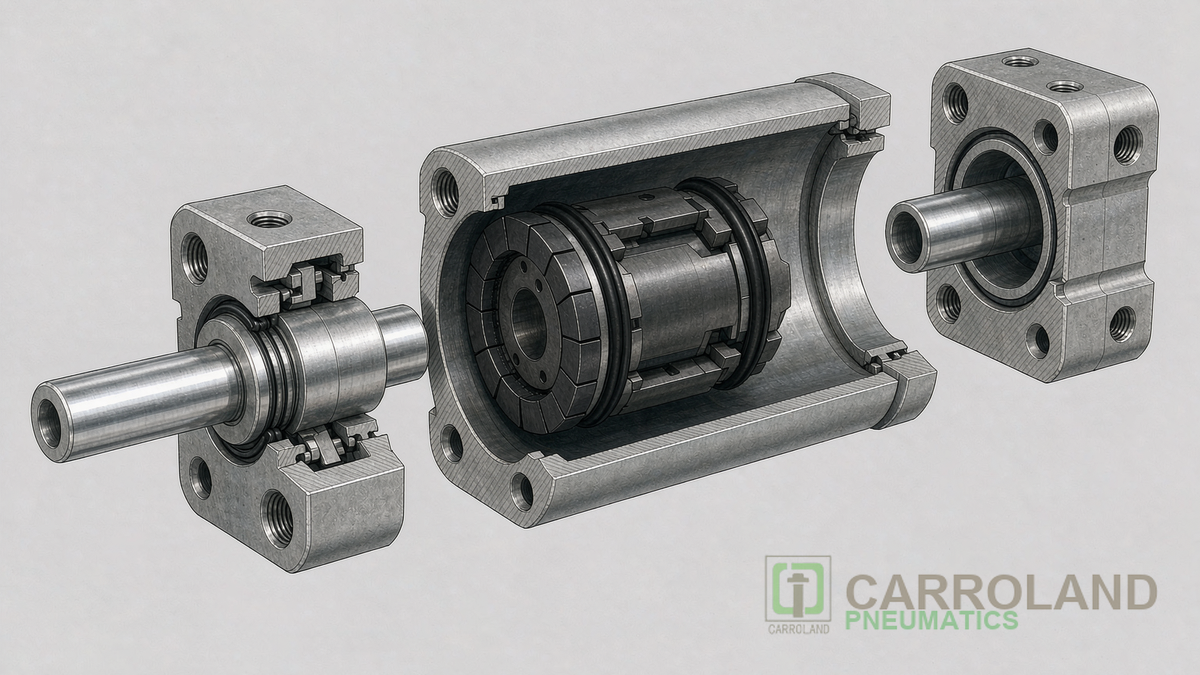
What the Magnet Inside the Piston Does
The magnet is an annular ring moulded or bonded into the piston, concentric with the bore. As the piston travels, the field around it moves along the barrel wall, and a sensor sitting in the barrel groove switches when the field strength crosses its operating threshold. Detection therefore depends on three variables that a buyer can verify in a datasheet: magnet grade and ring thickness, sensor sensitivity, and the wall thickness of the barrel. An extruded aluminium barrel a few millimetres thick is transparent to the field. A thick cast barrel or a stainless-steel tube is not. Position sensing on round stainless bodies therefore needs a purpose-designed sensor, not a standard groove sensor.
Magnet strength is also a safety-relevant parameter rather than a convenience. Sensors are usually installed to confirm full extension and full retraction. A signal that arrives a few millimetres early lets a controller sequence the next motion before the piston has reached the end cap.
Sensor Grooves on Standard Cylinder Barrels
ISO 15552 profile cylinders carry T-slots along the extruded barrel, and ISO 6432 mini cylinders accept sensors through a bracket. The groove does two jobs. It holds the sensor at a repeatable height above the piston magnet, and it lets the switch point be adjusted by sliding the sensor along the stroke. Typical groove-mounted sensors measure about 30 mm long, 4.7 mm high and 6.3 mm wide, which is small enough to fit between the tie rods of a profile cylinder without adding to the envelope.
Reed Switch or Hall Effect Sensor
A reed sensor contains sealed contacts that close when the piston magnet passes; a Hall effect sensor uses a semiconductor element and reports the field electronically. Reed types are inexpensive, work across a wide voltage range and are immune to electrical noise, but the contacts are mechanical and can chatter under heavy vibration. Hall sensors give sharper switching points, higher switching frequency and immunity to the magnetic crosstalk that occurs when two cylinders are mounted close together. For most Indian packaging and assembly machines, reed sensors meet the duty; for high-cycle indexing or servo-adjacent axes, Hall sensors avoid repeat nuisance faults.
The Pneumatic Components Around the Sensor
Position feedback only pays off when the rest of the pneumatic system components are specified to use it. A 5/2 solenoid valve with a 24 V DC coil and a PLC input card form the standard loop: sensor closes, PLC registers end of stroke, PLC releases or reverses the valve. If the valve is a spring-return type, the sensor also tells maintenance whether the pneumatic spring returned the spool. That turns an intermittent fault into a logged event, not a mystery stoppage.
Wiring and Voltage Practice on the Shop Floor
Sensors are sold in 2-wire and 3-wire versions. A 2-wire sensor is wired in series with the load and accepts 5 to 240 V AC or DC, which suits relay logic and retrofit work. A 3-wire sensor needs 10 to 30 V DC and provides a PNP or NPN output, the configuration a PLC input module expects. Whichever type is used, the sensor’s maximum power rating must be respected. Exceeding a 10 W ceiling in a 2-wire circuit damages the contact capsule, and a damaged reed sensor typically fails open, producing a silent miss rather than an alarm. An LED indicator on the body is worth the small extra cost because it converts a wiring fault into a visible one.
Where a Pneumatic Control Valve Fits the Sensing Loop
On a double acting air cylinder, the valve is what the sensor controls, so the two must be chosen together. A single acting air cylinder returns by spring and needs only a 3/2 valve, which means one end-position sensor instead of two and a shorter wiring run. Automotive and electronics buyers increasingly ask for IO-Link capable valve terminals, where the sensor signal travels back on the same communication line as the coil command, removing the separate input card. On the air preparation side, a filter-regulator unit is still required, and the ISO 8573-1:2010 purity class stated in the datasheet should match the filter grade installed.
Air Cylinder Parts That Change When Sensing Is Required
Three parts of the assembly differ from a non-magnetic build. The piston carries the magnet ring. The cushioning seals must tolerate the slightly altered piston geometry. The piston rod bearing stays the same, but the barrel must have the groove and the clearance for a sensor body plus its cable routing. Beyond the cylinder, a pneumatic valve actuator on the machine may also need a feedback switch. Buyers who specify sensing end to end therefore place one order for cylinders, reed switches and cable assemblies. Sourcing them separately risks a groove mismatch discovered at commissioning.
Applications on Indian Lines
In Tamil Nadu and Karnataka, magnetic-piston cylinders show up on SMT conveyor stoppers, tray indexers and end-of-arm tooling for electronics assembly. Cycle times of a few hundred milliseconds leave no room for doubt about the end of stroke. Automotive tier suppliers around Chennai and Pune use the same hardware for weld-jig clamping, where an unconfirmed clamp position stops the robot for safety reasons. Industry research puts electronics and semiconductor at the fastest-growing pneumatic end-use in India, expanding at roughly 14 to 18 percent a year. The sensing specification is becoming the default rather than an option.
Frequently Asked Questions
Can a reed switch be added to a cylinder that was ordered without a magnetic piston?
No. The magnet is inside the piston, so sensing requires a magnetic piston at the time of build. Retrofitting means replacing the cylinder. A magnetic piston can be specified at the time of order for a small price difference, and it belongs as standard on any axis whose position feeds a PLC.
How close can two magnetic cylinders work without false signals?
Crosstalk depends on magnet grade and sensor sensitivity rather than on a fixed distance. Hall effect sensors resist external fields better than reed types, and mounting sensors on the side facing away from the adjacent cylinder is the usual countermeasure in multi-cylinder fixtures.
What is the operating life of a cylinder position sensor?
A quality reed sensor is rated for more than 10 million switching cycles, with IP67 sealing and a working range of about -10 to 70 degrees Celsius. On a machine cycling 30 times a minute, two sensors per cylinder, that life translates into years of service. The cable strain relief and the mounting screw must be properly tightened at installation.
Continue with the pillar guide to pneumatic cylinder types for Indian manufacturers and the companion pages on aluminium profile cylinders and bore and stroke sizing. Dimensional conventions are published in the ISO standards catalogue, and Indian compliance questions start at the Bureau of Indian Standards.