
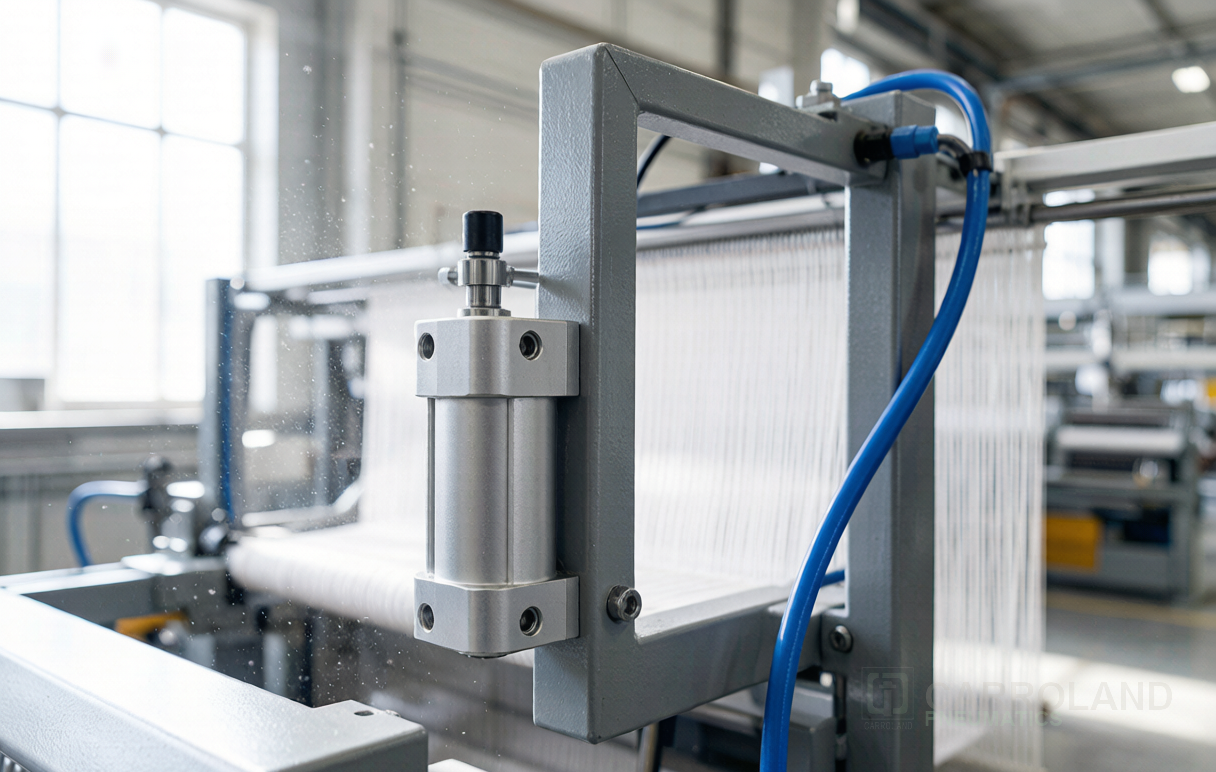
Textile mills in Coimbatore, Ludhiana, Bhilwara and Surat cannot afford a pneumatic cylinder failure mid-shift. The pneumatic cylinder for textile machine application sits in one of the harshest compressed-air environments on any Indian shop floor: airborne lint, fluctuating humidity from sizing machines, and continuous high-cycle operation that runs 20-24 hours a day during peak season. Carroland Pneumatics supplies textile-grade ISO 15552 profile-barrel cylinders and tie-rod cylinders engineered for these conditions, with optional high-temperature Viton seals rated to 150 °C for the drying-frame stations.
What makes a textile machine pneumatic cylinder different
A standard pneumatic cylinder fails in a textile mill for three predictable reasons. First, airborne lint migrates past the wiper seal and scores the chrome-plated piston rod within weeks, accelerating internal leakage. Second, sizing chemicals and silicone-based yarn finishes attack standard NBR (nitrile) seals, causing the elastomer to swell and lose compression set. Third, the high-cycle rate — typically 30-60 cycles per minute on a rapier or air-jet loom weft-insertion system — accumulates internal wear far faster than the same cylinder would see in a packaging line.
The fixes are well-understood and have been validated in the field for decades.
- Stainless piston rod instead of chrome-plated carbon steel. Grade SS304 or SS316 is more expensive but tolerates lint-induced scoring and the humidity cycling of a sizing room. Indian humidity routinely hits 80-90 % relative humidity for half the year.
- Viton (FKM) seals for hot zones. Stenter frames, heat-setting calendars and drying cylinders push ambient air past 120-150 °C. NBR is rated to roughly 80 °C; Viton holds to 200 °C. A Viton seal pack on the same cylinder body typically adds 12-18 % to the cylinder price but triples seal life in a hot zone.
- Magnetic piston with reed-switch position sensing. Most modern Indian looms run with PLC-controlled weft break detection and weft-feeder actuation. A magnetic piston lets the cylinder talk to a standard magnetic sensor mounted in the profile barrel without adding external limit switches.
India’s air-jet loom market and what it means for cylinder demand
India’s air-jet weaving machine market reached USD 348.26 million in 2025, capturing a 16.0 % share of the global segment, and is projected to reach USD 457.44 million by 2034 at a 3.1 % CAGR. The wider Indian textile machinery market is forecast to expand from USD 1.2 billion in 2025 to USD 2.1 billion by 2034 at a 6.02 % CAGR. The Indian Union Budget for FY 2025-26 allocated INR 5 272 crore to the Ministry of Textiles, a 19 % increase year-on-year, with a five-year Cotton Mission aimed at lifting cotton productivity.
Each modern air-jet loom typically uses 8-14 pneumatic cylinders per machine — for weft insertion relay nozzles, weft-feeder drives, selvage trimmers, let-off motions and take-up rollers. A single mid-size Indian mill running 200 air-jet looms is therefore maintaining roughly 2 000 cylinders on a continuous duty cycle.
Sizing the cylinder for a loom weft-insertion system
Weft-insertion on an air-jet loom requires a short, sharp actuation — typically 30-50 mm stroke, fired in 50-80 ms. The cylinder needs to deliver consistent acceleration across the stroke even as the supply pressure dips during the mill’s morning start-up. Use the table below as a starting point.
| Loom function | Typical stroke (mm) | Recommended bore (mm) | Operating pressure (bar) | Cycle rate (cycles/min) |
|---|---|---|---|---|
| Weft-feeder drive | 40-50 | 32-40 | 5-6 | 30-45 |
| Selvage trimmer clamp | 25-30 | 25-32 | 5-6 | 20-30 |
| Let-off motion brake | 50-80 | 40-50 | 5-6 | 10-20 |
| Drop-wire picker | 20-30 | 20-25 | 4-5 | 40-60 |
| Stenter frame latch | 50-100 | 50-63 | 6-8 | 5-10 |
The dust-resistance question
The single most common failure mode in an Indian textile mill is wiper-seal bypass. Once lint gets past the wiper, it scores the rod in a straight line, the scored rod cuts the primary lip seal, and the cylinder starts leaking at the rod end. The mill’s first signal is a small mist of oil around the rod; the second is the cylinder slowing down on stroke; the third is a seized actuator mid-cycle.
Two countermeasures work. First, specify a hard-chrome-plated rod with a surface roughness of Ra 0.1-0.2 µm rather than the standard Ra 0.4 µm; the smoother surface is harder for lint particles to embed in. Second, install an external protective bellows (a fabric or polyurethane cover that expands and contracts with the rod) where the cylinder is mounted in an exposed position on the loom frame. Both measures are documented in the Carroland textile-mill datasheet.
Carroland supply to Indian textile OEMs
Carroland Pneumatics supplies pneumatic cylinders engineered for Indian textile conditions — profile-barrel ISO 15552 in 32-100 mm bores with optional stainless rods, Viton seals and magnetic pistons, plus the FRL air-preparation skids sized for the compressed-air quality Indian mills actually deliver. The IMARC India textile machinery market study projects 6.02 % annual growth through 2034 — for the OEMs and mill engineering teams building that capacity, the cylinder specification is no longer a commodity line item. See the Carroland guide on pneumatic cylinder selection for the Indian market for the parent overview.
FAQ
What bore size does a typical air-jet loom weft feeder need?
Most weft feeders run a 32-40 mm bore cylinder at 5-6 bar with a 40-50 mm stroke. Smaller bores work for ultra-light yarn feeders; larger bores (50 mm) are used on heavy denim or technical-textile looms where the weft yarn package is heavier.
Are Viton seals worth the extra cost on a textile cylinder?
If the cylinder sits within 500 mm of a stenter frame, heat-setting calendar or drying cylinder, yes. NBR will fail in 6-12 months in that ambient; Viton typically lasts 24-36 months. The 12-18 % price premium is recovered within the first avoided seal change.
How does Carroland handle the lint and humidity challenge in India?
Carroland supplies hard-chrome-plated piston rods at Ra 0.1-0.2 µm surface finish, optional SS304 rods for the most humid mills, and Viton seal packs rated to 150 °C continuous. External bellows and magnetic position sensing are also standard options in the textile-mill datasheet.
What is the typical cylinder replacement cycle on a 24-hour textile mill?
A well-specified ISO 15552 cylinder in a textile application typically runs 18-30 months before the seal pack needs replacement, and 5-7 years for full cylinder refurbishment. Mills that skip the FRL or run unfiltered air usually see seal failure inside 12 months.