What Makes a Pneumatic Cylinder Automatic?
An automatic pneumatic cylinder is a linear actuator that moves without manual intervention, driven by compressed air and controlled by valves, sensors, and a PLC or relay logic. In Indian manufacturing, these cylinders power clamping, ejection, transfer, and pressing stations across automotive, packaging, textile, and 3C electronics lines.
Carroland Pneumatics supplies ISO 15552 automatic cylinders with magnetic pistons, integrated sensor grooves, and matching solenoid-valve interfaces for Indian OEMs and machine builders.
Components of an Automatic Cylinder Circuit
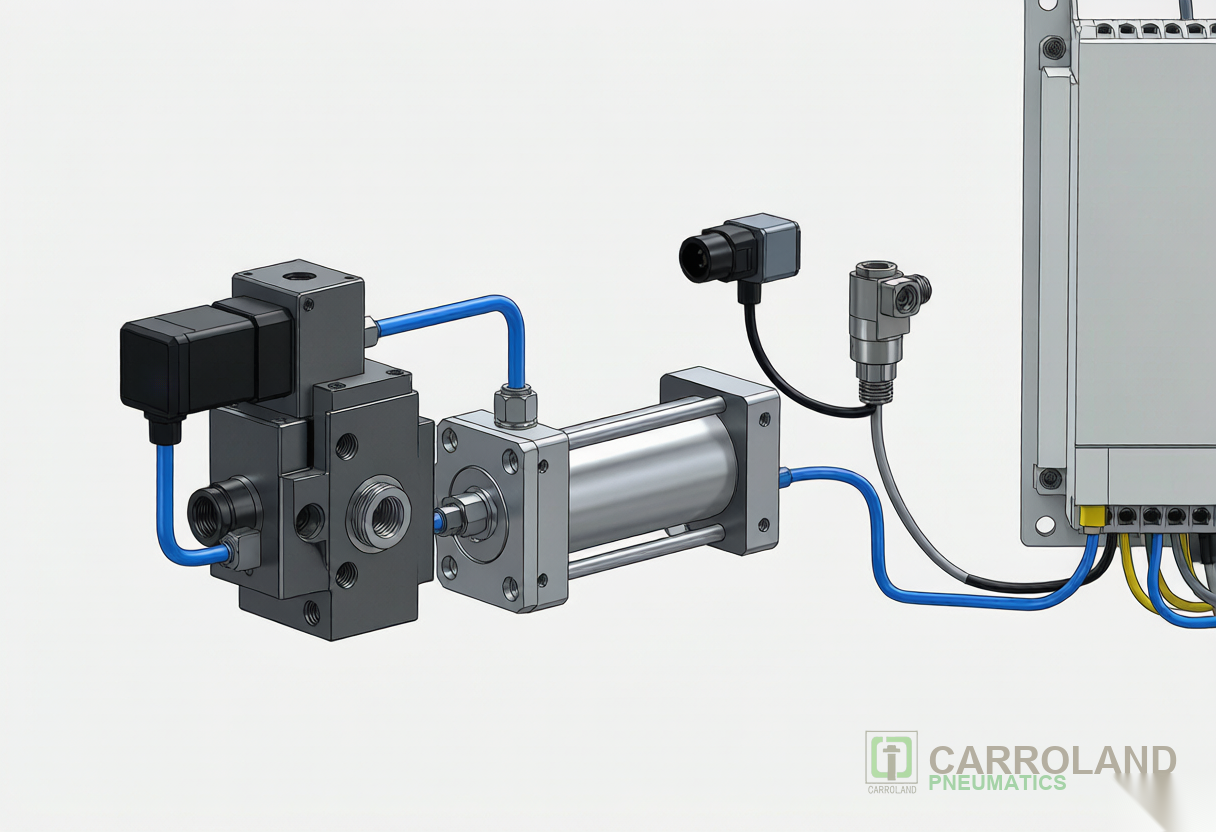
A complete automatic cylinder system includes:
- Cylinder: double-acting ISO 15552 actuator with magnetic piston
- Directional valve: 5/2-way solenoid valve that switches air path
- Air preparation: FRL unit to filter, regulate, and lubricate supply air
- Sensors: reed or Hall-effect switches mounted in the cylinder groove
- Controller: PLC, relay, or valve manifold receiving machine signals
When the controller energises the solenoid, the valve shifts and pressurises the cap or rod side of the cylinder. The piston extends or retracts until the sensor confirms end-of-stroke position.
ISO and Performance Data
Automatic cylinders for general automation typically comply with ISO 15552:2018. Key figures for Indian buyers:
- ISO 15552 rated pressure: 10 bar maximum
- Common control voltage in India: 24 VDC for solenoid valves
- Standard sensor switching current: up to 100 mA for reed switches
- Typical response time for a 5/2 solenoid valve: 10–30 ms
These numbers matter when integrating cylinders into high-cycle automation. A valve that switches in 20 ms and a cylinder that strokes in 100 ms sets a practical cycle ceiling of roughly 8–10 cycles per second, depending on load and air flow.
Automation Applications in India
Automatic pneumatic cylinders are used in:
- Automotive component fixture clamping
- Packaging carton erecting and sealing
- Textile loom shedding and cutter drives
- 3C electronics pick-and-place transfer
- Food processing sorting and rejection
Carroland supports Indian manufacturers with cylinders pre-drilled for sensor mounting and rod ends compatible with standard ISO accessories. Our production lines are certified for smartphone and 3C fixture systems, which translates into the consistency needed for high-cycle automatic equipment.
Control Logic Basics
A simple automatic sequence looks like this:
- Part-present sensor triggers PLC input
- PLC energises solenoid A; cylinder extends
- Extended-position sensor confirms stroke end
- PLC starts process timer or next actuator
- Timer expires; PLC energises solenoid B; cylinder retracts
Adding dual-pressure regulators or proportional valves enables force or speed control for delicate parts.
Selection Checklist
- Define cycle time and required force before selecting bore
- Choose 5/2 valves with sufficient Cv for the cylinder bore
- Specify magnetic piston and matching sensor type
- Size tubing for low pressure drop between valve and cylinder
- Plan safe exhaust routing, especially in clean-room environments
Related Guides
Learn more in our Pneumatic Cylinder Guide for Indian Manufacturers. For sequencing with valves, see Working of Solenoid Valve: India Pneumatic Guide.
FAQ
What is the difference between manual and automatic pneumatic cylinders?
The cylinder itself is the same. The difference is the control method: manual valves use hand levers or foot pedals, while automatic systems use solenoid valves controlled by sensors and a PLC.
Do I need a PLC for automatic cylinder control?
Not always. Simple sequences can use relay logic or valve manifolds with built-in timers. PLCs become necessary when the sequence has multiple branches, interlocks, or HMI integration.
Which sensor fits an ISO 15552 cylinder?
Reed switches and Hall-effect sensors are the most common. Hall-effect sensors are preferred for solid-state reliability and PLC compatibility.
Can one valve control two cylinders?
Yes, if both cylinders always move together and the valve has enough flow capacity. Independent motion requires separate valves.