
Electro Pneumatic Cylinder: Closed-Loop Positioning for Indian Production Lines
Closed-Loop Pneumatic Motion, in Plain Language
The electro-pneumatic cylinder is the right pick when an Indian production line needs more than simple open-loop push-and-retract — when setpoint positioning, velocity profiling, force limiting or programmable deceleration are required. In practical terms, it is a conventional pneumatic cylinder packaged with three additional elements: a position sensor on the rod, an electronic controller, and one of two control valves — either a servo / proportional valve for closed-loop throttling, or a directional solenoid with a mechanical / pneumatic brake for soft-stop applications. The combination can deliver positioning accuracy of ±0.1 mm against the ±1–2 mm repeatability of an ordinary on/off pneumatic system, while cutting energy consumption by up to 35 % and improving MTBF roughly 40 % in industrial deployments.
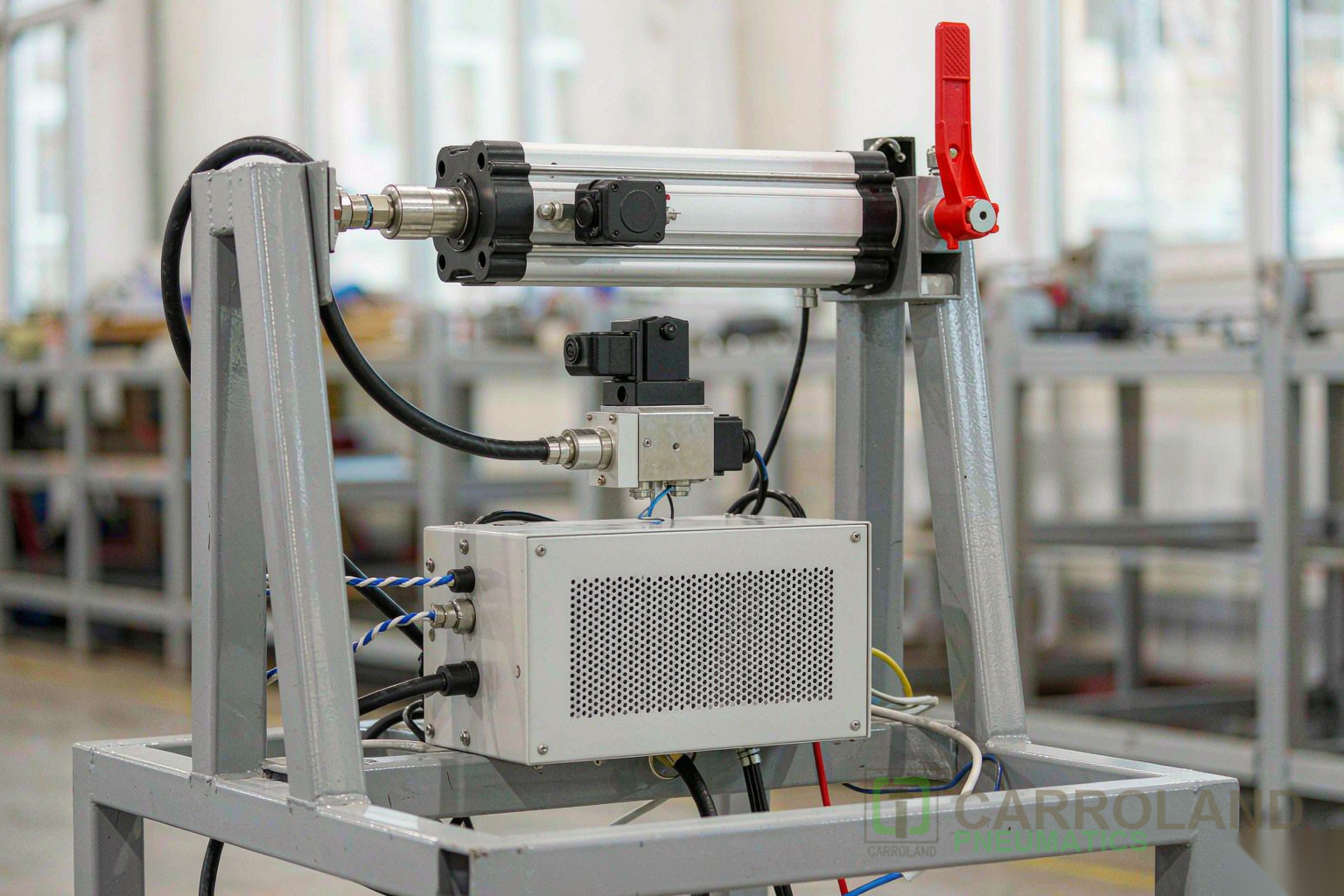
For Indian engineering teams the framing question is whether the requirement is really “closed-loop control” or whether an open-loop cylinder with a position sensor feeding a PLC counter would do the job at one-tenth the complexity. This article works through the construction, the closed-loop principle and the realistic Indian application set, drawing on our broader cylinder selection guide.
What Makes a Cylinder “Electro-Pneumatic”
An electro-pneumatic actuator blends electrical control signals with pneumatic power. The electrical side typically includes a PLC or microcontroller, a position sensor (linear potentiometer, magnetostrictive, or Hall-effect switch array), and a proportional / servo amplifier. The pneumatic side is a standard ISO 15552 or ISO 21287 cylinder plus a five-port proportional or servo valve that throttles flow in both directions based on the control signal.
Position Sensing Options
Two families dominate in Indian factories. Reed switches are mechanical, switched by a permanent magnet on the piston — cheap (about half the price of their solid-state equivalent), AC/DC compatible, and limited in speed by their magnetic hysteresis (around 500 Hz). Hall-effect sensors are solid-state, non-contact, with response speed in the 100 kHz range — important when the controller cycle time is faster than the mechanical bounce of a reed switch. Repeatability of either is around 0.005 in. (0.127 mm) for the sensor itself; overall system repeatability is usually set by rod velocity and valve response, not the sensor.
Valve Options: Proportional vs Servo vs Solenoid + Brake
The valve choice defines system behaviour. A proportional valve modulates air flow continuously against a setpoint signal; a servo valve does the same with higher dynamics for mid-stroke position control. Lower-cost alternatives use a directional solenoid valve plus a mechanical or pneumatic brake that engages as the rod approaches the setpoint — typically 32 user-defined set points across 8 programs in mid-range industrial controllers. Industrial closed-loop controllers — combining proportional valves, continuous-acting valves, position feedback and electronic control — typically reach ±0.1 mm accuracy and 1–5 Hz piston natural frequency, adequate for most material-handling, spot-welding and pick-and-place work.
How the Closed Loop Works in Practice
- The PLC demands a rod position.
- The position sensor continuously reports the current position.
- The controller compares demand and actual, computes an error.
- The proportional or servo valve modulates air flow to drive the error toward zero.
- At setpoint, the valve shifts overcentre, pressurising the opposite chamber to brake the rod to a controlled stop.
A classical rule of thumb: the natural frequency of the control valve must be at least three times that of the cylinder and load to keep the loop stable. Most cylinder-and-load systems sit in the 1–5 Hz range; modern pneumatic servo valves comfortably exceed 15 Hz natural frequency, which is why the closed-loop architecture is now practical for production rather than reserved for aerospace and laboratory applications.
Where Electro-Pneumatic Cylinders Earn Their Place
| Industry Segment | Typical Application | Why Closed Loop |
|---|---|---|
| Pharma packaging (Hyderabad) | Vial-stopper insertion, dose metering | Force-limited setpoint prevents crushing |
| Automotive welding (Pune, Chennai) | Weld-gun approach, body-panel position | Soft stop prevents panel marking |
| Electronics assembly (Noida) | PCB component insertion, connector mating | Programmable force & velocity profiles |
| Robotics / cobots | Joint actuation, tool placement | Compliance for safe human interaction |
| Process control | Valve actuation, flow regulation | Remote setpoint integration with DCS |
Specifying an Electro-Pneumatic Cylinder for an Indian Line
Three parameters drive specification. Positioning accuracy sets whether you need a servo valve, a proportional valve, or a solenoid-with-brake architecture. Response time sets the valve natural-frequency requirement. Air preparation sets the FRL specification — ISO 8573-1 class 2.4.1 (oil ≤ 0.1 mg/m³) is a common minimum for proportional-valve service life. Carroland India stocks ISO 15552 and ISO 21287 cylinders with magnet-equipped pistons for the position-sensor interface, paired with the appropriate proportional valve series for closed-loop configurations. For deeper coverage of the broader pneumatic component family, see the parent cylinder pillar.
Frequently Asked Questions
What is an electro-pneumatic cylinder?
A pneumatic cylinder paired with an electronic position sensor, electronic controller, and proportional or servo valve, used for closed-loop positioning, velocity profiling and force limiting. Standard accuracy on industrial systems is about plus or minus 0.1 mm.
Is electro-pneumatic better than hydraulic?
Electro-pneumatic systems deliver faster response for their force class, run on clean compressed air rather than hydraulic fluid, and integrate directly with PLC-based control architectures. For high-force, fine-position applications in steady state, hydraulic still wins; for high-cycle, clean-room or food/pharma environments, electro-pneumatic is often the better choice.
How accurate is an electro-pneumatic cylinder?
Industrial systems commonly reach about plus or minus 0.1 mm positioning accuracy against the plus or minus 1 to 2 mm typical of open-loop pneumatic systems. Premium positioning systems in electronics manufacturing reach 0.01 mm accuracy.
Does an electro-pneumatic system save energy?
Yes. Industrial case studies report up to about 35 percent energy savings over conventional on/off pneumatic systems, because proportional valves only flow the air needed to do the work, and the closed loop reduces over-shoot and waste.
Sources: ISO 15552:2018, ISO 6432:2015; iso.org; Wikipedia: Proportional control.