Why the Coolant Solenoid Valve Matters on Machining Lines
A coolant solenoid valve is the part of a machining line that opens and closes coolant flow to a cutting tool or grinding wheel. Done right, it sharpens tool life, improves surface finish, and prevents thermal damage to the workpiece. Done wrong — undersized, wrong material, or wrong duty cycle — it leaks coolant into the cabinet, starves the tool, or fails mid-shift. Indian automotive tier-2 and tier-3 machining plants run hundreds of coolant valves per shift, so a small per-valve cost difference amplifies into a meaningful tooling and downtime figure.
Carroland Pneumatics supplies the air-side and pneumatic-control valves that actuate coolant nozzles, alongside the cylinder and clamps on the work-holding fixtures. The coolant itself stays inside the machine tool’s coolant circuit; the solenoid valve is the gate that turns it on and off.
How a Coolant Solenoid Valve is Built
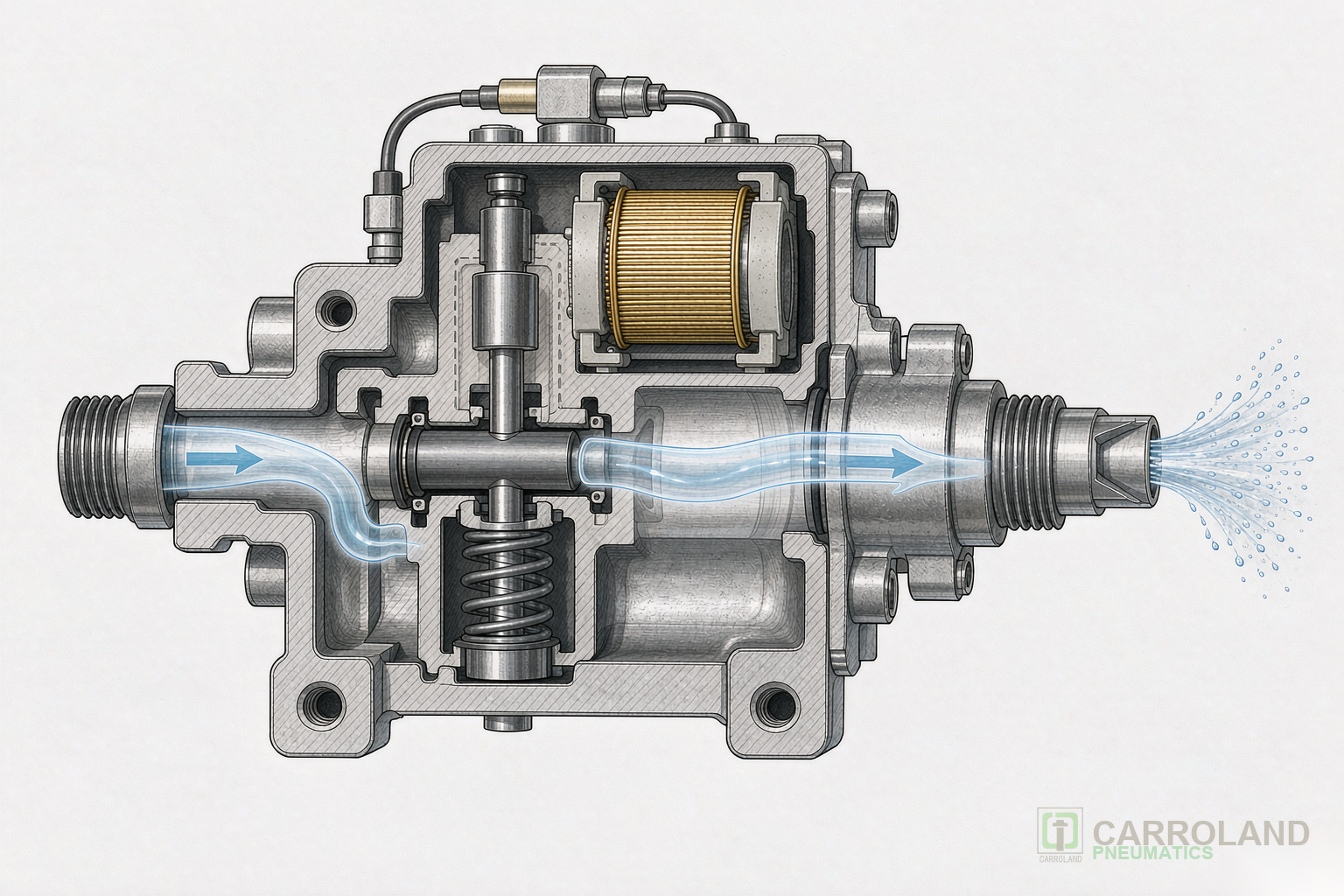
A coolant solenoid valve is essentially a 2/2 or 3/2 way valve with a body material chosen for the coolant chemistry. The body is usually brass or stainless steel. The seal is FKM (Viton) or EPDM because NBR breaks down in the presence of most cutting fluids. The coil is rated for continuous duty because coolant valves typically stay open for the entire machining cycle and close only during tool change. The flow path is sized to keep pressure drop below 0.5 bar at the design flow rate, otherwise the tool runs hot.
Common Coolant Solenoid Valve Specifications
| Parameter | Typical Range | Why It Matters |
|---|---|---|
| Port size | G 1/4 to G 1/2 | Matches the coolant line fitting |
| Body material | Brass or stainless | Compatibility with coolant chemistry |
| Seal material | FKM (Viton) or EPDM | Resistance to oils and cutting fluid additives |
| Working pressure | 2 to 10 bar | Coolant loop pressure |
| Coil voltage | 24 VDC or 110/220 VAC | Matches cabinet control voltage |
| Duty cycle | 100% ED continuous | Coolant valves stay open for the cycle |
| Protection class | IP65 minimum | Coolant splash and oil mist resistance |
How the Coolant Valve Fits the Pneumatic Circuit
The coolant valve is one of three electrical valves on most machining cells: a coolant on/off, an air-blast on/off, and a clamp-cylinder direction valve. All three are normally driven from a single manifold that sits inside the machine cabinet. From the pneumatic side, the coolant valve is just another actuator pneumatic valve connected to the coolant loop rather than to a cylinder. From the electrical side, the coolant valve is wired into the PLC output the same way as the other valves; a single PLC cycle turns on the clamp, the coolant, and the spindle together.
Common Failure Modes on Indian Shop Floors
- Seal swell: caused by NBR seals reacting with coolant additives. The fix is to spec FKM or EPDM seals from the start.
- Coil burnout: caused by under-voltage at the cabinet. Indian plants sometimes see 190 V instead of 220 V at peak load. Specify 24 VDC for new cabinets.
- Body corrosion: caused by coolant residues left in the valve between cycles. Specify stainless body where chemistry allows it.
- Stuck open: caused by debris in the coolant. Add a 500-micron strainer upstream of the valve.
Coolant Valve vs Pneumatic Solenoid Valve: What Engineers Confuse
The coolant solenoid valve is often confused with a pneumatic solenoid valve. They look similar but do different jobs:
- A coolant solenoid valve controls the cutting fluid (liquid). Body and seal are rated for coolant chemistry.
- A pneumatic solenoid valve controls compressed air (gas). Body and seal are rated for clean dry air at 6 to 10 bar.
Substituting one for the other ends in either a leaked cabinet or a starved cylinder. The fastest way to tell the difference at a glance: coolant valves sit on the machine’s fluid skid near the nozzle; pneumatic valves sit on the air manifold inside the cabinet.
Sourcing Coolant Solenoid Valves for India
Indian machine shops usually source coolant solenoid valves locally because the volume and the lead-time sensitivity make domestic supply easier. Carroland focuses on the pneumatic-air-side valves (5/2 way manifold valves, FRLs) and the cylinders and clamps on the fixture. For the coolant-side valve itself, we recommend working with a coolant-system specialist. Walk through the air side in our Solenoid Valve Working Guide; for the cylinder and clamp package, see the Clamps for Pneumatic Cylinder reference.
FAQ
Is a coolant solenoid valve the same as a pneumatic solenoid valve?
No. A coolant valve is rated for liquid (usually cutting fluid or water-based coolant). A pneumatic valve is rated for compressed air. Body, seal, and pressure ratings differ.
What seal material is best for coolant valves?
FKM (Viton) or EPDM. NBR swells in the presence of most cutting fluids.
Can Carroland supply coolant solenoid valves directly?
Carroland focuses on the pneumatic-air side. The coolant-side valve is best sourced from a cutting-fluid or fluid-handling specialist; we help with the air-side valves and cylinders that surround it.
What is the typical voltage rating for a coolant solenoid valve?
24 VDC is the most common in new cabinets. 110 or 220 VAC are still found in older plants. Match the coil to the cabinet’s PLC output voltage.