Why Clamps for Pneumatic Cylinders Matter on 3C Lines
A pneumatic cylinder without a clamp is a loose rod. Clamps for pneumatic cylinder mounting are the hardware that turns the linear force of the cylinder into a stable, repeatable clamp on the workpiece. On a 3C automation line (Computer, Communication, Consumer electronics), clamps hold housings, frames, and components while the cylinder strokes through the assembly cycle. A clamp that flexes or slips will throw takt time and scrap rate simultaneously. Indian electronics plants building or buying 3C lines are paying closer attention to clamp selection and to the parts of a pneumatic system that surround the cylinder.
Carroland Pneumatics supplies ISO 15552 cylinders and ISO 21287 compact cylinders together with matching clamps, brackets, and mounting hardware for 3C automation lines. We have shipped clamping cylinders and the supporting clamps for iPhone production lines via Foxconn-tier contracts.
The Common Clamp Types for Pneumatic Cylinders
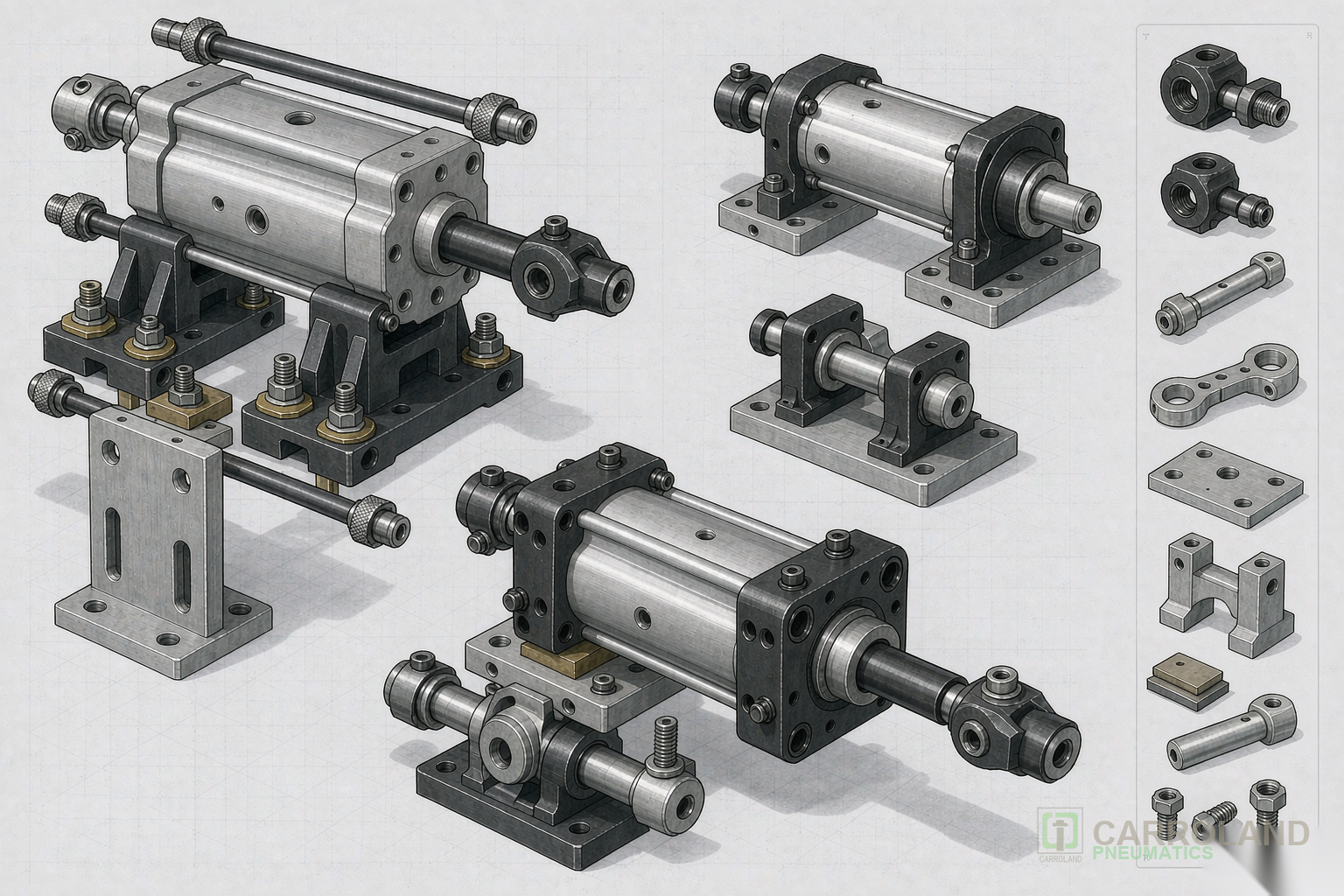
- Foot mount: two flat brackets bolted to the cylinder base. Suits horizontal mount on a flat plate.
- Flange mount (front or rear): a flat flange at one end of the cylinder. Front-flange gives a fixed pivot; rear-flange lets the cylinder pivot as it strokes.
- Trunnion mount: two bosses with through-holes that pivot in a frame. Best for long-stroke cylinders that swing as they extend.
- Clevis and pivot pin: a U-shaped end fitting that pivots in a matching bracket. Used when the cylinder swings on each stroke.
- Clamp body assembly: a forked arm that closes on the workpiece. Common in 3C line part-holding fixtures where the cylinder drives the clamp.
| Clamp Type | Motion of Cylinder | Typical 3C Line Use |
|---|---|---|
| Foot mount | Linear only | Press stations, simple push fixtures |
| Front flange | Linear, fixed pivot | Pick-and-place heads, sealing heads |
| Trunnion mount | Pivoting arc | Long-stroke swing clamps |
| Clevis + pivot pin | Pivoting arc | Door clamps, cover clamps |
| Clamp arm assembly | Linear to clamp motion | Workpiece hold-down, frame clamping |
Selecting Clamps to Match the Cylinder Bore
Clamp sizing has to follow the cylinder bore because the bending load on the clamp rises with bore. A 32 mm bore double acting air cylinder at 6 bar develops about 480 N of thrust, which most clamp bodies can carry. A 100 mm bore cylinder at the same pressure pushes about 4700 N, and a mismatched clamp will deflect by a few tenths of a millimetre — visible to a vision system and fatal for a tight assembly. Always match the clamp manufacturer recommended load envelope to the cylinder thrust, and add a 2× safety factor if the line includes vibration.
How Cylinder Specs Influence Clamp Choice
The pneumatic actuator that drives the cylinder determines how fast the clamp can move, how much force the clamp must absorb, and whether the clamp needs a magnetic-piston position sensor. A high-frequency press line uses a compact ISO 21287 cylinder at 50 to 100 cycles per minute; the clamp needs low inertia and a stiff body. A slow heavy-duty framing line uses an ISO 15552 profile cylinder at 10 to 20 cycles per minute; the clamp can be heavier and the linkage can include a toggle mechanism for mechanical advantage.
For mid-stroke and small-bore work, consider a single acting air cylinder with a spring return: the clamp sees one direction of air force and the spring does the rest, which simplifies the air routing and halves the solenoid valve count on the manifold.
Where Clamps, Cylinders and Solenoid Valves Meet
A complete pneumatic system on a 3C fixture has three layers:
- Power layer: the compressor, FRL, and the air supply line that brings clean dry air at 6 bar to the fixture.
- Actuator layer: the cylinder with its clamp, mounted to the fixture body.
- Control layer: a 5/2 way solenoid valve on a manifold that routes supply air to the cylinder ports based on PLC commands.
The clamp is part of the actuator layer. For system-level sizing, see our circuit pneumatic overview in the 3C automation components hub and our Solenoid Valve Working Guide for valve-side wiring and manifold design.
India Sourcing Notes for 3C Lines
Indian electronics lines expect ISO-standard mounting hardware so that spares can be sourced from multiple qualified factories. Carroland supplies clamps and brackets matched to ISO 15552 and ISO 21287 cylinders from a single factory in China. For each shipment we issue ISO 9001:2015 certificates, dimensional reports, and pressure-test data so that the Indian importer can complete the FMCS path to BIS. Cylinder bore, stroke, and clamp selection are coordinated before quotation so the line builder receives a matched kit, not a parts list.
FAQ
What clamp should I use with a 32 mm bore ISO 15552 cylinder?
A 32 mm bore cylinder pairs with a front-flange or foot-mount clamp for linear motion, or a clevis-and-pin arrangement if the application needs the cylinder to pivot. All three are standard ISO 15552 accessories.
Can a clamp from one supplier fit a cylinder from another supplier?
Yes, if both follow ISO 15552 or ISO 21287 mounting dimensions. The clamp spec is keyed to the cylinder bore and the rod end thread, both of which the ISO standard controls.
How do I hold a clamp in place during a power loss?
Use a single-acting spring-return cylinder. The spring keeps the clamp in its safe state (open or closed) when air is lost, which protects the workpiece on the line.
Does Carroland supply a complete clamp + cylinder + valve assembly?
Carroland supplies ISO-standard cylinders and brackets. A complete sub-assembly kit with the solenoid valve manifold can be quoted on request for production-volume orders.