Pneumatic Cylinder Aluminium Profile: ISO 15552 Design Guide
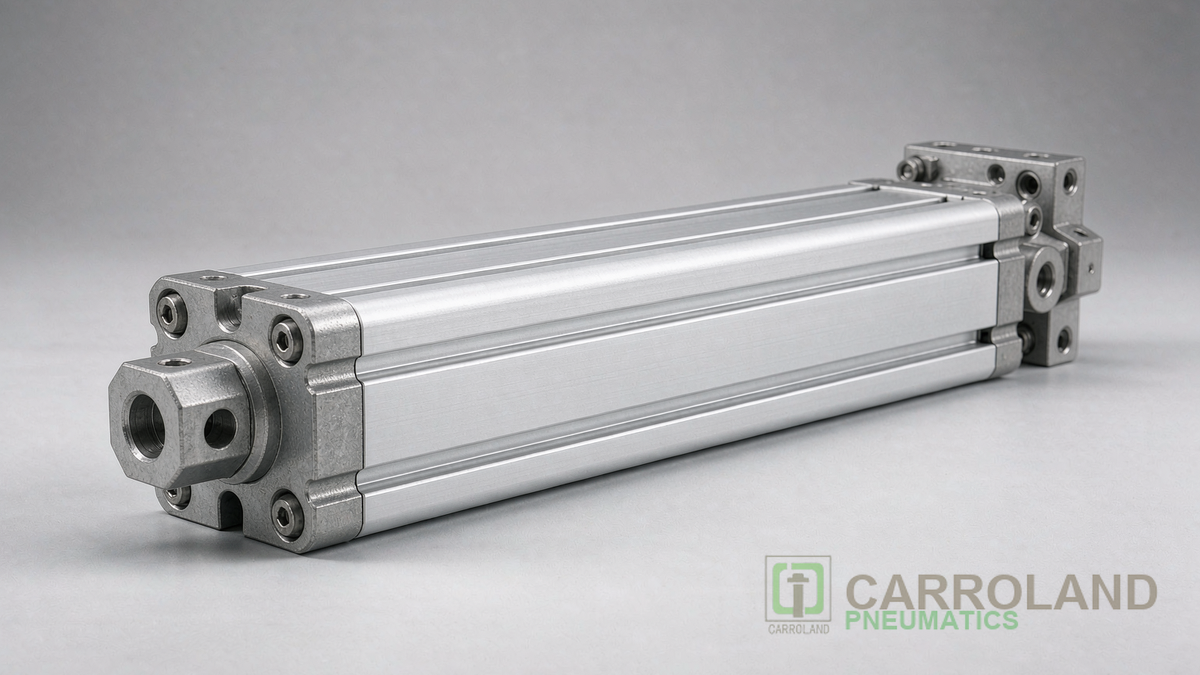
The pneumatic cylinder aluminium profile construction — an extruded, anodised aluminium barrel with integrated tie-rod function and rail grooves — has replaced round tie-rod bodies in most new automation machinery. Under ISO 15552, profile barrels are standard for bores from 32 to 100 mm, and their weight, accessory-mounting and corrosion behaviour explain why Indian machine builders keep specifying them.
Profile construction sits inside the broader cylinder family described in our pneumatic cylinder guide; for design comparisons see 3 stage telescopic pneumatic cylinder layouts and the force-multiplication logic of the force booster cylinder.
Why Aluminium Profile Changed Air Cylinder Design
Aluminium has a density of about 2.70 g/cm³ against roughly 7.85 g/cm³ for steel, so a same-volume barrel weighs about 65% less before any design optimisation. Extrusion adds the second advantage: the profile shape can carry dovetail or tongue-and-groove rails along all four faces, so air cylinder types such as proximity-switch bands, reed switches, stabiliser brackets and end-faces clamp on without drilling the barrel. Drilling an anodised barrel breaks its protective layer; clamping to rails does not.
ISO 15552 Profile Barrels: What the Standard Fixes
ISO 15552 (the successor of VDMA 24562 practice) standardises the profile barrel interface for bores 32–320 mm. The extruded profile form itself is standardised across the 32–100 mm range. That means a sensor bracket or mounting foot bought for one conformant cylinder fits another conformant cylinder of the same bore. Indian maintenance teams rely on exactly this property when a line mixes suppliers. Anodising the extruded surface (typically a hard-anodised layer a few tens of microns thick) gives the bore a smooth, wear-resistant running surface and protects the outside against workshop atmospheres.
Double Acting Pneumatic Air Cylinder Performance in Profile Bodies
Most profile-barrel units are double acting pneumatic air cylinder designs; the profile wall carries the cushion chambers, so adjustable cushioning is standard in the larger bores. The extruded body tolerates the same 10 bar typical service pressure as tie-rod equivalents. Magnetic pistons are standard, so switching positions can be added later — a frequent retrofit request on Indian packaging machines. For push-pull duty the profile body also resists twist better than a round barrel of equal mass, which improves guide-rod alignment.
Specifying the Circuit and Pneumatic Air Cylinder Parts
A profile cylinder only performs as well as its circuit pneumatic layout: size the FRL unit and tubing for the cylinder’s air demand, fit flow controls for exhaust-metered speed setting, and plan the parts of a pneumatic system — valve, tubing, fittings, sensors — around the rail-groove accessories the profile offers. Because the pneumatic air cylinder parts (seal kits, cushion assemblies, pistons) are standardised per bore size, spare-part stocking becomes simpler than for proprietary bodies.
| Property | Aluminium profile barrel | Steel tie-rod barrel |
|---|---|---|
| Relative weight (same volume) | ≈35% of steel | Reference (100%) |
| Accessory mounting | Rail grooves, no drilling | Brackets, tapped holes |
| Corrosion protection | Anodised bore and exterior | Paint or plating |
| Standard bores (ISO 15552) | 32–320 mm (profile form 32–100 mm) | Same bore series |
Frequently Asked Questions
Is an aluminium profile cylinder weaker than a steel tie-rod cylinder?
Not at standard automation pressures. ISO 15552 profile cylinders are rated for the same typical 10 bar service as tie-rod units; the anodised bore provides the wear surface, and the extruded section gives high bending stiffness for its weight. Very high shock loads or harsh impact duty may still favour heavy-duty steel construction.
Can I mount sensors without drilling the profile?
Yes — that is the main advantage. Rail grooves accept standard switch brackets, band-mounted reed or Hall sensors and stabiliser clamps, so positions can be changed or added without breaking the anodised layer.
What does the standard list of profile bores mean for spares?
Because bores follow the ISO 15552 series (32, 40, 50, 63, 80, 100, 125, 160, 200 mm and above), seal kits and service parts are standardised per bore. Carroland Pneumatics (European Technology · China Manufacturing · Since 1992) supplies dimension-conformant profile cylinders with test reports for Indian buyers; background reading is available on Wikipedia’s pneumatic cylinder page.