Dual Stroke Pneumatic Cylinder: Tandem and Multi-Position Designs for Indian Industry
Two Strokes in One Body
A dual stroke pneumatic cylinder packages two independently controllable output strokes into a single pneumatic body — a configuration that, in the Indian fixture and clamping world, often replaces a pair of single-stroke cylinders when cabinet space is constrained, when one motion must follow the other within a single cycle, or when a fail-safe return position is required alongside the working stroke. The most common industrial forms are the tandem centre-block cylinder (two pistons on a common rod, sharing the centre air port) and the multi-position / dual-stroke cylinder (two mechanically independent pistons in tandem, each with its own supply port). Both are covered under standard mounting families; specifications typically map back to ISO 15552 or ISO 21287 installation envelopes.
For Indian manufacturers specifying these units, the practical questions are sizing of both strokes against real loads, plumbing of the shared port on tandem units, and how the dual stroke interacts with valve logic. The rest of this guide walks through the construction options, the working principle, and the realistic applications where each form earns its place.
Two Construction Routes, Two Different Behaviours
Tandem Centre-Block Cylinder
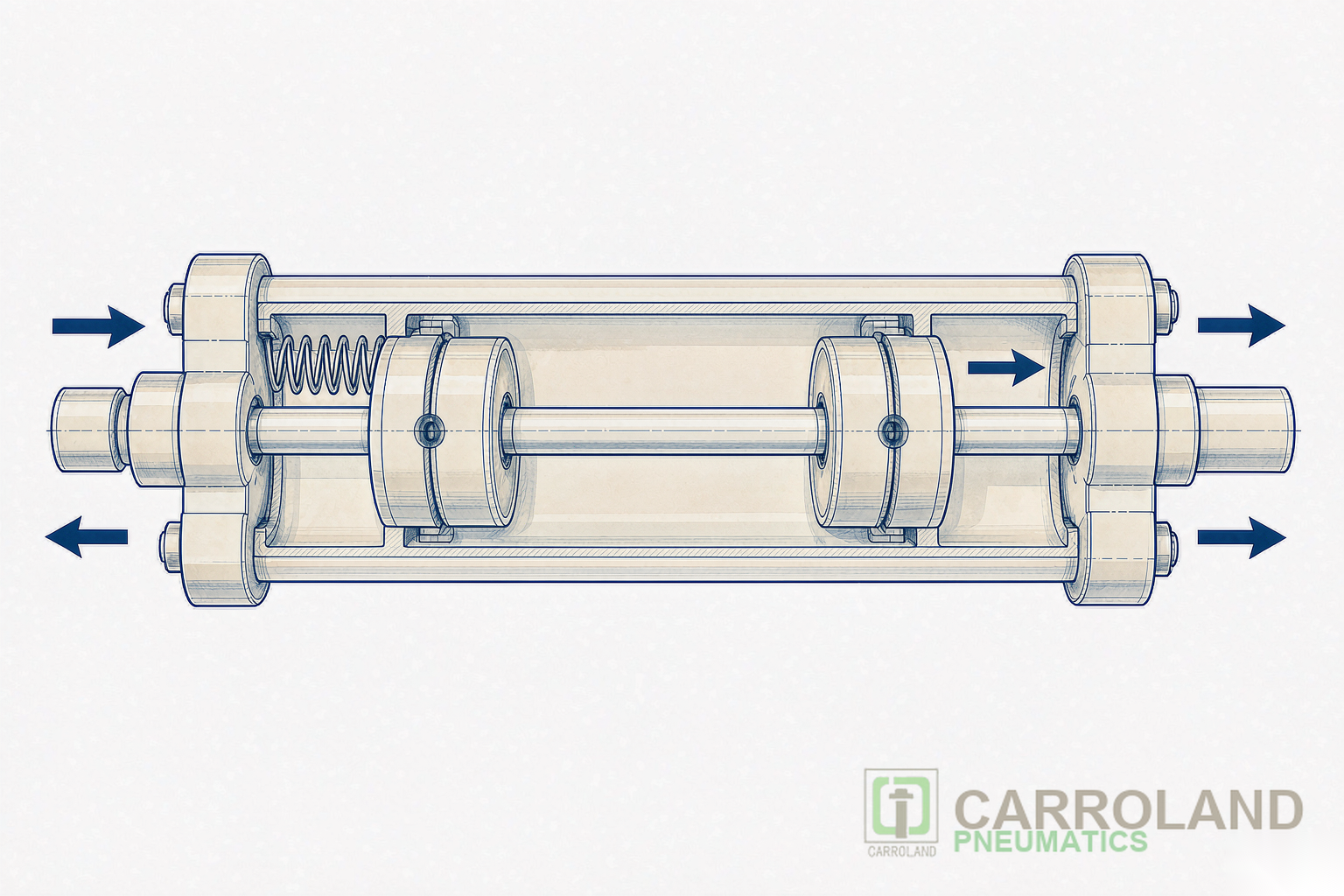
A tandem centre-block cylinder is essentially two ISO 15552 (or ISO 21287 compact) pistons mechanically joined on a single piston rod, with the central area between them connected to a third air port. Pressurising the centre port drives the rod; pressurising either end port pulls it back at a force that combines the two back pistons. The dual-stroke behaviour comes from selectively pressurising the centre port for the active stroke and the end port for the return stroke. The advantage is that the cylinder produces double the force of a single-piston cylinder of the same bore at the same pressure when both piston areas are pressurised — useful where force density matters more than stroke length.
Multi-Position / Independent Dual-Stroke Cylinder
A multi-position cylinder has two mechanically independent pistons in the same tube, each with its own supply and exhaust port. The rod ends of the piston can be linked so the rod has three settled positions (rear, mid, extended), which is the form often called a dual-stroke cylinder in automotive welding fixtures and pallet-stop applications. Here each piston is driven independently, and a 5/3 or two 3/2 valves control the rod position. Stroke lengths are independent and can differ — exactly the case where picking a single-stroke cylinder would force a custom-built extension.
Working Principle and Force Model
The force model is the same as a double-acting cylinder, applied to each piston segment:
- Extend force: Fext = P × (A1 + A2) when both piston areas are pressurised on the same side (tandem mode).
- Return force: Fret = P × (A1 + A2) on the opposite side, less any rod area lost on a single-rod configuration.
- Independent mode: each piston segment is sized as its own DAC: F = P × π · D²/4, with a 50–70 % load-ratio design margin.
Because two equal-bore pistons produce roughly double the force of a single cylinder at the same pressure, an Indian specifier can downsize the bore and still meet force targets — a useful tool when a fixture cannot accept a larger bore diameter. For a quick reference on how stroke length and tandem units are specced together, see the pneumatic cylinder selection guide and the related clamping cylinder guide.
Selection Factors Specific to Dual-Stroke Units
| Decision | Tandem Centre-Block | Multi-Position Dual-Stroke |
|---|---|---|
| Force density | ≈ 2× single-piston at same bore | Equivalent to two single-cylinder units |
| Valve logic | One 5/3 or two 3/2 valves | Two independent 5/2 or 5/3 valves |
| Cushioning | Adjustable pneumatic (most series) | Per-piston adjustable |
| Repairability | Tie-rod: repairable; compact: replace | Same as the host cylinder family |
| Typical use | High-force clamps, pressing | Three-position gates, pallet stops |
Indian Industry Use Cases
Across Pune’s automotive tier-1 lines and Chennai’s EMS cells, dual-stroke and tandem cylinders commonly serve three roles. First is high-force clamping in press and welding fixtures where the upstream force budget (often 2,000 N or more) cannot be reached at a single Ø50 bore at 6 bar without increasing the bore size and clashing with the fixture geometry — a tandem centre-block at Ø40 delivers the same force at the same footprint. Second is three-position transfer on assembly pallets, where a multi-position cylinder cycles through retracted / mid / extended positions in sequence under PLC control, replacing what would otherwise be two separate cylinders. Third is fail-safe return where one half of a tandem cylinder is biased by a 5/3 valve centre position to retract on air-loss and hold the load in safe position, with the other half delivering the working stroke.
Carroland’s India portfolio supports both constructions with the same seal and cushioning choices used across the single-cylinder range. Magnetic-piston position sensing, AISI 304/316 stainless variants for washdown, and 1.5–10 bar operating pressure ratings align directly with FMCG and pharma-line requirements. For an extended discussion of how these units are integrated with the surrounding pneumatic valve and FRL architecture, see the parent pillar on cylinder types.
Frequently Asked Questions
What is a dual stroke pneumatic cylinder?
A pneumatic cylinder that delivers two strokes, typically by carrying two pistons in the same body so each can be controlled independently. The two common forms are tandem centre-block cylinders and multi-position / independent dual-stroke cylinders.
What is the difference between a tandem cylinder and a dual-stroke cylinder?
A tandem cylinder has two pistons on a common rod, sharing a centre air port for a force-doubled extend stroke. A dual-stroke cylinder has two mechanically independent pistons, each with its own supply port, producing three or more settled positions.
Where is a tandem cylinder used?
Where you need roughly twice the output force of a single-piston cylinder of the same bore, commonly in fixture clamps and pressing operations on Indian automotive welding lines.
What pressure does a dual-stroke cylinder operate at?
Dual-stroke and tandem units are typically rated for the same 10 bar (1000 kPa) series that covers ISO 15552 and ISO 21287. Shop-air nominals in India are 6 bar; size against the actual port pressure after FRL losses.
Sources: ISO 15552:2018, ISO 21287; iso.org; Wikipedia: Pneumatic cylinder.