Pneumatic Cylinder Bore and Stroke: Sizing Guide with Charts
Pneumatic cylinder bore and stroke are the two numbers that decide whether a cylinder does the job — the bore sets the force, the stroke sets the travel. Sizing them correctly is arithmetic, not intuition: force equals air pressure multiplied by piston area, and every standard ISO 15552 bore gives you a predictable force per bar. Indian buyers who size by “same as last time” routinely overspend on oversized bores or stall lines with undersized ones.
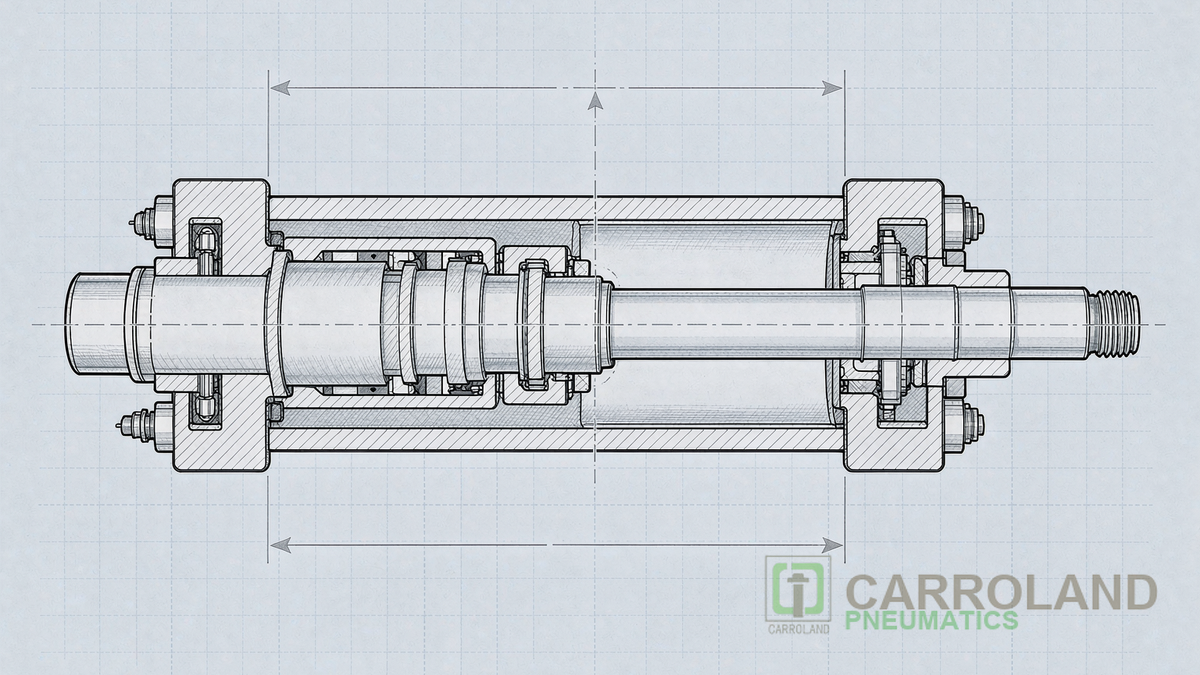
The guide extends our pneumatic cylinder guide; for force-critical applications also read 5 ton pneumatic cylinder sizing and the supplier comparison in best pneumatic cylinders.
The Force Equation Behind Every Bore
Theoretical extend force is F = p × A, where p is gauge pressure and A the full-bore piston area. At 6 bar: a Ø50 mm bore (19.6 cm²) gives about 1,178 N; a Ø63 mm bore (31.2 cm²) gives about 1,870 N; a Ø100 mm bore (78.5 cm²) gives about 4,712 N; a Ø200 mm bore (314 cm²) gives about 18,840 N. Retraction force is lower because the rod reduces the effective area. Good practice applies a 25–50% reserve margin above the theoretical value for friction, load dynamics and supply droop — a rule embedded in every serious sizing tool.
Standard Bores and Their Manufacturers’ Logic
ISO 15552 fixes the bore series at 32, 40, 50, 63, 80, 100, 125, 160, 200, 250 and 320 mm, and catalogues from every established pneumatic manufacturer follow it — one reason cross-brand maintenance is workable in India. Pick the smallest bore whose force-with-margin covers the load; stepping up one bore size roughly multiplies force by 1.5, while stepping two sizes roughly doubles it. When an application sits between bores, check whether a higher operating pressure or a force-multiplier design (see force booster cylinders) is cheaper than the next bore up.
Stroke Selection and the Pneumatic Circuit Around It
Stroke follows the mechanism, not the other way around: measure required travel, add clearance for the tooling, and confirm the cylinder reaches it at working pressure. Standard strokes come in fixed increments per manufacturer; non-standard strokes are ordinary factory items. The surrounding pneumatic circuit then governs behaviour — exhaust flow controls set speed, cushioning absorbs end-of-stroke energy, and pneumatic valves and actuators must be sized so the valve’s flow coefficient does not choke a fast, long-stroke cycle. A long stroke moved quickly needs far more air per second than the same bore idling; undersized valves are the most common cause of “the cylinder is slower on the machine than in the catalog”.
Where Bore and Stroke Choices Diverge by Cylinder Family
Compact and guided cylinders trade bore force for envelope; rodless designs deliver long strokes in a short footprint; rotary and zero-stroke clamping units convert pressure into clamping force at very short strokes for fixture work. A rodless air cylinder can replace a 2 m conventional stroke where hall space is tight, while clamping duty rarely needs more than a few millimetres of stroke but benefits from high force density. Matching family to duty first, then bore, then stroke, keeps the whole bill of materials smaller.
| Bore (mm) | Piston area (cm²) | Force at 6 bar (N, theoretical) |
|---|---|---|
| 32 | 8.0 | 483 |
| 50 | 19.6 | 1,178 |
| 63 | 31.2 | 1,870 |
| 100 | 78.5 | 4,712 |
| 200 | 314.2 | 18,840 |
Frequently Asked Questions
How much reserve force should I add on top of the load?
Size the bore for roughly 1.25 to 1.5 times the working load as a baseline, more for impact-prone or high-speed duty. The margin absorbs seal friction, supply-line pressure drop and dynamic load changes without resizing later.
Does a longer stroke reduce cylinder force?
No — force depends on bore and pressure, not stroke. What changes with stroke is air consumption, cycle time and buckling risk on the rod; long strokes at high speed need careful valve sizing and, for long unsupported rods, a stop tube or guided design.
How do I convert a required tonnage into a bore?
One tonne-force is about 9,810 N. At 6 bar that needs roughly a Ø144 mm bore, so catalogue practice steps up to the 160 mm size, or uses a pressure booster or hydro-pneumatic intensifier for compact force. Carroland Pneumatics sizes and supplies such units (European Technology · China Manufacturing · Since 1992); the underlying physics is summarised on Wikipedia’s pneumatic cylinder page.