Double Acting Pneumatic Cylinder Types: ISO 15552, 21287 and 6432 Compared
Where the Bi-Directional Pneumatic Cylinder Earns Its Place
In Indian automotive lines, packaging machinery and 3C assembly cells, the double-acting pneumatic cylinder is the workhorse family — it accounts for the bulk of linear-actuator units on a typical shop floor because its controlled force in both directions removes an entire class of timing and position-control problems that a spring-return unit cannot solve. The standardisation picture in 2025–2026 is dominated by ISO 15552:2018 (profile tie-rod, 32–320 mm bore, 10 bar) and ISO 21287 (compact, 20–100 mm bore) on the main-line side, plus ISO 6432:2015 round-body mini sizes (8–25 mm bore) for instrumentation. Picking among the families comes down to stroke, side-load, repairability and the cabinet envelope.
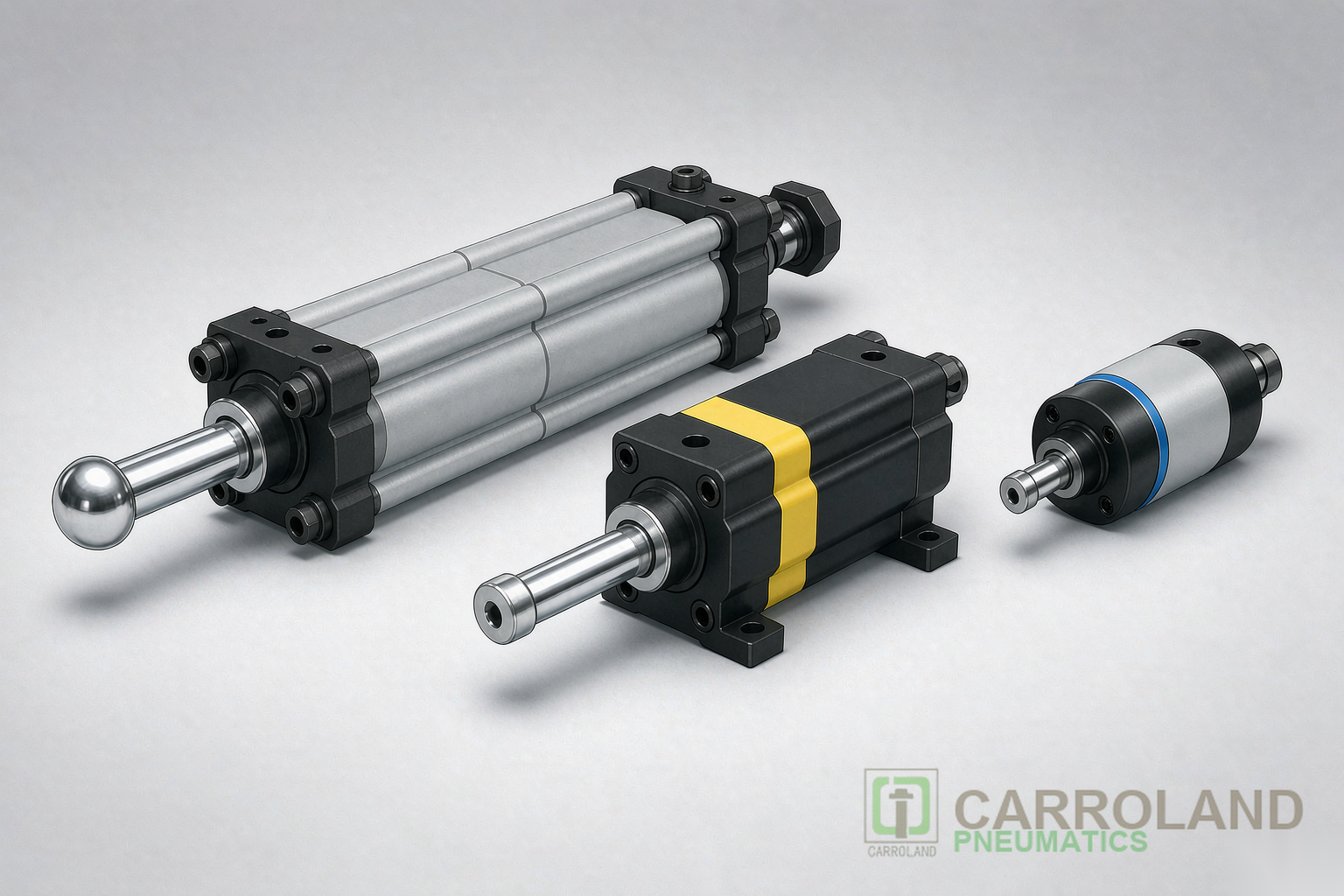
Carroland’s pneumatic cylinder selection guide for Indian manufacturers works through these decisions in a four-step framework and maps each type of double-acting cylinder to the environments where it is most commonly specified in Indian industry.
The Three Double-Acting Families You Will Encounter
ISO 15552 Profile Tie-Rod DAC
The ISO 15552 cylinder is the global industrial default. Tie rods run externally along the profile barrel, holding the end caps; that mechanical arrangement is repairable. Field service opens the unit, replaces the seal kit, hones the bore if scoring is mild, and returns the unit to service. Bore range is 32–320 mm at the 10 bar / 1000 kPa series. At a 6 bar Indian shop-air nominal, theoretical push force scales as π·D²/4 × 600 kPa — for Ø50 mm that is 1,178 N; for Ø80 mm approximately 3,016 N. ISO 15552:2018 replaced ISO 6431 and VDMA 24562; calling out “ISO 6431-style” remains common in legacy indents, but new specifications should reference ISO 15552 so cylinder, mountings and accessories remain dimensionally interchangeable across compliant Indian and global suppliers.
ISO 21287 Compact DAC
Where horizontal envelope is constrained — packaging-line spacer units, electronic-component pick-and-place stations, 3C assembly cells in Greater Noida — the ISO 21287 compact cylinder saves 40–50 mm of length against an ISO 15552 unit of the same bore. Bore sizes span Ø20–Ø100 mm (Ø16 from specific series), rubber-buffer fixed cushioning is standard, and magnetic-piston variants accept side-mounted reed or Hall-effect position sensors. The trade-off is non-repairability: end caps are not designed to be unbolted for field reseal, so a worn seal typically means a full-unit replacement.
ISO 6432 Mini DAC
The ISO 6432 round-body mini cylinder (8–25 mm bore) covers small actuators in lab, instrumentation and assembly-rig setups. Its barrel is a single stainless-steel tube in many designs, end caps threaded on; mechanical cushioning only is permitted by the standard. Service life up to 30 million cycles with polyurethane seals is achievable, and 15 million cycles with NBR seals — both ratings reference-class for OEM equipment builders.
Single-Rod vs Through-Rod: Equal Force or Half-Force
Most Indian indents specify single-rod DAC, but a through-rod double-acting cylinder exposes both sides of the piston through a rod at each end, equalising push and retract force to the full bore area. This is the right choice when the load has to be moved with identical dynamics in both directions, when a guide rod is needed on the second end, or when the cylinder itself acts as a structural tie. Through-rod DACs are heavier, more expensive, and seal on both rods; for typical conveyor, clamp and pick-and-place work, single-rod is the economical answer.
How the Double-Acting Cylinder Generates Bi-Directional Force
The classical explanation is a pressure differential across the piston face, but for sizing in practice the relevant numbers are:
- Extend (push) force: Fpush = P × (π · D² / 4), using the full bore area.
- Retract (pull) force: Fpull = P × (π · (D² − d²) / 4), where d is the rod diameter. Pull force is always lower than push force on a single-rod unit.
- Effective output: theoretical force is reduced by seal friction and back-pressure; designers apply a load ratio of roughly 50–70 % of theoretical to leave margin.
Air is compressible, so mid-stroke position control requires either a proportional valve with a position sensor, mechanical stops, or external checking — topics addressed in our electro-pneumatic and guided-cylinder articles.
Sizing Worksheet for a Common Indian Use Case
| Step | Formula / Action | Example (Ø50, 6 bar) |
|---|---|---|
| 1. Push area | Apush = π · D²/4 | Apush ≈ 19.63 cm² |
| 2. Theoretical push force | F = P × A | F ≈ 1,178 N |
| 3. Apply load ratio (≈ 0.6) | Fdesign ≈ 0.6 × F | Fdesign ≈ 707 N |
| 4. Compare to load | Fdesign ≥ Load + 20 % safety | Confirms Ø50 at 6 bar for ≤ 580 N working load |
Where Each Type Belongs on the Indian Shop Floor
- Automotive tier-1 (Pune, Chennai): ISO 15552 profile DAC for press feeds, conveyor lifts and transfer shuttles; ISO 21287 compact for door-closer and short-stroke clamp stations. Repairability of the tie-rod family matters when three-shift production can’t tolerate a full-unit swap.
- Electronics & EMS (Noida, Greater Noida): ISO 21287 compact and guided-compact DAC dominate PCB assembly and component-insertion cells, where envelope and cleanroom-amenable finishes matter most.
- Pharma packaging (Hyderabad, Ahmedabad): stainless ISO 6432 mini DAC with PTFE seals paired with FRL sets at ISO 8573-1 class 2.4.1 — washdown tolerance and airborne-oil control outweigh raw force.
- FMCG bottling lines: ISO 15552 DAC where bore ≥ 50 mm; high-cycle continuous operation justifies the 30-million-cycle PU-sealed service rating.
All of the DAC families above are available through Carroland with the appropriate position sensing, cushioning type and seal compound. For deeper coverage of construction options — guided, rodless and rotary — see the related clamping-cylinder guide and the parent pillar on cylinder types.
Frequently Asked Questions
What is a double-acting pneumatic cylinder?
A cylinder with two air ports that admits compressed air on both sides of the piston. Air drives the rod in both directions instead of relying on a return spring, giving you controlled force and position in each stroke.
Which ISO standard covers double-acting cylinders?
ISO 15552:2018 is the profile tie-rod standard covering bores 32–320 mm. ISO 21287 is the compact standard covering 20–100 mm. ISO 6432:2015 is the round-body mini standard covering 8–25 mm. All three are 10 bar / 1000 kPa series.
How do you calculate the force of a double-acting cylinder?
F = P × A. For a single-rod DAC the push area is π·D²/4 and the retract area is π·(D² − d²)/4 where d is the rod diameter. Apply a load ratio of about 50–70 % of theoretical to leave margin for seal friction and acceleration.
What is the difference between single-acting and double-acting cylinders?
A single-acting cylinder uses air for one stroke and a spring (or external load) for the return. A double-acting cylinder uses air for both strokes, producing more force and faster cycling but consuming more compressed air per cycle.
Sources: ISO 15552:2018, ISO 6432:2015, ISO 21287:2004; iso.org; Wikipedia: Pneumatic cylinder.