
What ISO 21287 Defines
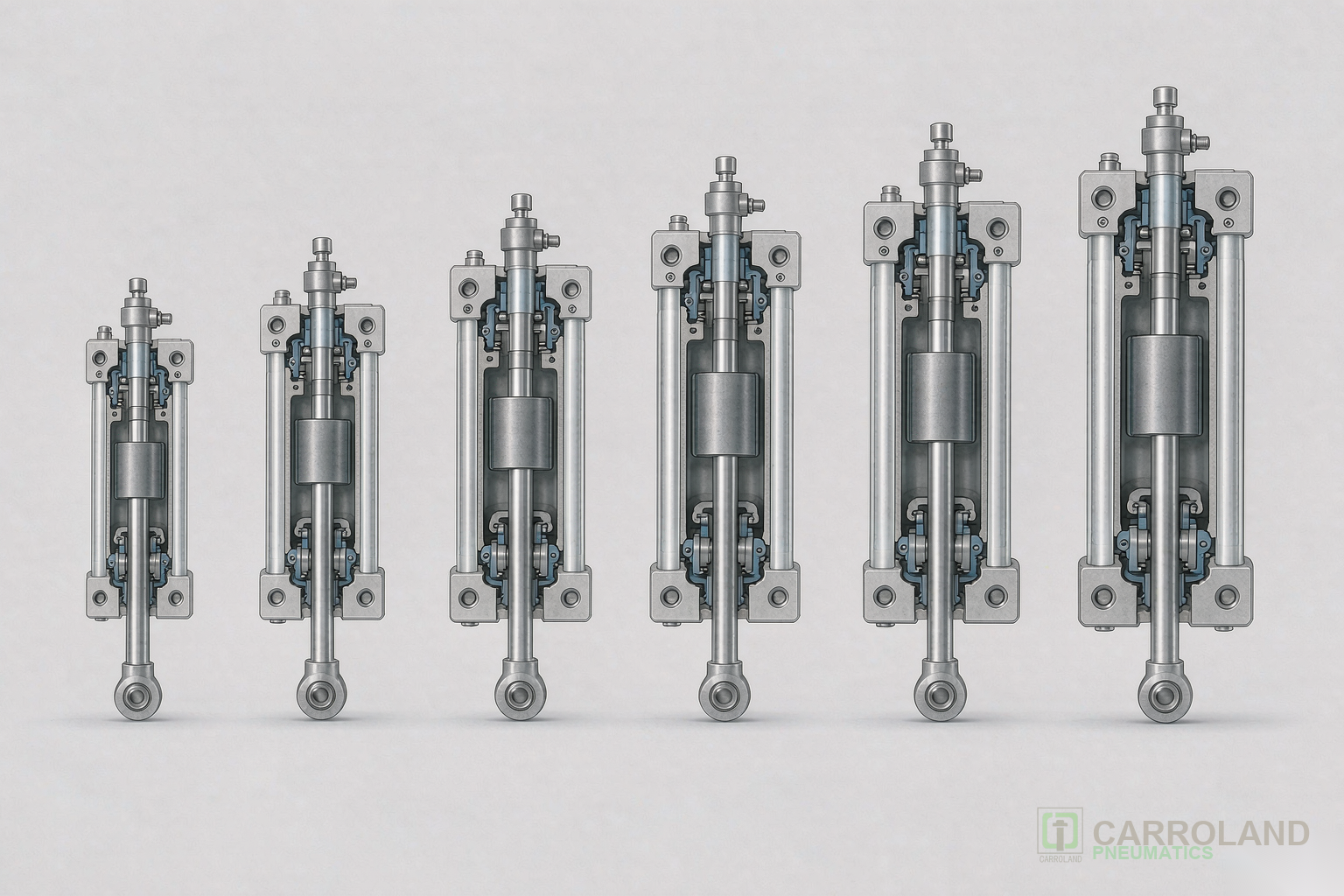
ISO 21287 compact cylinders are round-body pneumatic cylinders with a bore range defined by the standard from 20 mm to 100 mm, built for installations where axial space is limited. The standard fixes the mounting interface dimensions, rod thread, and port thread, so a cylinder from one source can be swapped into a fixture designed for another without reworking the bracket. Understanding the bore range defined in ISO 21287 is the first step in compact cylinder selection, because bore diameter sets the available force and the physical envelope.
Compact cylinders differ from tie-rod cylinders in construction. A tie-rod design uses four external bolts running the length of the body to clamp the end caps; a compact design integrates the body and caps into a single machined profile. This removes the tie rods from the outside diameter, which is why a compact cylinder fits into tighter bays. The trade-off is a shorter maximum stroke, since the internal piston and cushioning space is reduced.
Bore Range and Force Output
Bore selection in ISO 21287 compact cylinder applications is driven by required thrust, not by the space available. The theoretical extending force is the product of the piston area and the supply pressure:
F = (π × d² / 4) × P
Where d is the bore diameter in mm and P is the gauge pressure in MPa. Because force scales with the square of the bore, moving from 32 mm to 40 mm raises the theoretical thrust by roughly 56 percent at the same pressure, while the body only grows modestly in width.
| Bore (mm) | Theoretical force at 0.6 MPa (N) | Typical use |
|---|---|---|
| 20 | 188 | Clamping small parts, light pick-and-place |
| 25 | 295 | Ejector pins, small fixture clamping |
| 32 | 483 | General fixture clamping, light pressing |
| 40 | 754 | Part locating, medium clamping duty |
| 50 | 1178 | Press-fit assistance, heavier clamping |
| 63 | 1870 | Heavy clamping, punching assist |
| 80 | 3016 | High-force clamping stations |
| 100 | 4712 | Heavy pressing and forming support |
These figures are theoretical values calculated from the formula above and ignore friction, cushioning back-pressure, and the rod-area loss on the retract stroke. Practical selection should apply a duty margin rather than sizing to the bare calculated figure.
How Bore Selection Interacts with Stroke
A compact cylinder’s usable stroke is limited by bore. Small bores tolerate longer strokes relative to their body length; large bores at long stroke create side-loading problems because the piston rod guide is short. For a 100 mm bore compact cylinder, long strokes are generally avoided in favour of a rod lock or an external guide. When the application needs both a large bore and a long stroke, a tie-rod cylinder built to ISO 15552 or ISO 6432 dimensional verification principles is usually the better structural choice.
The practical rule is to select the smallest bore that meets the force requirement with margin, then confirm the stroke falls within the compact cylinder’s stable range for that bore. Oversizing the bore wastes compressed air: every cycle charges a larger volume than the task requires, and the cost is paid continuously across the machine’s life.
Port Thread and Air Delivery
ISO 21287 specifies the port thread sizes associated with each bore. Undersized ports are a common selection error: the bore is chosen correctly for force, but the port cannot pass enough air to fill the volume at the required cycle rate. The cylinder then appears slow, and the usual misdiagnosis is to increase the supply pressure, which raises air consumption without fixing the flow restriction.
Air quality matters as much as air volume. The compressed air feeding a compact cylinder should match the contamination classes the downstream components can tolerate; the ISO 8573-1 air quality classes define the particulate, water, and oil limits used for this check. Particulate ingress is particularly damaging in compact cylinders because the internal clearances are tight.
Cushioning Options
Compact cylinders are commonly supplied with elastic cushioning at both ends — a polymer buffer that absorbs residual kinetic energy. Elastic cushions suit moderate speeds and light loads. Where the moving mass is high or the cycle rate is fast, adjustable pneumatic cushioning is preferred, because it meters the exhaust air over the last portion of the stroke and can be tuned to the actual load.
Cushioning should never be treated as a substitute for correct sizing. If the cylinder requires the cushion to be fully closed to avoid end-of-stroke impact, the load is too high for the bore and the next size up should be specified.
Mounting and Accessories
ISO 21287 bodies accept through-hole mounting on the end faces, plus a range of accessories including foot brackets, flanges, and rod clevises. Because the standard controls the interface pattern, accessories from one source can be fitted to a cylinder from another.
Three mounting checks prevent most field failures:
- Axial alignment. A rod loaded off-axis wears the rod bushing and seal prematurely. Use a floating joint where perfect alignment cannot be guaranteed.
- Rod rotation. Some compact cylinders include anti-rotation guides; specify them when the load is asymmetric.
- Sensor mounting. Position sensing is usually via a magnetic piston and an external reed or solid-state switch mounted in a body slot.
Compact vs Tie-Rod: A Selection Checklist
Choose an ISO 21287 compact cylinder when the axial envelope is tight, the stroke is short relative to the bore, and the load is guided by the machine structure. Choose a tie-rod or profile cylinder when the stroke is long, the load is unguided, or the application needs field-repairable seals and adjustable cushioning at both ends.
A related comparison that often arises at the design stage is bore standardisation across a machine family; consolidating on one bore family simplifies both spares and air sizing.
Integration with Valve Sizing
The cylinder bore determines the flow the directional valve must deliver. Selecting the cylinder first and the valve second is the reliable order of operations. A valve that cannot exhaust fast enough will make a correctly sized cylinder perform poorly. Where the valve is mounted remotely from the cylinder, the tubing between them adds restriction, and the 5/2 versus 5/3 valve selection decision determines whether the cylinder can be held in a mid-position during a pause.
Applications that need a defined safe state on power loss should use a 5/3 valve with a closed or exhausted centre, or a 5/2 valve with spring return, rather than relying on the cylinder’s own cushioning to hold position.
Practical Sizing Sequence
- Determine the actual load force including friction, gravity, and any process reaction force.
- Apply a duty margin to cover pressure variation across the machine’s air system.
- Calculate the required bore from the formula, then round up to the next standard ISO 21287 bore.
- Confirm the stroke is within the stable range for that bore.
- Check the port size against the required cycle rate.
- Confirm air quality class and mounting accessories.
Following this sequence avoids the two most common specification errors: sizing the bore from the available space, and selecting the valve before the cylinder.
FAQ
What bore range does ISO 21287 cover?
ISO 21287 covers compact pneumatic cylinders with bore diameters from 20 mm to 100 mm, with mounting and port interface dimensions defined by the standard for each bore size.
Why does force increase so quickly with bore?
Theoretical thrust is proportional to piston area, which grows with the square of the bore diameter. Increasing the bore from 32 mm to 40 mm raises piston area by about 56 percent at unchanged pressure.
Can a compact cylinder replace a tie-rod cylinder of the same bore?
Only if the stroke, cushioning requirement, and mounting pattern are also compatible. Compact cylinders suit short strokes; long strokes with unguided loads are better served by tie-rod or profile designs.
How does air quality affect compact cylinder life?
Compact cylinders have tight internal clearances, so particulate contamination accelerates seal and bushing wear. Matching the supply to the ISO 8573-1 class required by the machine protects the cylinder and the valve equally.