
Pneumatic Cylinder for Lifting: Bore Sizing for Indian Plants
Vertical lifting is the quickest way to expose an undersized actuator. A pneumatic cylinder for lifting has to hold a static load, accelerate it, and absorb shock at both ends of travel, so the bore is decided by force margin rather than by the space left on the fixture. Carroland Pneumatics builds ISO 15552 profile cylinders and ISO 21287 compact cylinders in China for Indian OEMs, machine builders and system integrators, and this guide walks through the calculation, the standard bore sizes and the circuit details that keep a raised load under control. European Technology, China Manufacturing, Since 1992.
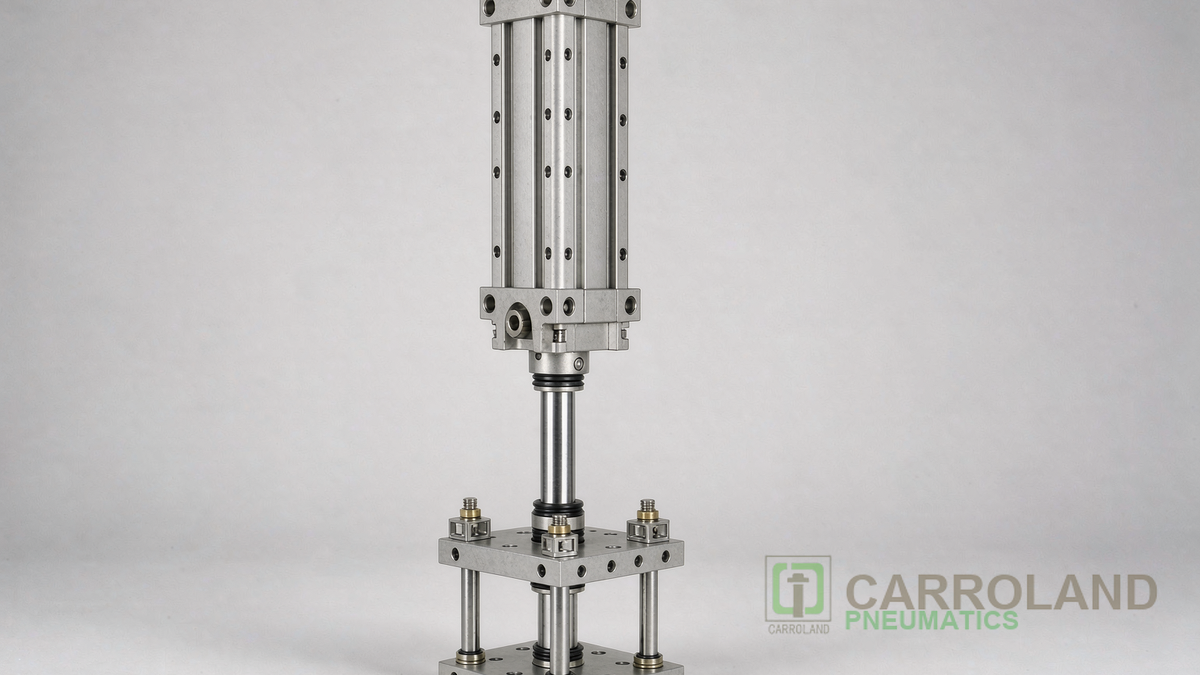
How Air Pressure Becomes Vertical Thrust
Extending force obeys a single relationship: F = (π/4) × D² × P, where D is the bore in millimetres and P is gauge pressure. At 6 bar a 32 mm bore produces 483 N, a 50 mm bore produces 1,178 N, a 63 mm bore produces 1,870 N, an 80 mm bore produces 3,016 N, and a 100 mm bore produces 4,712 N. Retracting force is lower because the piston rod removes area from the effective face: F = 0.471 × (D² − d²) with the rod diameter d in millimetres and the result in newtons at 6 bar. A 63 mm bore with a 20 mm rod therefore pulls 1,682 N, roughly ten percent less than it pushes.
The numbers above are theoretical. Seal friction, guide-bush drag and back pressure on the exhaust side typically remove five to fifteen percent of that figure in service, which is why industrial practice applies a safety factor of 1.5 to 2.0 on a static vertical load and never sizes a cylinder at 100 percent of calculated thrust. A crane-like margin is unnecessary; a margin of zero is a stall waiting for the first cold morning in an unheated shop.
Double Acting Pneumatic Cylinder or Single Acting Pneumatic Cylinder
The choice changes the failure mode more than the force. A double acting pneumatic cylinder drives both directions with air and needs a 4/2 or 5/2 directional valve. A single acting pneumatic cylinder uses one air port and relies on a spring or gravity for return; spring force subtracts from the available thrust, so a single action pneumatic cylinder of the same bore lifts less, and spring fatigue limits cycle life in dusty environments. For a lift axis that must hold position when air is lost, the usual answer is a double acting cylinder with a 5/3 closed-centre valve, or a cylinder fitted with an end-position lock.
Load Capacity Across Standard Bore Sizes
The table lists theoretical thrust at 6 bar, the load that remains after a 1.5 safety factor on a vertically guided axis, and the lift duties each size normally serves on an Indian assembly line. Convert to kilograms with 1 kgf = 9.807 N.
| Bore | Rod diameter | Thrust at 6 bar | Guided lift load (1.5 factor) | Typical lifting duty |
|---|---|---|---|---|
| 32 mm | 12 mm | 483 N | 32.8 kg | Light pick-and-place, small jigs |
| 50 mm | 20 mm | 1,178 N | 80.1 kg | Fixture and nest lifting |
| 63 mm | 20 mm | 1,870 N | 127.1 kg | Pallet and tray lifting |
| 80 mm | 25 mm | 3,016 N | 205.0 kg | Heavy tooling, mould handling |
| 100 mm | 25 mm | 4,712 N | 320.3 kg | Gantry assistance, press feeding |
A common engineering rule goes further and caps continuous dynamic duty at fifty percent of theoretical thrust. Cylinders run near their limit compress air before the piston breaks static friction, which shows up as a lurch at the start of the stroke and shortens seal life. When a lift must move smoothly and repeatably, choose at least one bore size above the minimum the calculation allows.
Pneumatic Cylinder Parts and Pneumatic Cylinder Components That Affect Lift Quality
Lift repeatability is decided by the parts list, not by the catalogue force figure. The barrel is extruded aluminium with T-slots for sensor mounting; the piston rod is stainless steel, commonly AISI 303, with an end thread fixed by ISO 15552; the rod bearing is bronze or polymer and sets the side-load ceiling; and the buffer seals absorb the kinetic energy of the load at each end of travel. Seal compound selection follows the environment: NBR for clean, dry, room-temperature air, and FKM where ambient temperature or oil mist is higher.
Air quality belongs in the same conversation. ISO 8573-1:2010 defines compressed air purity classes, and class 5 for particles corresponds to filtration that most pneumatic cylinder components expect. Water carry-over rusts barrels and washes out grease, so a filter-regulator-lubricator unit upstream of the valve is not optional on an outdoor or monsoon-exposed line.
Pneumatic Valve and Pneumatic Actuator Circuit for Holding a Raised Load
The pneumatic valve sets how the load behaves during a power failure. A 5/2 solenoid valve with spring return drops a lift when the coil loses power; a 5/3 closed-centre valve traps air in both chambers and holds position, though internal leakage means a load above a few hundred kilograms should also be supported mechanically. Exhaust flow controls, mounted on the valve rather than on the cylinder, give smoother descent than supply-side throttling because they resist the air pushing the load out rather than the air pushing the piston down.
Any pneumatic actuator with a stroke beyond 500 mm deserves a buckling review. The piston rod behaves as a slender column; once it bows, the seal loses concentricity, air leaks past it and the rod can bend permanently. Oversize the rod, add external guide rails, or arrange the mechanism to pull instead of push, since tension straightens the rod.
Where Lifting Cylinders Run on Indian Production Lines
Electronics and semiconductor assembly is the fastest-growing pneumatic end-use in India, expanding at roughly 14 to 18 percent a year according to industry market research, and component-level pneumatic hardware accounts for about half that demand by value. In Tamil Nadu and Karnataka, that growth shows up as fixture lifts over SMT and final-assembly nests, tray indexers on EMS lines, and end-of-arm tooling on pick-and-place robots. Automotive tier-two plants around Chennai and Pune use the same bore families for weld-jig clamping and component presentation, where the lift is short but the cycle count is in the millions.
For buyers comparing quotations, the practical filter is documentation rather than brand. Dimensional compliance to ISO 15552 or ISO 21287, pressure-test reports at 1.5 times working pressure, material certificates and a stated seal compound separate a supply chain that can be audited from one that cannot. Carroland issues IS 15867 and ISO 15552 dimensional compliance reports with each shipment so that the Indian importer of record can pursue the BIS FMCS path under its own name.
Frequently Asked Questions
Which bore do I need to lift 50 kg at 6 bar?
A 50 kg load needs about 490 N to hold, and a 1.5 safety factor raises that to 735 N. At 6 bar the 32 mm bore is ruled out at 483 N, and the 40 mm bore is marginal at 754 N. The 50 mm bore at 1,178 N keeps the load at roughly 62 percent of available thrust, which is the comfortable band for smooth motion on a guided vertical axis.
Is a single acting cylinder suitable for a lift?
Only where gravity performs the return stroke and the spring is a safety element rather than the working return. Spring force subtracts from thrust, so a single acting cylinder lifts less than a double acting cylinder of the same bore, and spring envelopes become impractical above about 63 mm bore or 300 mm stroke.
What pressure should a plant air supply deliver to a lifting cylinder?
Most Indian plants run 5.5 to 7 bar at the main receiver. A cylinder rated for 10 bar working pressure operated at 6 bar gives a predictable force figure and leaves headroom for pressure drops across filters, dryers and long hose runs. Always size the bore from the worst-case pressure at the cylinder port, not from the compressor set point.
Selection continues in the pillar guide to pneumatic cylinder types for Indian manufacturers, and the companion pages on bore and stroke sizing and aluminium profile cylinders cover the dimensional questions that follow. Dimensional conventions are published on the ISO standards catalogue, and Indian import compliance starts at the Bureau of Indian Standards.