
Pneumatic Equipment Suppliers: 7 Checks Before You Buy
Reliable pneumatic equipment suppliers share three measurable traits: a documented quality system, in-house process control, and spare-parts depth. Those traits keep your line running after commissioning. Price separates quotes by a few percent; a wrong supplier choice can idle a cell for days. This guide gives you seven verification checks, a weighted scorecard, and the specific documents to request before you place the first order.
Why Supplier Selection Drives Line Uptime
A pneumatic component rarely fails alone. When a cylinder seal gives out at hour 60 of a production week, the cost shows up in scrap parts, changeover time, and expedited freight — not in the invoice of the cylinder itself. ISO 9001:2015, clause 8.4, treats purchased parts the same way: it requires you to evaluate, select, and monitor external providers based on the impact of what they supply. For motion components on an automated line, that impact is high. The evaluation must therefore go beyond a certificate scan.
Buyers often start from a search for the best pneumatic cylinder brands and stop at brand recognition. A more defensible method is to score suppliers on engineering evidence. The evidence covers process capability, standards compliance, manufacturing depth, and support structure. The seven checks below turn that method into a repeatable checklist.
Check 1: Quality System and Process Capability
Ask for the ISO 9001:2015 certificate first, then ask what sits behind it. A mature supplier answers three questions with data. First, what is the process capability of critical dimensions — bore diameter, rod straightness, seal groove tolerances? Request Cp/Cpk values. A Cpk of 1.33 or higher on bore and seal-groove features indicates a controlled process. A supplier who cannot produce the numbers is relying on final inspection to catch defects. Second, what is the outgoing defect rate? For machined pneumatic parts, a defect level above roughly 500 PPM signals unstable processes. Third, does the supplier run First Article Inspection (FAI) on new parts, and will they share the report? A supplier who resists an FAI report on a custom cylinder is telling you how change requests will go later.
Check 2: Standards Compliance Across the Catalog
Certificates describe the factory; standards describe the product. Verify that catalog data references the correct dimensional and performance standards:
- ISO 15552 for profile cylinders with 32–100 mm bores, ISO 6432 for 8–25 mm round cylinders, and ISO 21287 for compact cylinders — so replacement parts interchange across brands of the same series.
- ISO 8573-1:2010 air-quality classes for valve and cylinder cleanliness expectations; food and electronics applications should target oil aerosol content at or below Class 1 (0.01 mg/m³).
- IEC 60529 ingress ratings (for example IP65) stated with test evidence, not as a marketing label.
Now compare the catalog with the reports. If the dimensional tables match the ISO series and the supplier can produce a test report for the same part number, you are looking at an engineering company. If the catalog shows glossy renders without dimensions, keep shopping.
Check 3: In-House Manufacturing Depth
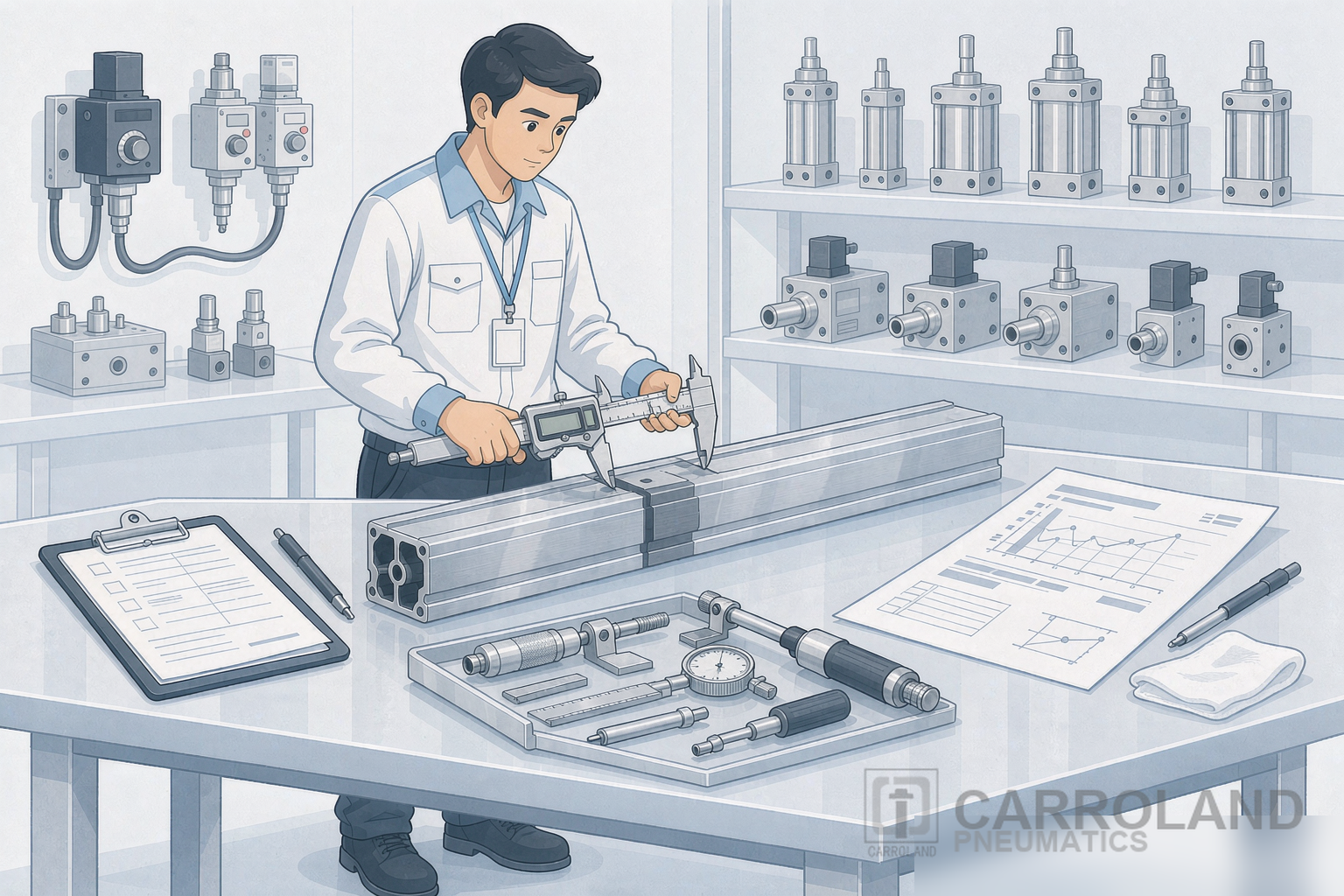
Many “manufacturers” are assembly shops that buy barrels, rods, and seals from traders. That structure is acceptable for standard parts, but it limits tolerance control and customization speed. Two verification steps help. First, ask which operations are in-house: barrel extrusion or honing, rod grinding, end-cap machining, and seal molding each move capability up a level. Suppliers who rank among serious aluminum air cylinder tubes suppliers control their own extrusion or at least honing. That control shows up in consistent bore finish. Two, ask for a factory tour or a live video walk-through with the specific production cell on camera. A trading company will delay or substitute a showroom; a factory will show you CNC lathes and a test bench within minutes.
Check 4: Product Breadth and System Match
A single vendor who can supply cylinders, valves, and air preparation units simplifies your documentation and your spares plan. Check the boundaries of the portfolio against your bill of materials. For motion, confirm the series you need (profile, compact, rotary, clamp). For control, look at how the supplier positions itself against dedicated pneumatic flow control valve manufacturers — meter-out flow controls with fine adjustment and a repeatable locknut are basic requirements on any automated station. For valve islands, confirm available coil voltages and Manifold options before you design the control cabinet. A supplier who covers 80–90% of your component list with coherent data sheets will cut your sourcing overhead. Five specialist vendors with inconsistent quality systems will not.
Check 5: Spare Parts and Aftermarket Support
Seals, cushions, and rods wear on a schedule you can predict. The question is whether your supplier can ship a wear kit faster than your production plan can absorb downtime. Ask three specific things. Can you buy complete pneumatic cylinder seal kits for every series in the catalog, with part numbers published rather than quoted case by case? What is the standard dispatch time for a seal kit, and is it days or weeks? Does the supplier keep price lists for consumables stable for at least 12 months? As a benchmark, a seal kit for a 63 mm ISO 15552 cylinder should be a low-cost, catalog-numbered item. It should ship in under a week. Suppliers who treat spare parts as an opportunity to re-quote the whole cylinder will cost you line availability later.
Check 6: Price Structure and Total Cost of Ownership
Unit price is one line in a longer calculation. Build the comparison on four columns: unit price, tooling or customization charges, freight and duty, and the expected service cost over the rated life. Coil pricing illustrates the pattern. When buyers compare a solenoid coil 230vac price against a solenoid coil 24vdc price, the 24 VDC coil usually costs slightly more. It still holds two advantages in plants: it stays safe to touch during maintenance, and it tolerates the voltage sag of long cable runs better than 230 VAC types. A supplier who explains these trade-offs with numbers is worth more than one who quotes lowest and disappears. For a concrete method, run our five-step supplier evaluation framework before the final decision.
Check 7: Logistics and Local Availability
Search results for a pneumatic fittings suppliers near me reflect a real constraint. Small, high-count items are expensive to ship one at a time. Urgent changeovers do not wait for ocean freight. Ask where the supplier stocks fast movers, what the reorder lead time is for your region, and whether they support consignment or safety-stock agreements for fittings, tubing, and coils. For project cargo like cylinder batches, confirm Incoterms and export documentation early. A supplier 30 shipping days away can still be the right choice for cylinders — provided your fittings and spares strategy covers the gap.
A Workable Supplier Scorecard
Turn the seven checks into a scorecard and weight it by risk. A practical starting split for pneumatic components: quality performance 40%, delivery 30%, technical responsiveness 15%. Documentation carries 10% and commercial terms 5%. Set a minimum total score, but add one veto rule — a critical quality escape, a lapsed certificate, or a counterfeit-part suspicion overrides any total score. The flow below summarizes the decision path.
flowchart TD
    A[Collect quotes and documents] --> B{ISO 9001 certificate valid?}
    B -- No --> R[Reject]
    B -- Yes --> C{Cpk >= 1.33 on critical features?}
    C -- No --> Q[Request process data or reject]
    C -- Yes --> D[Score: quality 40 / delivery 30 / technical 15 / documentation 10 / commercial 5]
    D --> E{Score above threshold?}
    E -- Yes --> F[Approve and add to ASL]
    E -- No --> G[Conditional approval with controls]
| Check | Evidence to request | Pass indicator |
|---|---|---|
| Quality system | ISO 9001:2015 certificate, Cp/Cpk data, PPM history | Cpk ≥ 1.33, ≤ 500 PPM |
| Standards | ISO 15552 / 6432 / 21287 tables, ISO 8573-1 class, IP rating report | Dimensions match series, reports on file |
| Manufacturing | Operation list, video audit of the cell | In-house machining and test bench |
| Portfolio | Catalog with dimensions and coil options | Covers 80–90% of your BOM |
| Spares | Seal-kit price list, dispatch times | Kits ship < 1 week, stable prices |
| TCO | Quote with tooling, freight, duty | Four-column comparison, no hidden charges |
| Logistics | Stock plan, lead times, Incoterms | Reorder lead time fits your plan |
Frequently Asked Questions
What documents should I request before approving a pneumatic supplier?
Request the ISO 9001:2015 certificate with scope, dimensional tables for the relevant ISO series, a sample FAI report, material and seal certificates, and the price list for spare seal kits. These five documents expose process control, product accuracy, and aftermarket intent in a single review.
How do I verify that a supplier manufactures in-house?
Ask which operations run on their own machines — honing, rod grinding, end-cap machining — and request a live video walk-through of the specific production cell. Trading companies stall or show showrooms; factories show lathes, honing machines, and a test bench on request.
What defect rate is acceptable for pneumatic components?
For machined parts such as cylinders and valve bodies, target 500 PPM or lower at incoming inspection, and confirm the supplier tracks PPM per line. Combine the rate with Cpk ≥ 1.33 on critical dimensions so the number reflects a capable process rather than a well-sorted batch.
Should I choose one supplier or split the volume?
Start with one primary supplier who covers most of the bill of materials, qualify a second source for critical series, and split only after both show stable PPM and delivery data. Splitting too early doubles documentation work and weakens your position with both.
Carroland Pneumatics supplies ISO 15552, ISO 6432 and compact cylinders, clamp solutions and air preparation components for 3C automation lines. Browse the product catalog or the pneumatic cylinder selection guide to compare series before you score a supplier.